Most apartment complexes in India bill water one of two ways: a flat fee hidden in maintenance, or a split of the tanker bill by flat count. Both are wrong, both are resented, and both hide the losses that a water audit later finds. Smart water metering is the fix — and in 2026 it is finally practical for Indian apartments: the hardware has matured, prices have fallen, and the billing-accuracy case sells itself to RWAs.
This guide covers what smart metering actually is (and the AMR-vs-IoT distinction vendors gloss over), what it costs at apartment scale, the vendor landscape in India, how tenant billing changes, and the return that pays for it — the leak alerts and the audit gap it closes. For the service-side view, see our smart water metering service page.
Key Takeaways
- Smart metering replaces flat-fee and per-flat water billing with measured, zone-wise and per-connection consumption — the precondition for fair billing and loss control.
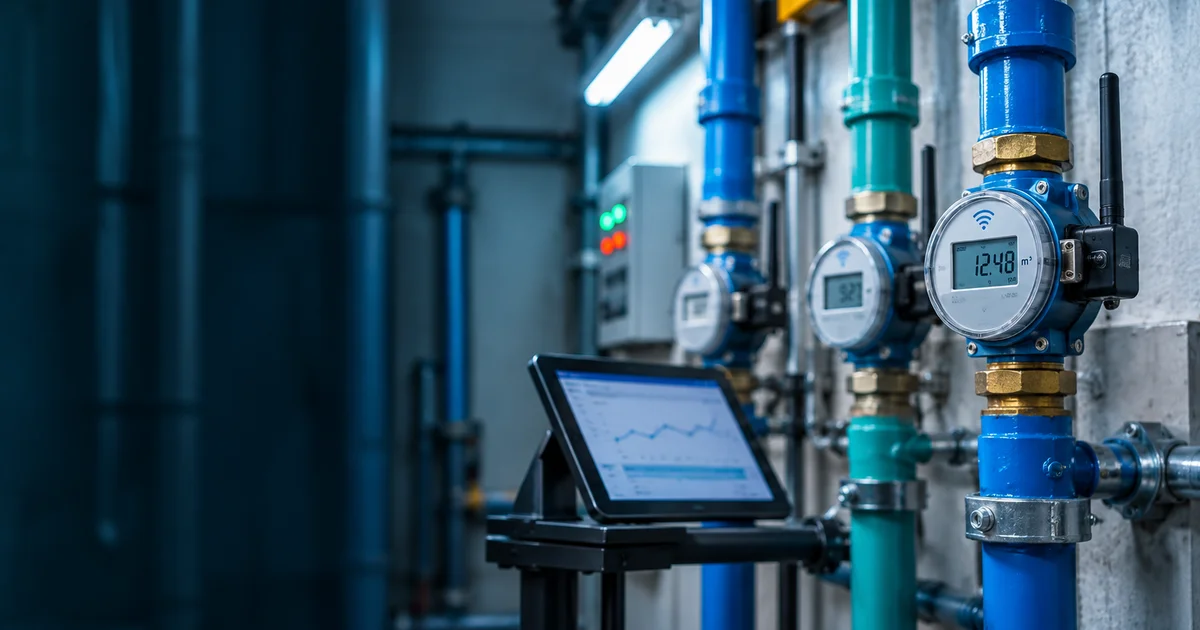
- The real decision is AMR (drive-by/walk-by reading) vs IoT (networked, live data). Apartments almost always want IoT once they see the leak-alert maths.
- Indicative costs at apartment scale: ₹8,000–₹25,000 per metered point installed, driven by meter type, retrofit plumbing and network choice — the audit first tells you how many points you actually need.
- The ROI is not the metering. It is what metering finds: overnight leaks, tank overflows and the billing gaps that quietly fund the system.
- Buy outcomes, not boxes: leak alerts with thresholds you control, open data export, and tenant-billing outputs — not a proprietary dashboard that holds your data hostage.
Why Apartments Meter: The Billing Problem
Flat-fee billing punishes the frugal flat and subsidises the wasteful one — a sociology problem that becomes a money problem every summer. When the tanker count rises, the society argues; nobody can say why, because nobody measured anything. Zone-wise and per-connection metering changes the conversation from opinions to numbers: which block consumes what, which flat uses how much, and where the unaccounted gap sits.
That gap is the expensive part. In our audits, meaningful shares of purchased water routinely go unaccounted — underground leaks, overflowing tanks, and usage nobody tracks. Metering is how the gap becomes visible within weeks instead of at the next water audit.
AMR vs IoT: The Distinction That Decides Your Budget
| AMR (drive-by / walk-by) | IoT (networked, live) | |
|---|---|---|
| How it reads | Reader device collects data in range, on a schedule | Meters report continuously over LPWAN/cellular network |
| Data latency | Reading-day snapshots | Live or near-live (hourly/daily) |
| Leak detection | Backward-looking — you find last month’s leak | Same-day alerts on abnormal flow patterns |
| Best fit | Small societies, tight budgets, billing-only goals | Apartments serious about losses, billing and compliance |
| Relative cost | Lower per point | Higher upfront, network + subscriptions — falling every year |
The vendor pitch often blurs this. Ask directly: “Does your meter push data on its own, or does someone have to come read it?” The answer sorts the market in one question.
What It Costs at Apartment Scale (Indicative)
| Scope | Indicative range | Notes |
|---|---|---|
| Meter + install, per point | ₹8,000–₹25,000 | DN15–DN25 domestic; ultrasonic costs more, lasts longer |
| Zone/bulk meters (per point) | ₹20,000–₹60,000 | Larger line sizes; fewer needed |
| Network / gateway + platform | ₹50,000–₹2,00,000 setup + annual subscription | IoT only; scales weakly with size — big complexes win |
| Retrofit plumbing per riser | Highly variable | The honest line item — old risers without valve access cost more than meters |
Numbers are indicative 2026 field ranges — the audit-driven design decides how many points you truly need. Metering every connection on day one is the most common overspend; zoning first, then selective sub-metering, does 80% of the job for far less.
The Vendor Landscape in India (How to Read It)
The Indian market spans established meter manufacturers adding IoT modules, water-tech startups with proprietary platforms, and system integrators who assemble both. Rather than naming brands that reorganise annually, here is the filter our teams use:
- Metrology first. Is the company fundamentally a meter maker with connectivity, or a connectivity company reselling meters? The first group’s failure modes are known; the second’s are discovered.
- Data ownership in writing. Your consumption data must export in open formats (CSV/API). Dashboards are nice; hostage data is not.
- Leak alerts you configure. Thresholds and notification rules set by you, not the vendor’s defaults.
- Billing output. The system should produce tenant-ready billing statements or integrate with your society management software.
- Local service. Meters fail; who swaps them, in what SLA?
- Tender-ready documentation. If your society formalises procurement later, the vendor should survive an RFP.
Tenant Billing: The Part That Sells Itself
Once per-connection data flows, billing stops being an argument: each flat pays for what it uses, common areas are split transparently, and the monthly reconciliation takes an email instead of a meeting. Two practical notes from deployments:
- Phase it. Start with zones and bulk meters, publish the numbers for a couple of months, then roll out per-flat metering. Consumption drops 15–25% on visibility alone — before a single leak is fixed.
- Set the tariff with the society’s consent. The meter measures; the general body decides the ₹/kilolitre and the common-area split. Metering answers fairness, not politics.
Compliance and ESG: The Quiet Second Life
Metered data is also the backbone of everything regulators increasingly ask for: groundwater NOC conditions that require extraction records, BRSR water disclosures that must survive assurance, and the measurement base that makes treated-water compliance provable. The same meters that settled the billing argument quietly become the audit trail — the point where water strategy and the city’s water balance meet at your gate.
What is a smart water meter?
A water meter with digital reading and communication — either AMR (collected by a reader device in range) or IoT (reporting continuously over a network). Beyond volume, smart meters timestamp consumption, expose abnormal flow patterns, and feed billing and monitoring platforms automatically.
How much does smart water metering cost for an apartment in India?
Indicatively ₹8,000–₹25,000 per metered point installed (domestic connections), ₹20,000–₹60,000 for zone/bulk points, plus network and platform costs for IoT setups. The design decision — how many points, where — matters more than the hardware price; that is what the audit-phase design settles.
AMR or IoT — which should our society choose?
If the goal is billing only and the budget is tight, AMR reads fine. If the goal includes loss control and leak alerts, IoT pays for the difference: overnight-flow anomalies and tank overflows surface the same day instead of at the next bill. Apartments that start on AMR for billing usually upgrade when the first big leak goes undetected.
Who makes smart water meters in India?
A mix of established meter manufacturers adding IoT capability and water-tech platform companies. Filter on metrology pedigree, open data export, configurable alerts, billing output, local service SLAs and tender-ready documentation — the brand list reorganises annually; the filter does not.
Can smart meters detect leaks?
Yes — that is their second job. IoT meters flag abnormal patterns (continuous overnight flow, sudden spikes) the same day. A classic first catch: the underground leak that ran for months, found the week the meters went live.
Does per-flat metering reduce consumption?
Consistently — visibility alone cuts apartment water use by 15–25% in our deployments, before any leak is fixed. When consumption is measured and billed to the flat using it, behaviour follows the meter.
Is smart metering mandatory for apartments?
Not generally mandated yet — but the direction is clear: groundwater NOC conditions increasingly expect metered extraction, and BRSR-reporting entities need measured water data. Metering ahead of the mandate is cheaper than metering under notice.
Conclusion: Measure the Building, Then Manage It
Smart water metering is not a gadget purchase. It is the decision to run a building on numbers: fair billing, visible losses, same-day leak alerts, and an audit trail that satisfies everyone from the treasurer to the assurance provider. The system pays for itself out of the gap it exposes — and in our experience, every apartment has a gap.
Start with the measurement plan: our water balance assessments design the metering architecture — how many points, which zones, AMR or IoT — before a single meter is bought.
Cost ranges and the consumption-drop figure are Ecolive field-experience, 2026; validate against a site-specific design and quotes.