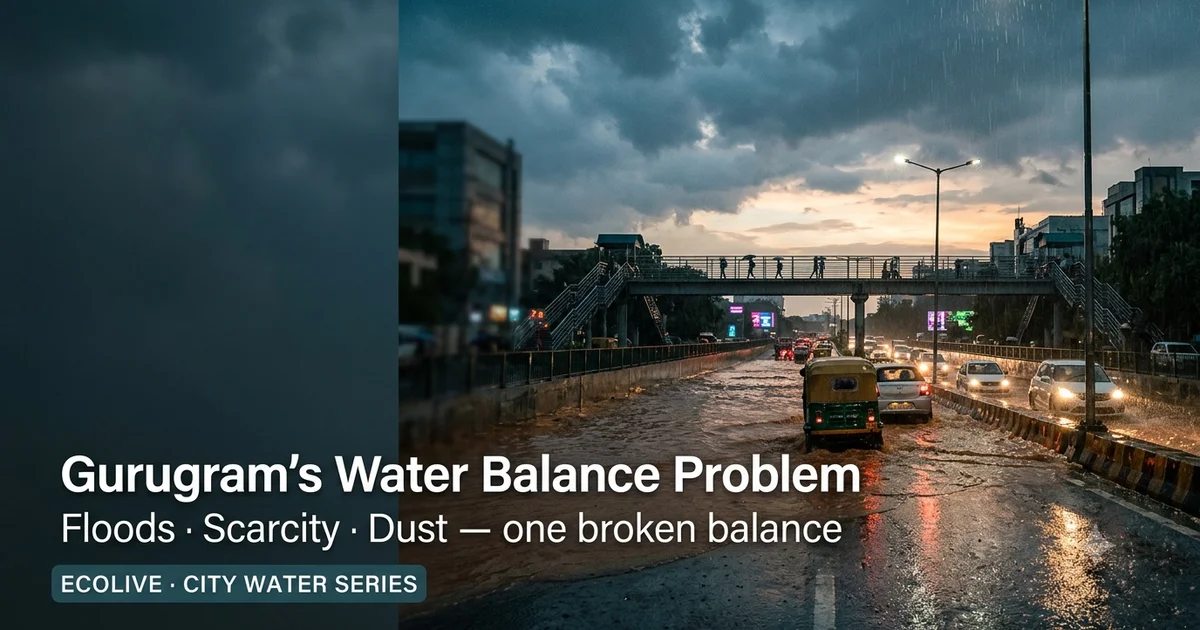
When Gurugram flooded again this monsoon, the internet renamed it “Drowngram”: four-hour commutes, roads gone under water in more than 50 spots, schoolchildren stranded, pumps that could not keep up. The immediate reaction is always to blame the rain. The truth is structural — and it did not appear overnight.
Gurugram’s real problem is a broken water balance. In summer the city struggles for water. In monsoon it struggles with too much of it on the roads. In winter, dust and air quality take over. All three seasons trace back to the same root: a city that paved over its natural sponges, ignored its natural slope, and treats rainfall as a drainage problem instead of a recharge opportunity. This guide puts the three seasons in one frame — and shows what buildings, campuses and societies can actually do about their share of it.
Key Takeaways
- Gurugram floods, dries and chokes for one reason: a broken water balance — runoff has nowhere to soak in, and every litre sent to a drain is a litre the summer borewell will miss.
- The city forgot its natural slope. Gurugram drains from the Aravalli side toward the Najafgarh basin — rainwater follows gravity, not layout plans.
- We replaced a sponge with a tray: green soil turns 15–25% of rainfall into runoff, concrete sends 70–95% of it into drains — the same storm now produces 3–5x more runoff than the city was built for.
- In field audits, fully functional rainwater harvesting systems are rare — structures exist on paper far more often than they work in the ground.
- Treated water is still treated as a disposal problem — STP output goes to drains instead of parks, construction and cooling.
Where the Water Used to Go
Before the concrete expanded, Gurugram had a vast network of natural absorbents: johads, seasonal streams and Aravalli runoff channels that caught the rain before it could flood the streets. Decades of rapid construction dismantled them. Ponds and bunds that once managed runoff have largely disappeared.
When rain falls on a paved surface, it cannot sink into the ground — it becomes surface runoff. Without those natural catchments, the water has nowhere to go but the roads. That is an immediate crisis for facility managers and municipal authorities every single monsoon, and it is treated as a surprise every single time — even though the monsoon is the most predictable event on India’s calendar.
The Sponge Became a Tray
This is the single most important number pair in urban water. Green, unpaved soil absorbs most of the rain that falls on it — only about 15–25% runs off. Concrete and asphalt reverse the ratio: 70–95% becomes runoff, routed directly into storm drains.
Even the “green” in new townships often sits on top of concrete basements and podiums. It looks like a sponge. Hydraulically, it is a tray.
Drains Are the Last Receiver of an Upstream Failure
When the city floods, the first demand is always for bigger drains. But a stormwater drain cannot carry sewage for eleven months and become a clean rainwater highway in the twelfth. And no drain, however wide, can swallow an entire catchment’s poor planning. The drain is the last receiver of failures that happen upstream — on rooftops, compounds, roads and parks across the city.
That reframing matters for anyone managing a building: your site is upstream. What your plot does with its rain decides what arrives at the drain, and what arrives at your borewell next summer.
Rainwater Harvesting Exists Mostly on Paper
Gurugram has rainwater harvesting bylaws; most large buildings have an RWH structure of some kind on record. In our field audits across homes, townships, hotels and public buildings, fully functional RWH systems are rare. Structures designed decades ago, undersized token pits, no runoff calculations, no first-flush diversion, no maintenance — installed for compliance, not for water.
A compliance-mandated pit that no one has cleaned since installation is not a recharge structure. It is paperwork with a hole in it. For what working maintenance actually looks like, see our guide to RWH system maintenance.
Treated Water Is Treated as a Disposal Problem
Societies and industries across the NCR run sewage treatment plants — and then discharge the treated water into the same overloaded storm drains. Meanwhile the city pays to pump groundwater and haul tankers for parks, construction dust control and cooling.
A citywide recycled-water grid — starting with parks, industries and large campuses — could transform the balance: less load on drains at exactly the peak moment, less freshwater demand year-round. For how factories and hotels can reuse STP-treated water properly, see our guide on STP treated water reuse.
What Your Building Can Actually Do: The 4R Lens
The city-scale fix is governance and planning — slow, contested, necessary. But the building-level fix is available now, and it compounds. We practice it as the 4R framework on every project:
- Reduce demand — meters, leaks, fixtures. You cannot manage what you do not measure.
- Reuse before recycling — route treated water to flushing, cooling, landscape.
- Recycle what is used — STPs sized and run for quality, not just compliance.
- Recharge what the sky gives — functioning RWH structures that return rooftop rain to the aquifer. The engineering is well established: see our borewell recharge pit design guide.
Want to see what your own plot contributes to the flood — and could contribute to the fix instead? Run your roof through our free runoff calculator, or stress-test a cloudburst scenario with the urban flooding simulator.
The Trade-Off Question
There are no solutions, only trade-offs. Which trade-offs is Gurugram willing to accept today so the city stops paying a bigger price every summer, monsoon and winter? Every percentage of rainfall we keep out of the drains — by recharging it, reusing it, or simply not demanding the water it replaces — is a percentage the city does not have to fight at the underpass.
If you manage a building, campus, township or facility in Gurugram or the NCR, the first step is knowing your own water numbers — a proper water audit is how you get them. That is where a water balance starts — and it is a conversation we are glad to have.
Why does Gurugram flood every monsoon?
Because its natural absorbents are gone. The city sits on a gradient from the Aravalli side to the Najafgarh basin, and its johads, streams and runoff channels used to slow and soak the rain. Paved surfaces now send 70–95% of rainfall straight into storm drains built for a far smaller runoff — so even normal monsoon events overwhelm them.
What is a city’s water balance?
The account of water entering, leaving and being stored across a city or site: rainfall, mains, groundwater and recycled inflows versus consumption, discharge and runoff. When a city floods in monsoon, runs dry in summer and imports water by tanker, the balance is broken in all three seasons — one system, not three separate problems.
Can rainwater harvesting really reduce urban flooding?
Yes — at neighbourhood scale it is one of the few levers that works on both floods and scarcity. Every litre captured and recharged is a litre kept out of the storm drain at peak, and a litre returned to the aquifer for summer. The catch: systems must be correctly designed and actually maintained; on-paper RWH structures reduce neither.
What can an RWA or facility do right now?
Three moves: (1) audit whether your existing RWH structure actually functions — most do not; (2) revive or rebuild recharge structures before the next monsoon, including first-flush and filtration; (3) meter the campus so you know demand, losses and reuse potential. All three are standard engineering, and they compound across a sector.
Merged and updated from two Ecolive flood-response posts (Aug 2026) with the author’s original Gurugram field analysis. Runoff percentages are Ecolive field-experience figures for NCR sites.