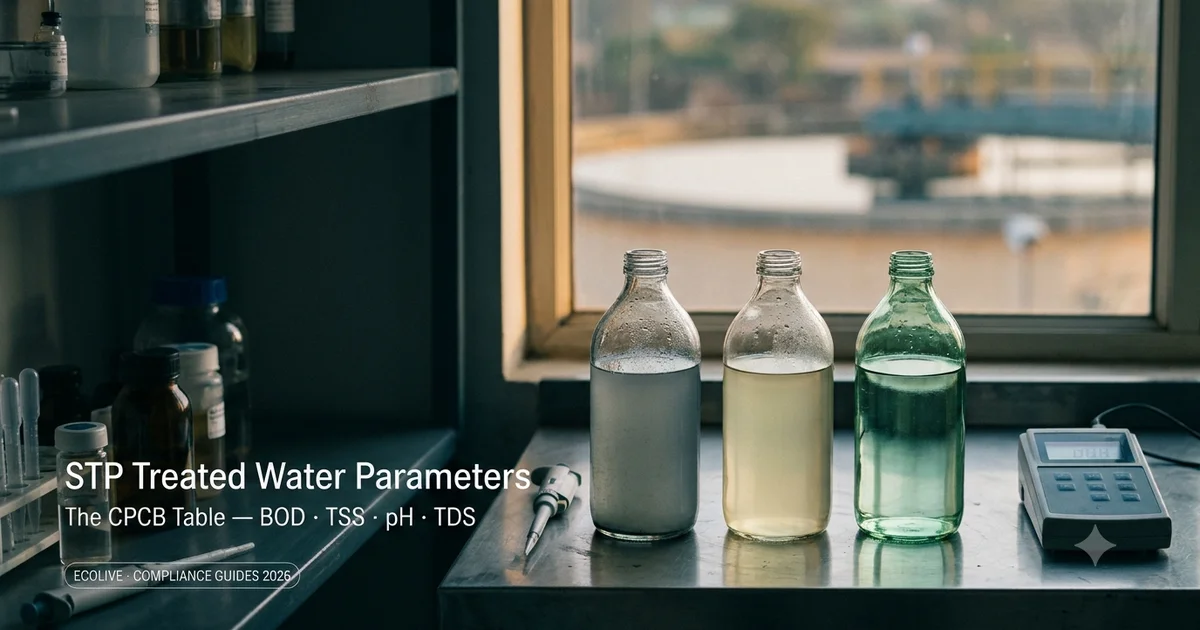
If your building or factory runs an STP, one question decides whether its treated water is an asset or a liability: what parameters must the outlet water meet? Facility managers search for “STP treated water parameters as per CPCB pdf” because the answer is scattered across notifications, tribunal orders and consent conditions — and because the consequence of getting it wrong runs from SPCB notices to wasted reuse potential.
This guide puts the numbers in one place: the CPCB/NGT discharge table (BOD, COD, TSS, pH, faecal coliform), what each parameter actually measures, the honest answer on TDS limits, the quality bar for each reuse — flushing, gardening, construction, cooling — and what to do when a parameter fails.
Key Takeaways
- The operative numbers for STP outlet water in India come from the NGT’s April 2019 uniform norms: BOD ≤ 10 mg/L, TSS ≤ 20 mg/L, COD ≤ 50 mg/L, faecal coliform ≤ 230 MPN/100 mL — stricter than the 2017 MoEF notification they superseded in practice.
- There is no single CPCB “TDS limit” for treated sewage — TDS is governed by end use: irrigation salinity, cooling-tower cycles, concrete chlorides and sulphates.
- The discharge standard is the floor, not the target: each reuse (flushing, garden, construction, cooling) adds its own quality bar on top.
- Whichever number applies to you is written in your Consent to Operate — that document, not a Google search, is the legally binding spec.
- Non-negotiables for any reuse: separate dual plumbing, “Treated water — Not for Drinking” labelling, disinfection before storage, and test records you can produce.
The Core Table: STP Outlet Parameters in India
Two frameworks matter, and the difference between them is real. The MoEF&CC notification of October 2017 set graded limits — stricter for large cities, looser elsewhere. In April 2019, the National Green Tribunal rejected that grading and directed uniform, stricter norms nationwide:
| Parameter | 2017 MoEF notification (metro / other cities) | NGT 2019 uniform norms |
|---|---|---|
| pH | 6.5 – 9.0 | 5.5 – 9.0 |
| BOD | 20 / 30 mg/L | ≤ 10 mg/L |
| TSS | 50 / 100 mg/L | ≤ 20 mg/L |
| COD | — | ≤ 50 mg/L |
| Faecal coliform | ≤ 1,000 MPN/100 mL | ≤ 230 MPN/100 mL |
Sources: MoEF&CC STP notification (CPCB), NGT order in the Nitin Shankar Deshpande matter, 30 April 2019. The two have coexisted in legal tension since; many State Boards (KSPCB, MPCB among them) enforce the tighter NGT-end numbers for apartment and commercial STPs — especially where the water is reused. Confirm the exact limits in your own Consent to Operate.
What Each Parameter Actually Measures
- BOD (Biochemical Oxygen Demand) — how much oxygen microbes consume breaking down the organics left in the water. High BOD = water still “food-rich,” which depletes oxygen wherever it goes and feeds biofilm in your reuse lines.
- COD (Chemical Oxygen Demand) — the total oxidizable load, including what BOD misses. COD persistently high relative to BOD points to industrial or chemical inputs the biology cannot touch.
- TSS (Total Suspended Solids) — the particles. High TSS clouds the water, clogs filters and drip lines, and carries pathogens past disinfection (UV and chlorine both fail on turbid water).
- pH — the acid-base balance. Outside roughly 6.5–8.5, disinfection weakens, metals leach, and soil and equipment suffer.
- Faecal coliform — the pathogen proxy. This is the number that decides whether people can be anywhere near the reuse stream.
The TDS Question — Answered Honestly
“What is the TDS limit for STP treated water?” is one of the most searched questions in this space, and most answers dodge it. The honest answer: the NGT/CPCB discharge norms do not set a single TDS limit for treated sewage. TDS is governed by what you do with the water:
| End use | What TDS actually threatens | Practical guidance |
|---|---|---|
| Irrigation / gardens | Soil salinity and sodium build-up (SAR) over seasons | Test TDS and sodium; watch long-term accumulation, prefer drip over spray |
| Toilet flushing | Staining, scaling in cisterns and lines | Moderate TDS tolerable if hardness and iron are controlled |
| Construction / curing | Chlorides and sulphates attacking concrete and rebar | Check Cl⁻ and SO₄ specifically before batching (IS 456 guidance) |
| Cooling towers | Scale, corrosion, cycles of concentration | Tightest TDS discipline; often needs softening or RO polish |
In our field work, TDS in well-run STP outlet water commonly lands in the high hundreds to low thousands mg/L — but the number only means something against the end use. This is exactly the thinking behind the National Mission for Clean Ganga’s Safe Reuse of Treated Water framework: fitness for use, not one blanket spec.
Usage Limits: The Reuse Ladder
Think of reuse quality as a ladder — clear the discharge floor first, then meet each end use’s added bar:
- Construction (curing, dust suppression, compaction) — least demanding; discharge-grade usually suffices, with the salt check above.
- Landscape and gardening — low BOD/TSS plus salinity and sodium control; disinfect enough for hygiene without scorching foliage.
- Toilet flushing — the biggest reuse stream in most buildings: clear, low-BOD, disinfected water with a small maintained residual chlorine so it does not go septic in the tank.
- Cooling towers — the most chemically demanding: hardness, silica and chloride control, low BOD, disciplined biocide regime against Legionella.
- Unrestricted irrigation / public parks — strictest microbial bar; near-nil faecal coliform.
For how factories and hotels build the full reuse business case on top of this, see our guide on STP treated water reuse for factories and hotels.
The Non-Negotiables for Any Reuse Scheme
- Dual plumbing — treated water in a physically separate, colour-coded network; no cross-connection, ever. This is a design decision; retrofitting is expensive.
- Labelling — every treated-water outlet marked “Treated water — Not for Drinking,” in English and the local language.
- Disinfection before storage — water sitting in tanks must be disinfected (chlorine or UV); for flushing, keep a small residual.
- Records — periodic testing against the parameters named in your consent, logged and inspection-ready. If you cannot prove quality, you do not have it. A water audit builds this evidence trail properly.
When a Parameter Fails: Field Troubleshooting
From our audits of underperforming STPs, failures cluster predictably:
- BOD or COD high → biology is stressed: check MLSS and sludge age, look for toxic or industrial inputs, verify the aeration actually delivers rated oxygen.
- TSS high → clarifier is shedding solids or the filter is bypassed; check sludge withdrawal and media condition.
- Faecal coliform high → disinfection stage failing: turbid water shielding pathogens from UV, exhausted chlorine dosing, or wrong contact time.
- pH drifting → usually upstream chemistry or over-dosing; fix the cause, don’t chase the meter.
The pattern worth noticing: most failures are operational, not technological. The plant was capable; the daily discipline was not.
What are the CPCB parameters for STP treated water?
The operative uniform norms (NGT, April 2019): BOD ≤ 10 mg/L, TSS ≤ 20 mg/L, COD ≤ 50 mg/L, pH 5.5–9.0, faecal coliform ≤ 230 MPN/100 mL. The 2017 MoEF notification’s looser graded limits (BOD 20/30, TSS 50/100, FC ≤ 1,000) still appear in older consents — your Consent to Operate states the binding set for your site.
What is the TDS limit for STP treated water?
There is no single statutory TDS limit for treated sewage in the discharge norms. TDS is end-use governed: salinity and sodium for irrigation, chlorides and sulphates for concrete, hardness and silica control for cooling towers. Test TDS against the use you actually intend.
What is the pH range for treated STP water?
The NGT uniform norm is 5.5–9.0; the 2017 notification specified 6.5–9.0. For reuse, the practical sweet spot is 6.5–8.5 — where disinfection works and equipment and soil are happiest.
Can STP treated water be used for gardening?
Yes — it is one of the best uses, provided BOD and TSS are within norms, disinfection is adequate, and you monitor salinity and sodium so years of application do not poison the soil structure. Prefer drip over spray where people walk.
Can STP treated water be used for toilet flushing?
Yes — it is typically the largest reuse stream in a building. Requirements: tertiary-polished, disinfected water with a small maintained residual chlorine, a separate dual-plumbing network, and clear “not for drinking” labelling at every outlet.
Can STP treated water be used for construction?
Yes — curing, dust suppression and compaction are the least demanding uses. The one check that matters: chlorides and sulphates, which attack concrete and reinforcement. Run that test before committing a batch to structural work.
What does “treated water parameters” mean?
The measurable quality values your STP’s outlet water must hit — BOD, COD, TSS, pH and faecal coliform against the legal discharge norms, plus whatever extra (TDS, hardness, residual chlorine) your intended reuse demands.
How often should STP outlet water be tested?
As your Consent to Operate prescribes — commonly monthly for BOD/TSS/pH, with faecal coliform on a set schedule and daily in-house checks (pH, turbidity, residual chlorine). Keep every result logged; the records are part of compliance.
Conclusion: The Number Sheet Is the Starting Point
The parameters table answers “is my plant legal?” The reuse ladder answers “what is this water worth?” — and that second question is where the money is. Every kilolitre of treated water reused is a kilolitre of freshwater, tanker cost and groundwater extraction avoided; cities thinking at scale frame it as a recycled-water grid, as we describe in Gurugram’s water balance problem.
If your STP’s numbers are not where they should be — or nobody has actually measured them against the consent — that is precisely what our audits do: see how a water balance assessment works.
Parameter values cited from the MoEF&CC 2017 STP notification (CPCB) and the NGT order dated 30 April 2019. Norms are periodically litigated and revised — the binding figures for any site are those in its Consent to Operate; verify with CPCB and your State Pollution Control Board.