India receives approximately 4,000 billion cubic metres (BCM) of rainfall every year. That sounds like a lot. Yet only 1,123 BCM, roughly 28%, is actually utilisable for agriculture, industry, and domestic use. The rest runs off into rivers that eventually drain into the sea, evaporates, or simply goes unmanaged. By 2050, India’s water demand is projected to reach 1,447 BCM. Against a utilisable supply of 1,123 BCM, that is a deficit of 324 BCM, enough to submerge the entire state of Punjab under a metre of water.
The question is not whether India has enough water. The question is whether we have the infrastructure and the policy to hold on to the water we already receive.
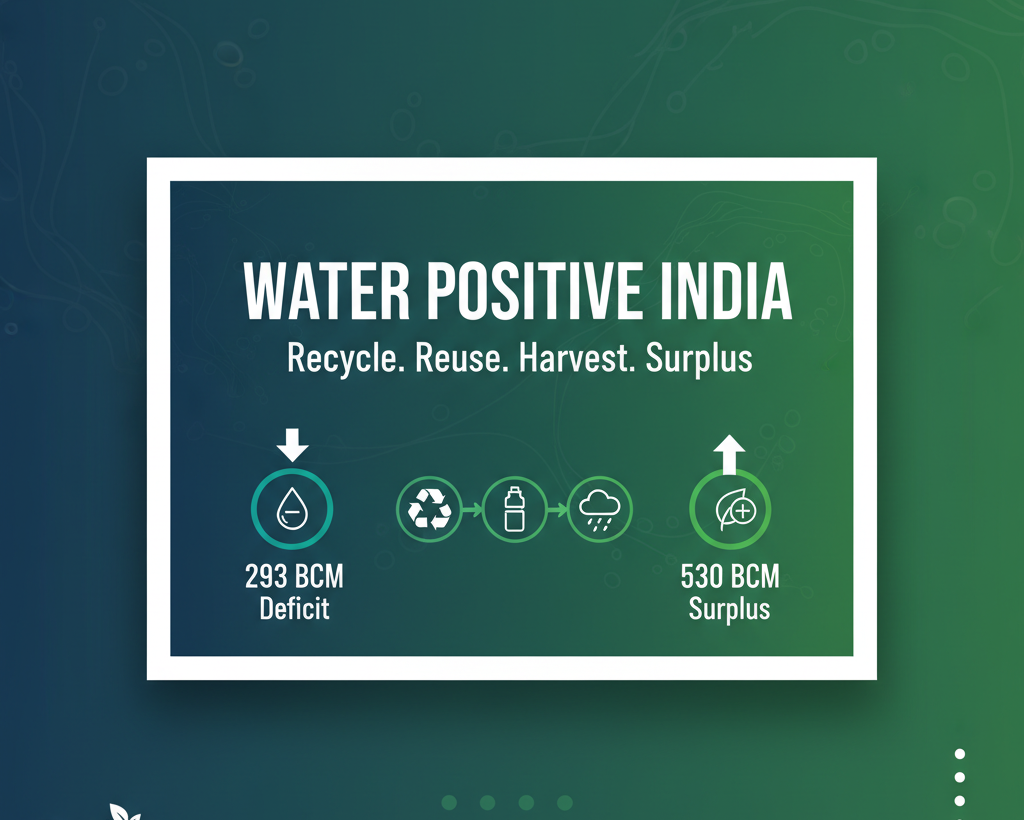
> TL;DR: India gets 4,000 BCM of rain annually but uses only 1,123 BCM. Wastewater recycling and rainwater harvesting can together create a 530 BCM annual surplus, turning India from water-stressed to water positive. Industry and institutions must lead this shift, not just comply.
India’s Water Balance Sheet: The Numbers That Matter
Think of India’s water situation like a company’s balance sheet. Water coming in versus water going out. The Central Water Commission and NITI Aayog have laid out the math clearly.
Water in: India receives about 4,000 BCM of rainfall each year, plus some contribution from glacial melt and transboundary rivers. But topographic, hydrological, and infrastructure constraints mean only 1,123 BCM is practically utilisable. Of this, 690 BCM comes from surface water (rivers, lakes, reservoirs) and 433 BCM from groundwater aquifers.
Water out: India’s current annual water demand stands at roughly 1,093 BCM, according to the NITI Aayog Composite Water Management Index. Agriculture alone consumes 80% of this. Domestic use takes about 6%, industry about 5%, and the rest goes to energy, environmental flows, and other sectors.
The gap: Today, demand nearly equals supply. By 2030, the NITI Aayog projects demand will be double the available supply in many regions. By 2050, at 1,447 BCM of demand against 1,123 BCM of supply, India faces a structural deficit of 324 BCM every year.
That is not a distant problem. Chennai ran dry in 2019. Bengaluru has faced acute shortages. Gurugram and Jaipur depend heavily on tanker water and deepening borewells. The writing is already on the wall for 21 major Indian cities identified as likely to run out of groundwater by 2030.
Where Does India’s Water Actually Go?
Here is a closer look at how India consumes its 1,093 BCM of annual water demand.
| Sector | Annual Demand (BCM) | Share of Total |
|---|---|---|
| Agriculture (irrigation) | ~874 | 80% |
| Domestic (urban + rural) | ~66 | 6% |
| Industrial (manufacturing, energy) | ~55 | 5% |
| Environment, energy, others | ~98 | 9% |
| Total | ~1,093 | 100% |
Agriculture’s 80% share is where the biggest savings lie, but industrial and institutional water use is where policy and corporate action can move fastest. A single large manufacturing plant can consume 1-5 million litres per day. A township of 5,000 households uses roughly 2 million litres daily. Multiply this across India’s 7,500+ industrial estates and thousands of townships, and the scale of opportunity becomes clear.
The Wastewater We Throw Away: India’s Biggest Missed Opportunity
India generates an estimated 72 billion litres per day (BLD) of sewage and wastewater. That is 26,280 billion litres per year. For perspective, this is roughly 26 BCM annually, almost the entire groundwater extraction of a state like Rajasthan.
Here is where the real shock comes in. According to CPCB data, India has the installed capacity to treat only about 37% of the wastewater it generates. And actual treatment rates are even lower, at around 28%. This means 72% of India’s wastewater, over 50 billion litres every single day, flows untreated into rivers, lakes, and land.
The Centre for Science and Environment (CSE) estimates that India has the potential to treat and reuse 80% of the wastewater it generates. If achieved, that means 57.6 BLD of treated water could be put back into productive use: industrial cooling, landscaping, toilet flushing, agricultural irrigation, and groundwater recharge.
That is 57.6 BLD. Every day. Per year, that is 210 BCM of water recovered from what we currently dump.
Why Recycling and Reuse Must Become National Policy
At present, the mandate to recycle and reuse water applies only to cities above a certain population, and enforcement is patchy. SEBI’s BRSR framework asks listed companies to report water consumption, but does not yet mandate recycling thresholds. Several state pollution control boards require zero liquid discharge (ZLD) from specific industries, but implementation is inconsistent.
Compare this with Singapore, which recycles 40% of its water through its NEWater programme and aims to meet 55% of demand through recycling by 2060. Israel recycles over 85% of its wastewater, the highest rate in the world. India sits at 28%.
The policy argument is straightforward. If the Ministry of Jal Shakti mandates that every industrial unit above a certain capacity, every township above 200 dwelling units, and every institutional campus above 5 acres must treat and reuse at least 60% of their wastewater within five years, the math changes dramatically.
| Metric | Current | With 80% Treatment + Reuse |
|---|---|---|
| Wastewater generated daily | 72 BLD | 72 BLD (no change) |
| Amount treated | ~20 BLD (28%) | ~57.6 BLD (80%) |
| Water recovered annually | ~73 BCM | ~210 BCM |
| Freshwater demand offset | ~6.7% of total | ~19% of total |
That 210 BCM of recovered water is more than enough to wipe out the projected 324 BCM deficit when combined with rainwater harvesting, and still leave room for growing demand.
Rainwater Harvesting: The Second Lever That Changes Everything
Now consider the other side of the equation. India receives 4,000 BCM of rainfall annually. Out of this, only about 8% is currently captured through surface reservoirs, check dams, and traditional rainwater harvesting structures. The remaining 92% either runs off into rivers and eventually the sea, or infiltrates naturally without being deliberately managed.
The CGWB’s 2024 assessment estimates India’s total annual groundwater recharge at around 448.52 BCM, with total extraction at 247.22 BCM. That means nature is already recharging more than we extract, but this recharge is unevenly distributed and declining in critical areas like Punjab, Rajasthan, and Tamil Nadu.
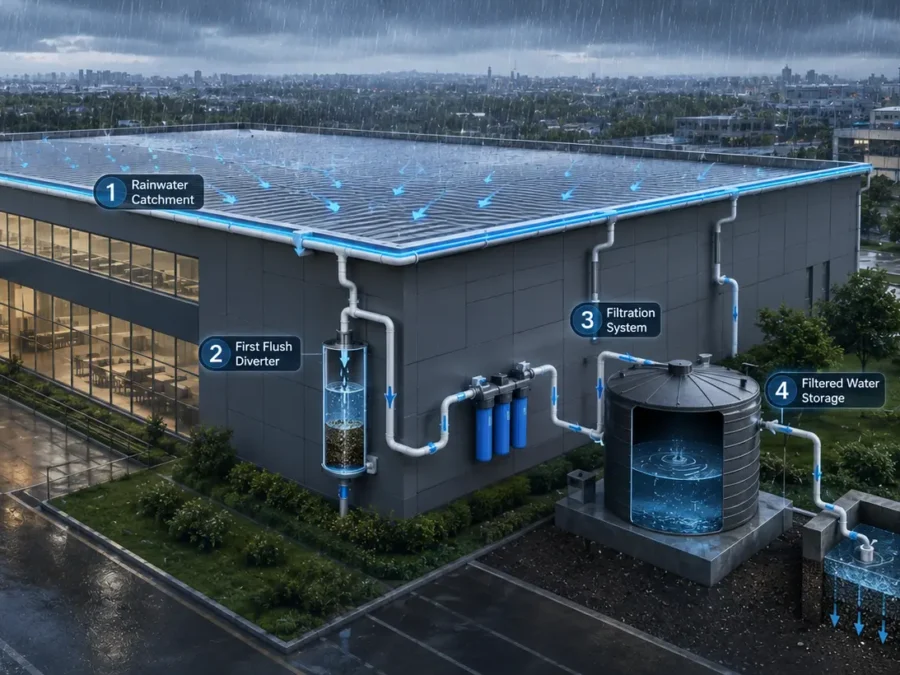
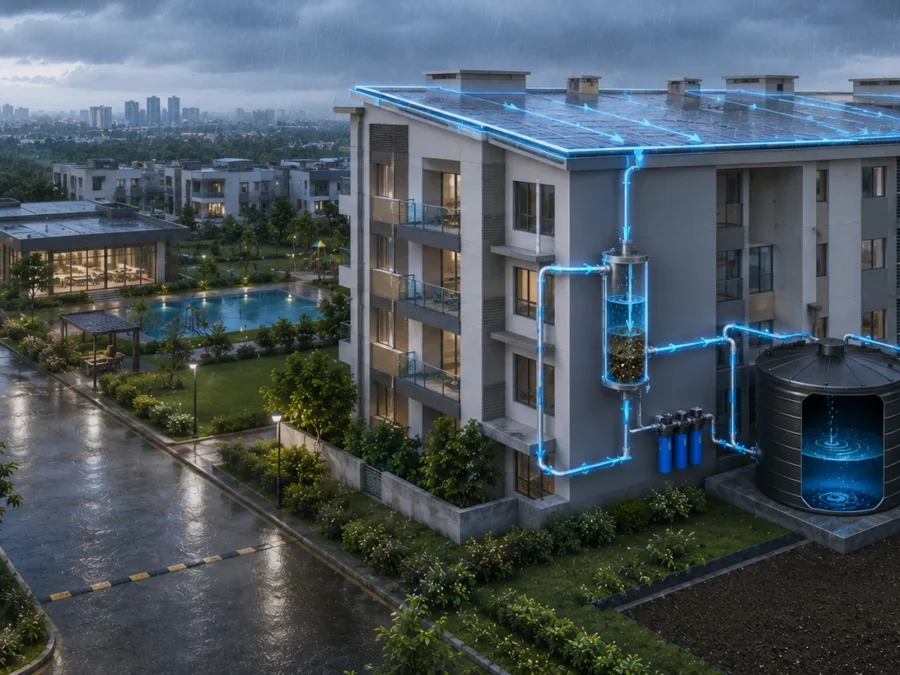
If India systematically captures even 8% more of its annual rainfall through rooftop harvesting, recharge pits, check dams, and percolation tanks, that adds approximately 320 BCM to the annual utilisable supply. This is not a theoretical number. EcoLive has demonstrated measurable outcomes across 1,150 projects and 11 states, proving that site-level rainwater harvesting delivers verified, reportable litres recharged.
Adding It Up: India’s Path to Water Positivity
Let us put both levers together and see what the balance sheet looks like.
| Scenario | Annual Volume (BCM) |
|---|---|
| Current utilisable supply | 1,123 |
| Plus: Wastewater recycled and reused (80% treatment) | +210 |
| Plus: Additional rainwater captured (8% more of 4,000 BCM) | +320 |
| Effective supply with both measures | 1,653 |
| Projected demand by 2050 | 1,447 |
| Surplus | +206 BCM |
India goes from a 324 BCM deficit to a 206 BCM surplus. That surplus is enough to irrigate an additional 20 million hectares of farmland, supply water to 600 million people, or simply allow aquifers to recover for the first time in decades.
And these are conservative estimates. The 80% treatment target is achievable. Several Indian cities already treat over 60% of their sewage. The 8% additional RWH capture is modest. States like Tamil Nadu have shown that mandatory rooftop RWH can yield measurable results within 5-10 years.
What This Means for Industries, Institutions, and Townships
The national policy conversation is important. But action happens at the site level. Here is what water recycling and reuse means for a typical industrial or institutional campus.
Step 1: Measure your water balance. You cannot manage what you do not measure. A water audit establishes your current consumption, sources, losses, and discharge. EcoLive’s Water Balance Optimiser lets you simulate your site’s water in versus water out in minutes.
Step 2: Calculate your recycling potential. How much wastewater does your STP generate? How much of it can be routed back for cooling towers, landscaping, toilet flushing, or groundwater recharge? For most Indian industries, treated wastewater reuse can offset 40-60% of freshwater demand.
Step 3: Assess your rainwater harvesting gap. What is your catchment area? What annual rainfall does your site receive? How much runoff can you realistically capture? EcoLive’s Runoff Calculator computes your rainwater potential based on your city’s rainfall data and catchment surface area.
Step 4: Close the loop with the 4R framework. Reduce demand through efficient fixtures and leak fixes. Reuse treated water for non-potable purposes. Recycle greywater within the campus. Recharge rainwater into the ground to raise water tables. When applied as an integrated system, the 4R framework does not just save water. It creates a measurable, reportable water balance.
The Policy Shift India Needs
India does not lack water. India lacks water management infrastructure. Three policy actions can accelerate the shift from water-stressed to water positive.
One: Mandate recycle-reuse thresholds for industry and institutions. Every unit consuming above 100 KLD (kilolitres per day) should be required to treat and reuse at least 60% of its wastewater within five years. SEBI’s BRSR framework should include recycled-water ratios as a mandatory disclosure metric.
Two: Make rainwater harvesting enforcement data-driven. Several states have RWH mandates on paper. What they lack is enforcement based on measured outcomes. Every building above a certain plot size should submit annual litres-recharged data, verified by an accredited auditor. This turns RWH from a compliance checkbox into a measurable outcome.
Three: Treat recycled water as a national resource. India’s treated wastewater should be mapped, priced, and traded. A factory in a water-stressed region should be able to buy treated water from a nearby municipal STP. This creates economic incentives for treatment plants to operate at full capacity and for industries to invest in recycling infrastructure.
Conclusion: From Deficit to Surplus, One Site at a Time
India’s water math is not a story of scarcity. It is a story of waste. We receive 4,000 BCM of rain every year, generate 72 BLD of wastewater, and let most of it slip away untreated and unmanaged. The tools to close this gap exist. Wastewater recycling can recover 210 BCM annually. Systematic rainwater harvesting can add another 320 BCM. Together, they turn a 324 BCM deficit into a 206 BCM surplus.
Most water companies install systems. EcoLive measures outcomes. Across 1,150 projects and 11 states, we have helped sites move from water dependence to water balance. If your industry, institution, or township is ready to calculate its water potential and close its balance sheet gap, start with our free tools.
Calculate your rainwater potential: Runoff Calculator
Simulate your water balance: Water Balance Optimiser
Get a site assessment: +91 9871472211 | ecolive.in