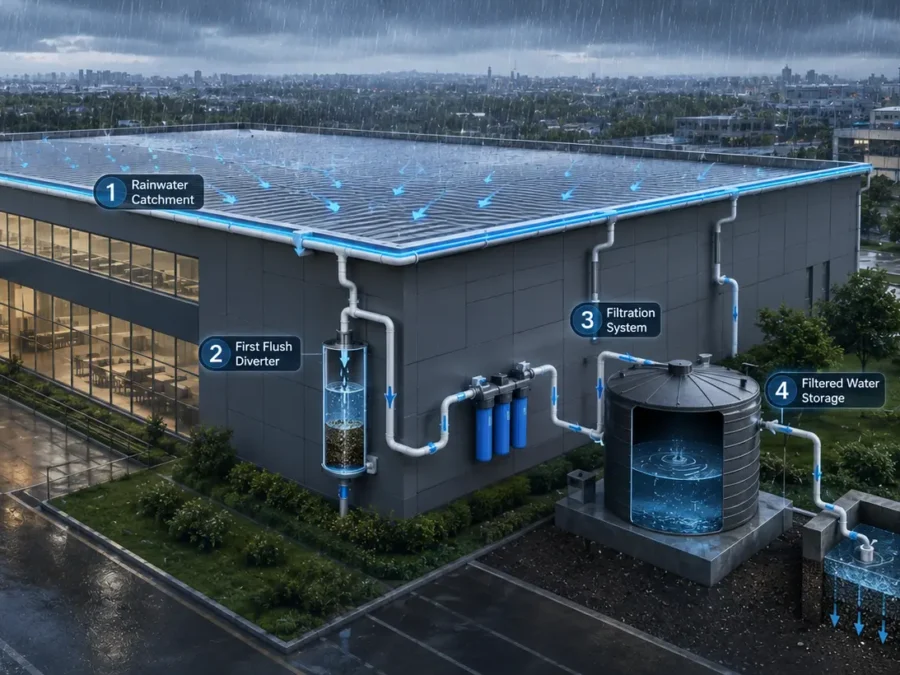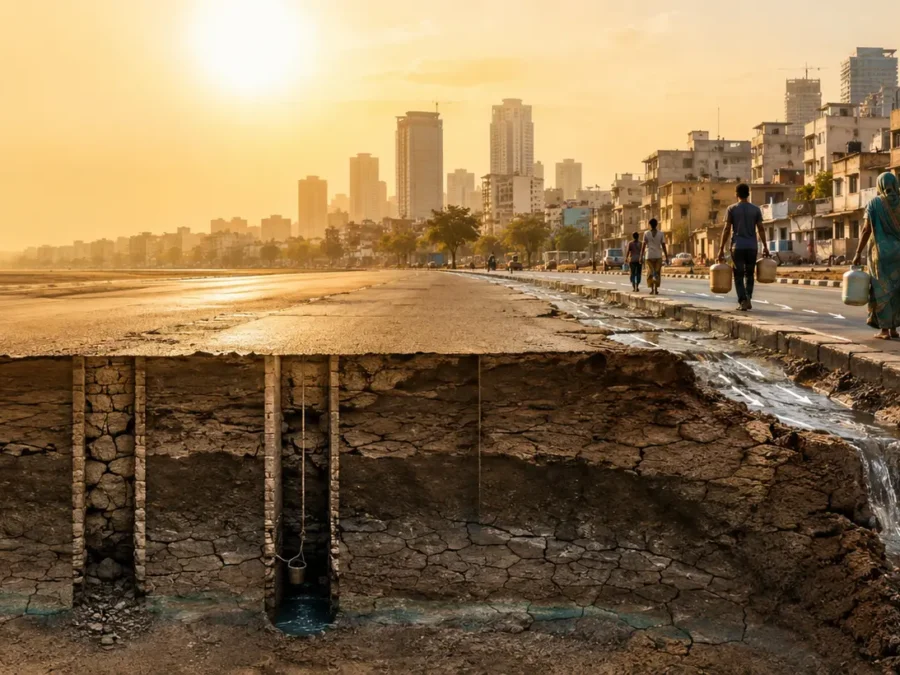
India has harvested rainwater for centuries. Stepwells in Rajasthan, temple tanks in Tamil Nadu, johads across the Aravalli hills — all built by communities and kings, without any government mandate. Today, 33 states and UTs have adopted rainwater harvesting mandates, yet most buildings still treat it as a compliance checkbox. Here’s why that mindset needs to change.
TL;DR: Rainwater harvesting has been a voluntary, community-driven practice in India for over 5,000 years. Modern mandates exist in 33 states, but compliance-driven adoption produces weak systems that fail in 2–3 years. Choosing RWH by choice — like installing a main gate or an inverter — leads to better design, maintenance, and real water savings. This guide covers India’s ancient water heritage, current mandates, and 6 reasons to adopt RWH on your own terms.
India’s Grand Rainwater Heritage: Built by Choice, Not Compliance
Long before any government guideline existed, Indians built extraordinary water structures. These weren’t compliance projects. They were expressions of foresight, community pride, and practical wisdom.
Chand Baori in Rajasthan, one of the world’s deepest stepwells, was built in the 8th–9th century. It descends 13 stories with 3,500 narrow steps, designed to harvest every drop of monsoon rain and store it for the dry months. No law required it. The local rulers built it because water security mattered.
Rani ki Vav in Gujarat, a UNESCO World Heritage Site, is an 11th-century stepwell that doubles as a subterranean water temple. Its 800 sculpted panels celebrate water as sacred and essential. Again, no mandate drove its creation.
In Tamil Nadu, temple tanks (eris) served as community rainwater harvesting systems for centuries. Every village temple had an associated tank that collected and stored monsoon runoff, irrigating fields and recharging groundwater. In Rajasthan, johads — small earthen check dams — were built by villagers across the Aravalli belt to capture rainfall and recharge aquifers. Taankas in the Thar Desert collected rooftop rainwater in underground cisterns, sustaining families through months without rain.
The Indus Valley Civilisation (2600–1900 BCE) had sophisticated drainage and water storage systems at Dholavira, where rainwater was channelled into massive reservoirs carved from rock. This was over 4,500 years ago.
None of these structures were built because a building bye-law required them. They were built because people understood a simple truth: rain is free, abundant, and fleeting. If you don’t capture it, it’s gone.
RWH Is Already Mandated: Here’s the Reality
India’s central government has had rainwater harvesting provisions in building regulations for decades. The Ministry of Housing and Urban Affairs (MoHUA) included RWH requirements in the National Building Code and the Model Building Bye-Laws 2016. These serve as the base framework that states and municipalities localise for their regions.
According to a Press Information Bureau release (2021), 33 states and Union Territories have adopted rainwater harvesting provisions in their building bye-laws or municipal regulations. States like Tamil Nadu made it mandatory as early as 2003 — over two decades ago. Rajasthan, Karnataka, Maharashtra, Gujarat, and others have followed with their own versions, adapted to local rainfall patterns and building types.
Industrial corporations and municipal bodies have their own additional requirements. The Central Ground Water Authority (CGWA) mandates groundwater recharge structures for industries extracting water in notified areas.
So the legal framework exists. The problem isn’t the absence of mandates — it’s the mindset. When people install RWH only because a notice arrived, the result is often a poorly designed, unmaintained system that clogs and fails within 2–3 years.
6 Reasons to Harvest Rainwater by Choice, Not Compliance
1. Your Borewell Is Drying Up — and Deepening Costs Money
Across India’s water-stressed cities — Gurugram, Jaipur, Bengaluru, Chennai — borewells are going deeper every year. A borewell that hit water at 150 feet five years ago may now need to go 300 feet or more. Each deepening costs lakhs, with no guarantee of sustained yield.
Rainwater harvesting recharges the same aquifer your borewell draws from. It’s not a separate system — it’s a direct investment in your own water supply. Use EcoLive’s Water Balance Optimiser to see how much recharge your site can achieve.
2. Tanker Water Bills Are Silent Budget Killers
RWAs and commercial buildings across NCR, Jaipur, and other cities spend ₹50,000 to ₹2,00,000 per month on tanker water during summer. That’s ₹6–24 lakh per year, year after year, with rates climbing 10–15% annually.
A well-designed RWH system can cut tanker dependence by 30–60%, paying for itself in 12–24 months. EcoLive’s Runoff Calculator shows you exactly how much rainwater your roof can capture each monsoon.
3. You’re Getting Free Water on Your Roof — Every Single Monsoon
An average Indian rooftop (1,000 sq ft) in a city receiving 600mm annual rainfall receives approximately 55,000 litres of rainwater per year. That’s equivalent to 3–4 months of household water supply for a small family — delivered free, directly to your building.
Without RWH, this water runs off into storm drains, causes urban flooding, and flows out of the city. You’re literally watching money and water flow away every monsoon.
4. It Adds Real Property Value
Buyers and tenants in water-stressed cities are increasingly asking about water security. A building with a functional RWH system and groundwater recharge commands a premium over one that relies solely on tankers and municipal supply. Real estate agents in Gurugram and Bengaluru report that water-positive buildings sell 10–15% faster than comparable properties without water infrastructure.
5. Compliance Is Catching Up Anyway
Between CGWA guidelines, state building bye-laws, BRSR water metrics for corporates, and municipal enforcement, the regulatory net is tightening. Installing RWH by choice means you choose your timing, your design, and your vendor — rather than scrambling when a notice arrives and accepting whatever the cheapest installer offers.
For corporate and industrial clients, BRSR water compliance is becoming a board-level priority. Acting now means you’re ready when the auditor comes.
6. Your Children Deserve Water Security
India’s per capita water availability has fallen from 5,200 cubic metres in 1951 to around 1,500 cubic metres today — officially a “water-stressed” country by international standards. By 2030, it’s projected to drop below 1,200 cubic metres, entering “water-scarce” territory.
The stepwells, johads, and temple tanks our ancestors built weren’t for themselves alone. They were for the generations that came after. Installing RWH today is the same act of foresight — just with modern engineering.
How to Get Started: The Practical Path
Adopting RWH by choice doesn’t mean you have to figure it out alone. Here’s a practical approach:
- Understand your site’s water balance. How much rain falls on your roof? How much water do you consume? Where’s the gap? Start with the Water Balance Optimiser.
- Get a professional assessment. An expert site visit covers catchment area, soil type, existing water sources, and the right RWH design for your building type. Call +91 9871472211 for a free consultation.
- Design for your context, not a template. A factory needs different RWH than a home or an RWA. Roof area, rainfall intensity, groundwater depth, and water demand all shape the design.
- Invest in maintenance. A pre-monsoon inspection every year keeps filters clean, recharge pits open, and your system working at full capacity.
- Think 4R, not just RWH. Rainwater harvesting is one part of the 4R framework — Reduce, Reuse, Recycle, Recharge. The real water security comes when all four work together as one system.
The Difference: Choice vs. Compliance
When you install a main gate, you don’t think “the government made me.” You choose a strong gate because it protects your family. When you buy an inverter or UPS, it’s not compliance — it’s preparation for power cuts. When you plant a garden or maintain a lawn, it’s for your own comfort and the beauty of your home.
Rainwater harvesting deserves the same treatment. It’s not a penalty. It’s infrastructure — like a gate, like an inverter, like a garden — that makes your home, your factory, or your society more resilient, self-reliant, and valuable.
Our ancestors understood this. They built Chand Baori, Rani ki Vav, johads, taankas, and eris because they chose to be water-secure. The mandates came much later. The wisdom was always there.
Frequently Asked Questions
Is rainwater harvesting mandatory in all Indian states?
Not all, but 33 states and UTs have adopted RWH provisions in their building bye-laws, based on MoHUA’s Model Building Bye-Laws 2016. Tamil Nadu was the first to mandate it in 2003. Enforcement varies by municipality.
How much rainwater can my rooftop actually harvest?
A 1,000 sq ft rooftop in a city with 600mm annual rainfall can capture roughly 55,000 litres per year. Use EcoLive’s Runoff Calculator for your exact numbers.
Why do RWH systems fail after 2–3 years?
Most failures come from compliance-driven installations: poor design, no maintenance, clogged filters, and silted recharge pits. A professional design with annual maintenance prevents this. Read the pre-monsoon RWH checklist for a quick assessment.
What is the 4R framework?
EcoLive’s proprietary 4R framework stands for Reduce, Reuse, Recycle, Recharge. It treats a building’s entire water cycle as one system, closing the gap between water in and water out. RWH (Recharge) is one of the four pillars.
How long does it take to recover the cost of an RWH system?
For most residential and commercial buildings, the ROI is 12–24 months through reduced tanker bills and borewell deepening costs. Industrial clients often see faster returns due to higher water consumption volumes.
Ready to harvest rain by choice? Get a free site assessment from EcoLive’s water engineers. Call +91 9871472211 or visit ecolive.in. Over 1,150 projects across 11 states. 652 million+ litres of water saved and counting.