
How to Pass Your Rainwater Harvesting Compliance Inspection (Without Wasting Money)
In cities like Bangalore, ignoring rainwater harvesting compliance on a 240 sq.m plot means penalties and lost property tax rebates. Building owners treat this as a regulatory burden. They hire the cheapest contractor to dig a pit, get the certificate, and forget about it. Two years later, the pit clogs, the borewell runs dry, and the building goes back to paying heavy tanker fees. You can pass the inspection and actually achieve water security at the same time.
TL;DR: Rainwater harvesting compliance requires specific catchment, filtration, and recharge capacities based on your roof area. A compliance-minimum system fails in two years. By applying the 4R framework, you can satisfy municipal inspectors, secure your compliance certificate, and eliminate your dependence on expensive water tankers.
What triggers a rainwater harvesting compliance notice?
A rainwater harvesting compliance notice is triggered when a building exceeds the municipal footprint threshold without an approved water recovery system. Authorities issue these notices based on property tax records and new building plan approvals. According to municipal guidelines, rainwater harvesting is mandatory in all new buildings with an area of 1000 square metres or more in many regions.
The threshold varies by state and city. Some older regulations, like the state Municipality Building Rules amended in 2004, introduced clauses for mandatorily installing rainwater harvesting systems. Other jurisdictions have lowered the limit over time. An order from January 2006 made rain water harvesting mandatory for buildings having an area of more than 250 square metres. If your property falls into these categories, the local water board or municipal corporation will demand proof of installation before granting an occupancy certificate or renewing a commercial license.
Ignoring the notice carries a financial cost. Regulations specify the required capacity based on land area, and non-compliance results in penalties like additional water charges on your monthly bill. In cities facing severe water stress, authorities also withhold the 5% property tax rebate offered to compliant buildings. This makes ignoring the mandate more expensive than addressing it. You can read more about the broader rainwater harvesting mandate in India to understand how these rules apply across different states.
How do compliance-minimum rainwater systems fail?
Compliance-minimum rainwater systems fail because they are designed to pass a one-time visual inspection rather than process peak monsoon runoff. These systems lack proper pre-filtration, which allows silt and debris to enter the recharge pit. Within two to three years, the aquifer pores clog completely. The system stops accepting water, and the investment becomes a dead asset.
When a building owner views rainwater harvesting as a checkbox, they optimize for the lowest installation cost. The contractor installs a basic mesh screen instead of a multi-stage filtration unit. They dig a shallow pit that barely meets the volume requirement. When the first heavy monsoon shower hits, the runoff carries leaves, bird droppings, and dust from the roof directly into the recharge structure.
The failure happens underground where no one can see it. The silt forms an impermeable layer at the bottom of the pit. The next time it rains, the water simply overflows into the municipal storm drain. The building owner has a valid compliance certificate on file, but their borewell continues to dry up. This is exactly why compliance-driven rainwater harvesting fails. The system was built for the inspector, not for the building.
The true cost of a failed rainwater system vs. a working one
A working rainwater harvesting system pays for itself by reducing your monthly water tanker bills. A failed system costs you the initial installation price, plus the ongoing penalty of buying tanker water every summer. When you calculate the return on investment over a five-year period, the higher upfront cost of an engineered system always wins.
Let us look at a typical commercial building in Gurugram with a 1,000 square metre roof area. If they install a compliance-minimum system, they spend less on day one. But because that system fails by year three, they spend millions of rupees on tankers. An engineered system built on the 4R framework costs more upfront but eliminates the tanker dependency. Here is the financial breakdown over five years.
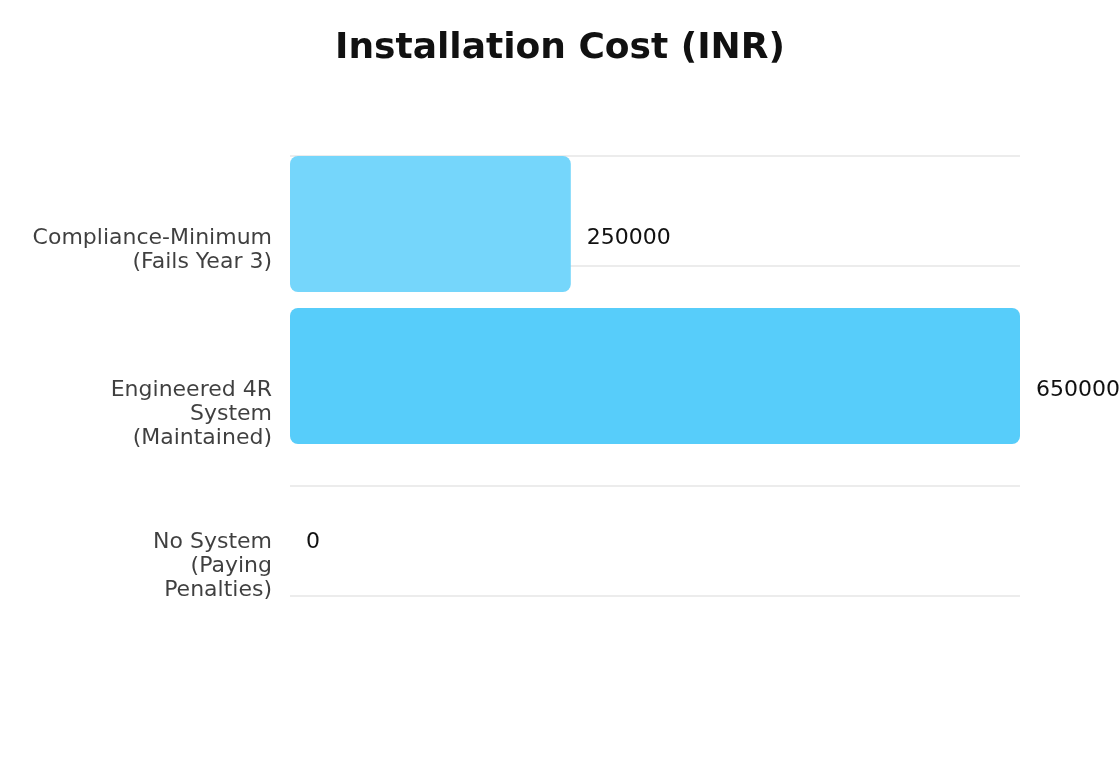
The data shows that building a system purely for compliance is almost as expensive as doing nothing at all. The engineered system requires a higher capital expenditure, but the operational savings are massive. If you want to understand how to achieve these savings, you can learn how to reduce tanker water dependency using proper catchment strategies.
How to design a system that passes inspection and saves water?
You design a system that passes inspection and saves water by sizing your storage and recharge structures to match your actual roof runoff, not just the municipal minimums. You must install a dual-stage filtration system to keep silt out of the recharge well. This ensures the inspector sees a robust setup while your building captures thousands of litres of usable water.
The engineering approach changes everything. Instead of asking what the minimum requirement is, you ask how much water your roof actually generates. India receives 75% of its annual rainfall in just four months. Your system must handle high-intensity storms.
Step 1: Calculate your total runoff potential. Multiply your roof area by the local annual rainfall and the runoff coefficient of your surface type. This gives you the total volume of water available to harvest.
Step 2: Separate the first flush. The first rain of the season washes months of accumulated dirt off your roof. A first-flush diverter automatically routes this contaminated water to the drain, protecting your filters.
Step 3: Install graded filtration. Before water enters any storage tank or recharge pit, it must pass through a filter chamber. We recommend a multi-layer system using gravel, coarse sand, and fine sand. This removes suspended solids and prevents your recharge pit from clogging.
Step 4: Implement the 4R methodology. Reduce your demand, reuse what you can, recycle treated water, and recharge the aquifer. You can read more about how the 4R framework water balance secures your entire site.
What documents do you need for a rainwater harvesting compliance certificate?
You need a site plan showing the catchment area, a technical drawing of the filtration and recharge structures, and photographic evidence of the completed installation to get a rainwater harvesting compliance certificate. The municipal engineer will verify that rain water is collected from the galvanized iron or concrete roof and routed correctly before signing the approval.
The documentation process requires precision. You cannot simply submit a letter claiming you have installed a system. The local authority wants proof that the system matches the building dimensions.
First, prepare the catchment area calculations. The inspector will check these numbers against your approved building plan. If your building has a 2,000 square metre footprint, your calculations must account for that exact area.
Second, provide the cross-section drawings of the recharge pit. The drawings must clearly show the depth of the pit, the layers of filtration media, and the slotted casing pipe if you are recharging a borewell.
Finally, schedule the physical inspection. The municipal engineer will visit the site to confirm the drawings match reality. They will check the pipe connections, inspect the filter chamber, and verify the overflow mechanism. Once they are satisfied, they will issue the compliance certificate. This certificate protects you from penalties and ensures your property tax rebates remain intact.
Why groundwater recharge matters more than simple storage
Storing rainwater in a tank only provides a few days of water supply, but recharging that water into the ground restores your borewell yield for the entire year. Groundwater recharge uses the earth as a massive, free storage tank that does not evaporate and does not require expensive concrete construction.
Most compliance guidelines allow you to choose between storage and recharge. Storing water seems easier. You route the pipes into your existing underground tank and call it a day. But a 1,000 square metre roof in Delhi generates over 600,000 litres of water a year. You cannot build a tank large enough to hold that volume economically.
When you route that filtered water into a recharge well, you replenish the local aquifer. This raises the water table directly beneath your property. In the summer months, when municipal supplies fail and tankers double their rates, your borewell will still yield water. Proper recharge helps maintain water levels and ensure compliance while supporting sustainable water management for the whole community.
How do you maintain an approved rainwater harvesting system?
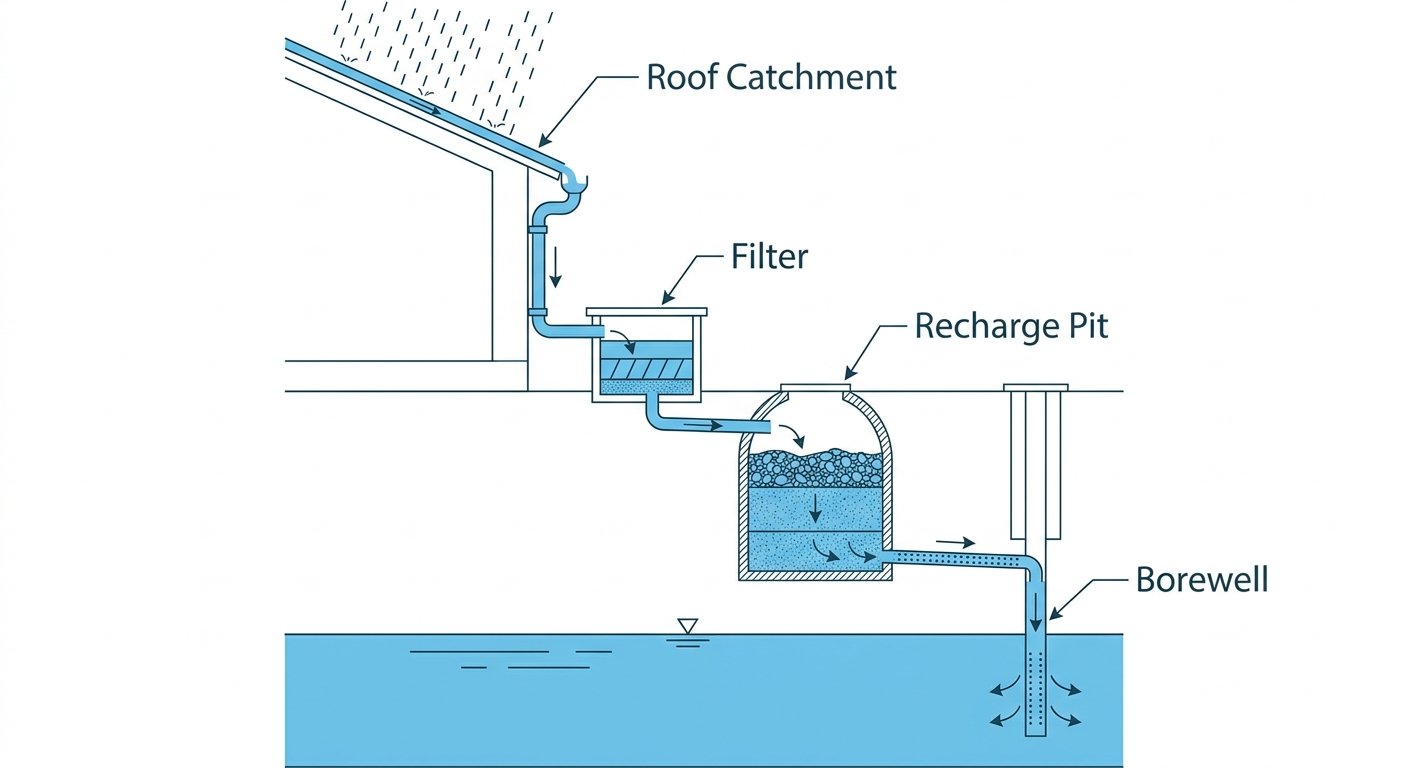
You maintain an approved rainwater harvesting system by cleaning the catchment area before the monsoon, washing the filter media annually, and desilting the recharge pit every three years. Regular maintenance prevents the system from failing and ensures you remain compliant during surprise municipal audits.
An unmaintained system is a dead system. The compliance certificate on your wall means nothing if the inspector finds a clogged filter during a random check. More importantly, an unmaintained system stops saving you money.
Start with the roof. Sweep the catchment area thoroughly in May, just before the monsoon arrives. Remove dry leaves, plastic wrappers, and dust. Clear the gutters and ensure the drain covers are intact.
Next, open the filter chamber. Take out the filter media, wash it thoroughly with clean water, and replace it. If the sand is heavily contaminated, replace it entirely. Check the first-flush valve to ensure it operates smoothly.
Finally, inspect the recharge pit. Shine a flashlight down the inspection chamber. If you see standing water days after a rain event, the pit is clogged. You will need to remove the top layer of silt to restore the percolation rate. Understanding rainwater harvesting maintenance is the only way to protect your capital investment.
FAQ
What is the penalty for ignoring rainwater harvesting compliance? Ignoring rainwater harvesting compliance typically results in additional water charges on your monthly municipal bill. In severe cases, authorities may withhold your 5% property tax rebate or deny your building’s occupancy certificate.
How much does a compliance-minimum rainwater system cost? A compliance-minimum system for a 1,000 square metre commercial roof usually costs around ₹250,000. However, because these systems lack proper filtration, they often fail within three years and lead to heavy tanker water expenses.
Can groundwater recharge help with rainwater harvesting compliance? Yes, routing filtered rainwater into a recharge well satisfies municipal compliance mandates in most Indian cities. This method is highly recommended because it replenishes the local aquifer and restores your borewell yield instead of just filling a small storage tank.
If your building has received a compliance notice, or if your current system is failing, EcoLive can help. We design, install, and maintain engineered rainwater harvesting systems that pass inspection and actually save water.
Contact EcoLive: +91 9871472211 | ecolive.in