
How the Expanding Rainwater Harvesting Mandate in India Affects Building Owners
In a shift that affects every new commercial development, the expanding rainwater harvesting mandate in India is tightening water regulations across major cities. Ghaziabad recently made rainwater harvesting mandatory for building plan approvals, following similar strict enforcement in Auraiya. Building owners who ignore this shift face stalled projects and heavy municipal penalties.
TL;DR: The expanding rainwater harvesting mandate in India requires commercial buildings and residential societies to install functional capture systems before receiving plan approvals or occupancy certificates. Facility managers must move beyond basic checkbox compliance and implement systems that actually recharge groundwater, or risk system failure within two to three years.
What is the new rainwater harvesting mandate in India?
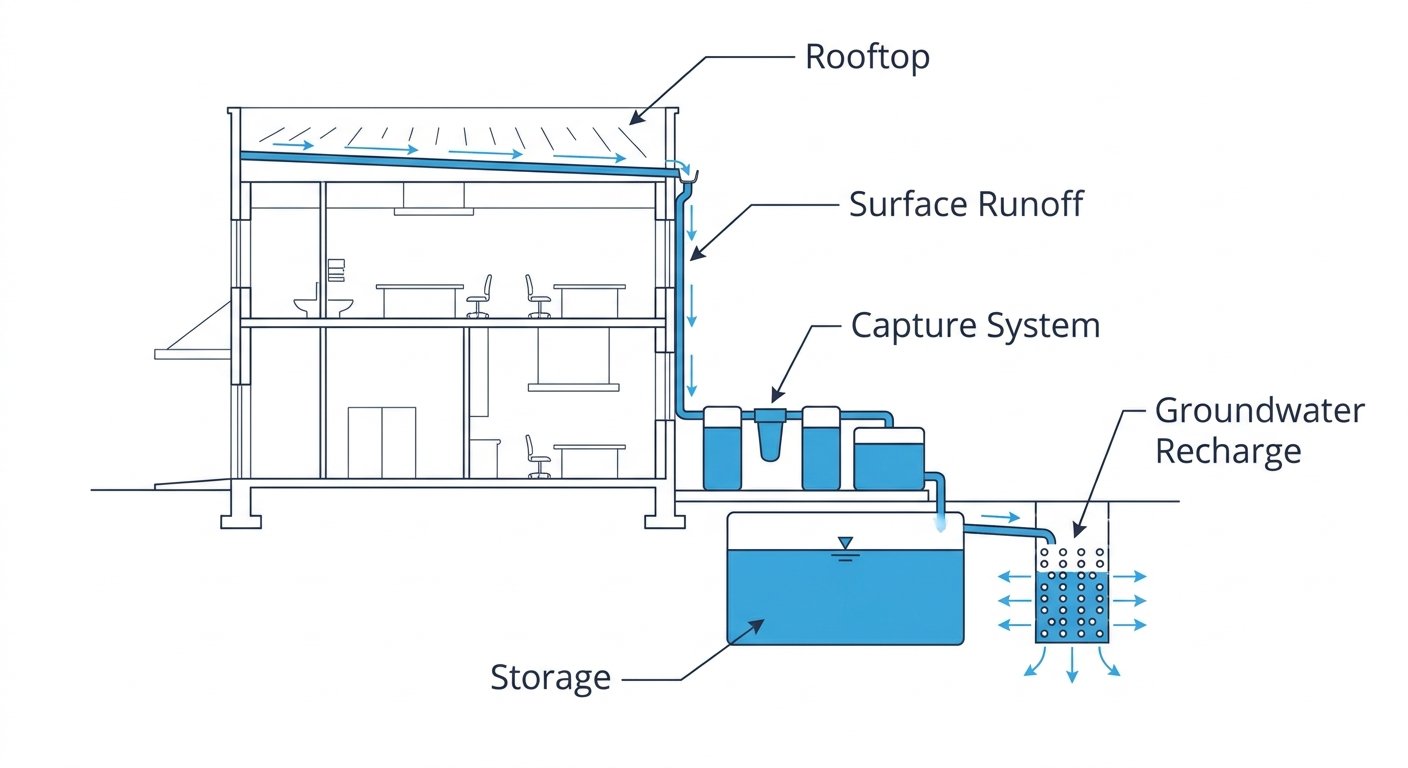
The rainwater harvesting mandate in India is a set of municipal and state-level rules requiring buildings over a specific size to install systems that capture and store or recharge monsoon runoff. According to Housing Ministry guidelines, these rules are now integrated directly into building bye-laws. In cities like Ghaziabad, you cannot secure a building plan approval without a verified rainwater harvesting design. This marks a shift from voluntary conservation to strict legal requirement.
The mandate varies slightly by state but generally applies to plots larger than 300 square meters. The core requirement remains the same across regions. You must calculate your rooftop and surface area, determine the potential runoff, and install a system capable of handling that volume.
Building owners often view this as a bureaucratic hurdle. This approach leads to cheap, poorly designed systems. When a system is built only to pass an inspection, it typically fails within a few years. You can read more about this trap in our guide on rainwater harvesting compliance approaches.
Why are cities enforcing stricter rainwater harvesting rules?
Cities are enforcing stricter rules because India currently captures barely 8% of its annual rainfall, according to experts, leading to severe groundwater depletion and urban flooding. With 33 states and union territories now holding some form of mandate, municipal bodies are realizing that uncaptured rain directly translates to dry borewells and flooded streets. The government is forcing private buildings to manage their own water footprint.
The math behind the crisis is straightforward. India receives an average of 1,170 mm of rainfall annually, IMD data confirms. About 75% of this falls during the four monsoon months. When buildings pave over natural recharge zones and direct runoff into storm drains, the water table drops.
A CGWB report shows municipalities can no longer supply enough water to meet commercial demand. By enforcing the rainwater harvesting mandate in India, local governments push the responsibility back to the consumer. If you want to operate a large facility, you must prove you are not draining the local aquifer without putting anything back.
How do compliance-driven systems compare to outcome-driven systems?
A compliance-driven system is built solely to secure a municipal certificate, while an outcome-driven system is engineered to permanently reduce tanker dependence and cut water costs. The difference becomes obvious after the first monsoon.
Facility managers often ask for the cheapest possible installation to satisfy the inspector. This is a costly mistake. A poorly designed recharge pit will clog with silt within 24 months. Once it clogs, the water backs up, the system fails, and the building returns to paying for expensive water tankers.
Here is how the two approaches compare over a five-year period for a standard commercial building:
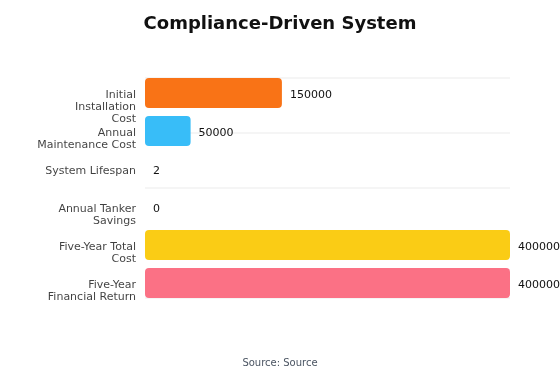
The data shows that building for compliance alone guarantees a financial loss. Building for outcomes turns the mandate into an investment. If you are facing a municipal notice, you should review what happened when Delhi’s rainwater harvesting deadline passed.
What are the technical requirements for commercial buildings?
Commercial buildings must size their rainwater harvesting systems based on their total catchment area and the local peak rainfall intensity. The system must include proper filtration to prevent roof debris from contaminating the groundwater, and the recharge well must reach the appropriate aquifer depth as specified by local groundwater authorities.
The first step is understanding your runoff potential. A metal factory roof generates a different runoff volume than a paved parking lot. You must calculate the exact volume of water your site will generate during a heavy storm. You can use our free Runoff Calculator to find your exact baseline.
Once you know the volume, you must design the storage or recharge structures. The water must pass through a desilting chamber and a dual-media filter before it enters the ground. If you inject unfiltered water into a borewell, you will ruin the aquifer. Municipal inspectors are now checking for these specific filtration components before signing off on the system.
How does the 4R framework simplify the rainwater harvesting mandate in India?
The 4R framework simplifies compliance by treating rainwater harvesting as part of a complete water balance strategy rather than an isolated plumbing task. By integrating Reduce, Reuse, Recycle, and Recharge, facility managers can meet municipal mandates while simultaneously cutting their operational water costs by up to 50%.
When you look at water as a complete cycle, the mandate becomes an opportunity. You stop asking how to pass the inspection and start asking how to capture the water. This is the core of the 4R framework.
EcoLive has implemented this framework across 1,150 completed projects in 11 states. We have verified over 652 million litres of water saved. We achieve these numbers because we measure the water balance of the entire site. We audit the incoming supply, route the treated wastewater for non-potable reuse, and ensure every drop of monsoon rain is captured and recharged.
What steps should facility managers take right now?
Facility managers must audit their existing water infrastructure immediately to identify gaps before municipal inspectors arrive. You should calculate your total catchment area, assess the condition of any old recharge pits, and map out a clear plan to capture the upcoming monsoon runoff.
Do not wait for a notice from the municipal corporation. If your building is located in a city with active enforcement, you are already on the clock. Start by reviewing your building plans. Identify where the storm drains exit the property. That is the water you are losing.
Next, consider your corporate reporting obligations. Proper water management directly impacts your ESG and BRSR compliance. Board directors now require verified water metrics. A properly engineered rainwater harvesting system gives you exact data on how many litres you recharged, which you can drop straight into your annual sustainability report.
Stop treating rainwater as a drainage problem. It is the cheapest source of freshwater your facility will ever get.
FAQ
Is rainwater harvesting mandatory in India? Yes, rainwater harvesting is mandatory in India across 33 states and union territories. Municipalities like Ghaziabad and Delhi require functional systems for building plan approvals and occupancy certificates, especially for plots larger than 300 square meters.
What happens if a building ignores the rainwater harvesting mandate? Buildings that ignore the rainwater harvesting mandate face severe penalties, including the withholding of building plan approvals, denial of occupancy certificates, and heavy municipal fines. In some cases, authorities may disconnect the municipal water supply.
How much does a commercial rainwater harvesting system cost? A commercial rainwater harvesting system typically costs between ₹2,00,000 and ₹15,00,000 depending on the catchment area, rainfall intensity, and whether the water is being stored or recharged into the ground. Outcome-driven systems provide a return on investment within 12 to 24 months by reducing tanker water costs.
Why do compliance-driven rainwater systems fail so quickly? Compliance-driven rainwater systems fail within two to three years because they are built with the cheapest materials just to pass inspection. They often lack proper desilting chambers and filtration, causing the recharge pits to clog with mud and debris after a single monsoon.
Ready to turn compliance into cost savings? Contact EcoLive at +91 9871472211 or visit ecolive.in to request a comprehensive water assessment for your facility.