How to Reduce Tanker Water Dependency in Gurgaon Offices
A standard commercial building in Gurgaon buys up to 40,000 litres of tanker water every day during the summer. At current rates, that costs facility managers over ₹1.5 lakh a month just to keep restrooms functioning and cooling towers running. The borewells are drying up, and municipal supply rarely covers peak demand. Blaming the summer heat is common, but it misses the actual engineering failure. Offices throw away treated wastewater while paying a premium to bring fresh water in. To reduce tanker water dependency, we must rethink this cycle.
TL;DR: You can reduce tanker water dependency by applying the 4R framework. Fix baseline leaks first, route treated STP water to cooling towers, and capture rooftop monsoon rain. This cuts daily freshwater demand by up to 60%, turning a monthly expense into a measurable return on investment.
Why do Gurgaon offices struggle to reduce tanker water dependency?
Gurgaon offices rely on water tankers because their daily operational demand outpaces the CGWA extraction limits set by the Central Ground Water Authority. A 500-person office uses roughly 22,500 litres daily. When local borewells fail or municipal lines drop pressure, facility managers have no choice but to call private tankers to keep the building open.
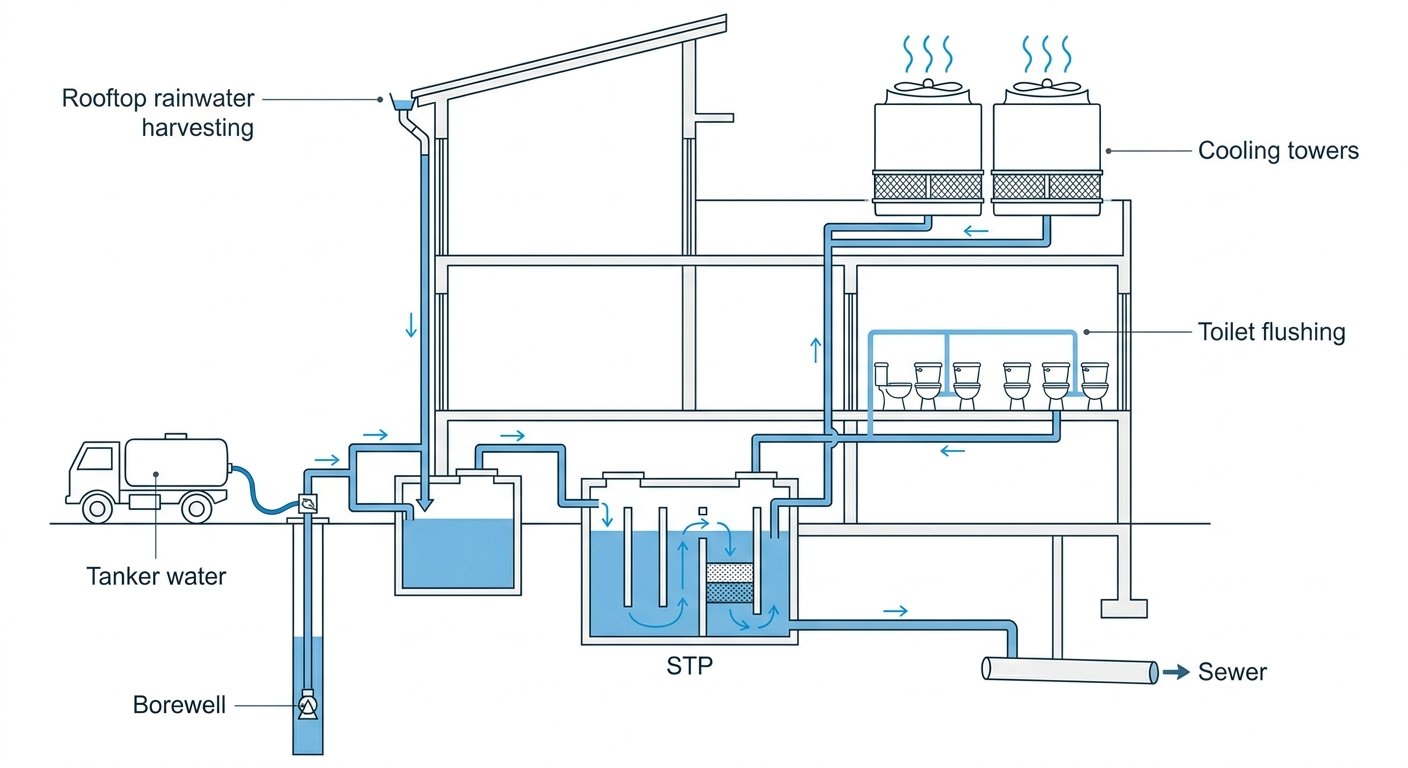
The problem multiplies during peak summer. Cooling towers for centralized HVAC systems consume massive amounts of makeup water due to evaporation. When you combine cooling demand with toilet flushing, you get a building that requires constant external water input. If you want to fix this, you must look at your building’s water balancing equation. Every litre of water that leaves the site as waste is a litre you have to buy back from a tanker tomorrow.
What are the best strategies to reduce tanker water dependency in India?
The best tanker water alternative solutions india offers for commercial real estate revolve around the 4R framework: Reduce, Reuse, Recycle, and Recharge. Instead of finding cheaper tankers, you engineer the building to need less external water in the first place.
Most facility managers view water as a straight line. It enters the building, gets used, and goes to the sewer. The 4R framework turns that line into a circle. By treating and reusing greywater onsite, you immediately drop your daily intake requirement. We have seen offices cut their reliance on external supply by more than half simply by mapping where their water actually goes.
Step 1: Audit and reduce your baseline consumption
You cannot fix what you do not measure. The first step is to establish exactly where the water goes. Install smart metres on your main inlet, your cooling tower makeup line, and your domestic supply lines.
Most offices find that 30% of their water goes to flushing and another 40% goes to the HVAC cooling towers. Once you have the baseline, you look for the invisible waste. A single leaking toilet flap can waste 11,000 litres annually. Upgrading to low-flow aerators on bathroom sinks reduces tap consumption from 6 litres per minute to just 2 litres per minute. This simple hardware change cuts your washroom water demand immediately, without requiring any behavioral changes from your employees.
Step 2: Route treated greywater to HVAC and flushing
If you run an office building, you likely already have a Sewage Treatment Plant (STP) installed for compliance. Most buildings treat their wastewater and then discharge it into the municipal sewer system. This is a massive financial leak.
Instead of discharging that treated water, you must route it back into the building. Toilet flushing and cooling towers do not require potable drinking water. By creating a dual-plumbing system, you can use your STP output to handle these two heavy loads. This is exactly how commercial buildings can cut water tanker costs with greywater recycling. When your own wastewater flushes your toilets, your need for fresh tanker water drops instantly.
Step 3: Capture rooftop rain to offset peak demand
India receives 75% of its annual monsoon rainfall in just four months. Most buildings treat this water as a drainage nuisance. Instead, you should harvest it.
A commercial building with a 1,000 square metre roof in Gurgaon can capture over 500,000 litres of water during the monsoon season. You can calculate your exact site potential using a runoff calculator. You can filter this water and store it in your underground tanks to offset municipal use, or you can route it into a scientifically designed recharge pit to replenish the local aquifer. When you recharge the groundwater, your own borewells yield better results during the dry months. Read more about the 4R framework to see how harvesting fits into the complete system.
How fast does an office see ROI on water conservation?
A typical commercial office sees a full return on investment for water conservation upgrades within 12 to 24 months. You calculate this by measuring the hard cost of tanker water avoided against the capital expenditure of plumbing and metering upgrades.
If you spend ₹1.5 lakh a month on tankers and a greywater routing project cuts that bill by 60%, you save ₹90,000 every month. A ₹15 lakh retrofitting project pays for itself in under a year and a half. Facility heads often use a water conservation ROI calculator india to present these numbers to their management boards. The math is highly predictable once you metre the baseline against commercial water tariffs.
Typical Gurgaon Office Water Demand vs. 4R Savings
Here is a breakdown of daily water consumption for a standard 500-employee office in Gurgaon, comparing a standard setup to a building optimized with the 4R framework.
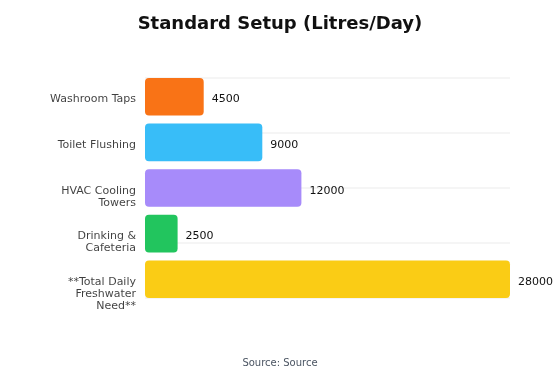
By applying basic efficiency measures and reusing treated water, the daily requirement drops by 20,000 litres. That equals two full water tankers that you no longer need to buy every single day. Stop believing that heat causes water shortage and start engineering your building to keep the water it already has.
FAQ
Why do Gurgaon offices rely on water tankers? Gurgaon offices rely on water tankers because daily demand for HVAC cooling and toilet flushing exceeds the extraction limits set by the Central Ground Water Authority. This forces buildings to buy private water when municipal supply falls short.
What are the best tanker water alternative solutions in India? The best alternative solutions involve the 4R framework. This includes reducing tap flow with aerators, reusing treated STP water for cooling towers, and harvesting rooftop rainwater to offset municipal demand.
How fast does an office see ROI on water conservation? A standard commercial office typically sees a full return on investment within 12 to 24 months. The savings come directly from eliminating the daily cost of private water tankers.
Ready to stop paying for water tankers? Contact EcoLive at +91 9871472211 or visit ecolive.in to request a complete water balance assessment for your commercial building.