How an Industrial Water Reuse System Cuts Factory Water Costs by 40%
The payback math most vendors will not show you about an industrial water reuse system is actually quite simple. Many Indian factories pay up to ₹5 lakh per month for freshwater and tanker deliveries. When a facility discharges treated effluent instead of reusing it, they pay for that water twice: once to buy it, and once to treat and throw it away.
TL;DR: An industrial water reuse system treats factory wastewater so it can be routed back into cooling towers, boilers, and washing processes. Facilities implementing the 4R framework (Reduce, Reuse, Recycle, Recharge) typically cut freshwater dependence by 40%, achieving a full return on investment within 18 to 24 months.
What is an industrial water reuse system?
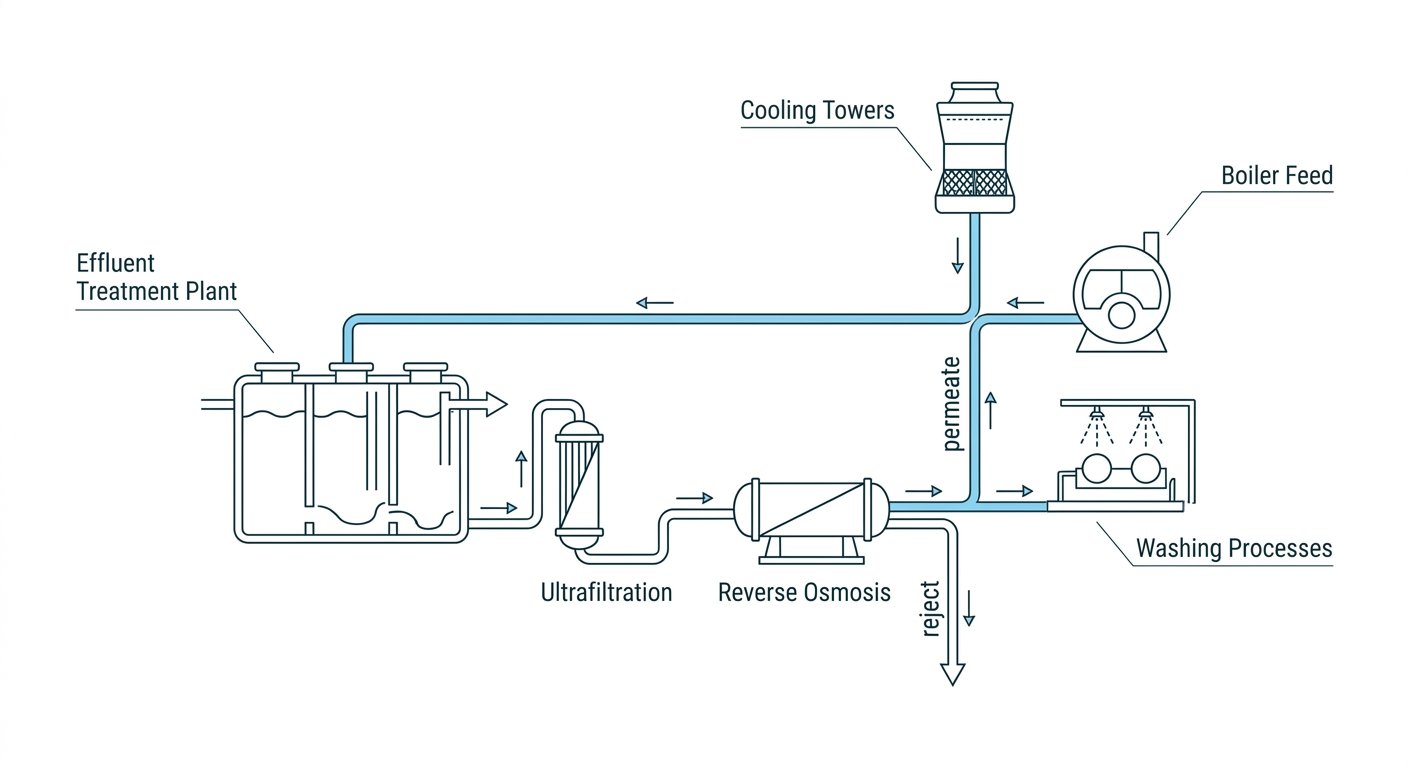
An industrial water reuse system is a treatment setup designed to clean wastewater so a facility can reuse it safely in its own processes. According to industry data, these systems treat effluent to a quality suitable for cooling towers, utility washing, and boiler feed. This stops the cycle of buying expensive tanker water while throwing away water you already paid to treat.
Most factories already have an Effluent Treatment Plant (ETP). The reuse system takes the output from that plant, applies advanced filtration like reverse osmosis or ultrafiltration, and pipes it back into the production line.
How much does an industrial water reuse system save?
A properly designed industrial water reuse system cuts freshwater procurement costs by 30 to 50 percent. Facilities that achieve high wastewater reuse rates see immediate drops in their monthly utility bills. The exact savings depend on the current cost of water and the volume recycled.
Here is a typical monthly cost comparison for a mid-sized manufacturing plant using 100 kilolitres per day (KLD), before and after implementing a reuse system.
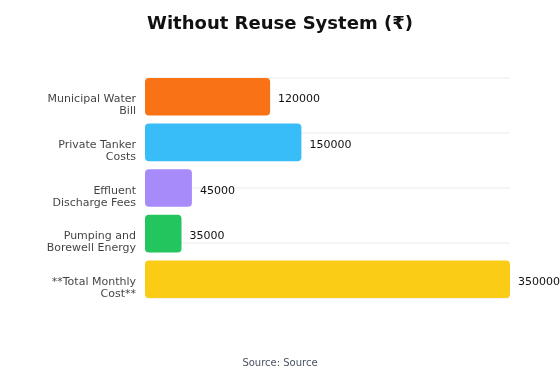
Saving ₹2.08 lakh per month translates to over ₹24 lakh annually. This makes the capital expenditure easy to justify to the board.
Why Zero Liquid Discharge (ZLD) mandates change the math
The Central Pollution Control Board (CPCB) now enforces strict Zero Liquid Discharge mandates for highly polluting industries like textiles, distilleries, and chemicals. ZLD means a factory cannot release any liquid effluent outside its boundaries.
When you must treat your water to a level where no liquid leaves the site, transforming that wastewater into a usable resource is the only logical step. If you are forced by law to run evaporators and advanced filters, routing that clean water back into your cooling towers offsets the massive energy cost of the ZLD process. You turn a compliance burden into an operational asset. This directly supports your ESG and BRSR compliance reporting by providing verifiable water metrics.
How do you calculate the payback period?
You calculate the payback period by dividing the total capital cost of the reuse system by the monthly savings in freshwater and discharge costs. The payback factors for greywater and industrial effluent include the avoided cost of tankers, reduced municipal tariffs, and lower borewell pumping costs.
For a system costing ₹40 lakh that saves ₹2 lakh per month, the simple payback period is 20 months. After year two, the system generates pure operational profit. If you want to see how this applies to your specific site, you can run your numbers through our Water Balance Optimiser.
The 4R framework for factory water balance
Installing a filter is not enough. To get real financial returns, you must apply the 4R framework: Reduce, Reuse, Recycle, and Recharge.
First, reduce consumption at the source by fixing leaks and optimizing machine use. Second, reuse water where treatment is not needed. Third, recycle effluent through the ETP and advanced systems for high-grade applications. Finally, recharge any surplus rainwater into the ground to secure your borewells. This creates a closed loop. We have seen this exact approach to STP treated water work across hundreds of facilities.
What are the common mistakes in industrial water recycling?
The most common mistake in industrial water recycling is failing to match the treated water quality to the specific end-use. If you need circular water management to succeed, you do not need drinking-quality water to wash down a loading bay.
Over-treating water wastes electricity and membrane life. Under-treating it damages your boilers or cooling towers. A proper water balancing audit maps exactly what quality of water each process requires, and routes the effluent accordingly. This fit-for-purpose routing is what separates a profitable reuse system from an expensive compliance checkbox.
FAQ
What is an industrial water reuse system? An industrial water reuse system is a treatment setup designed to clean wastewater so a facility can reuse it safely in its own processes. This includes applications like cooling towers, utility washing, and boiler feed.
How much does an industrial water reuse system save? A properly designed industrial water reuse system typically cuts freshwater procurement costs by 30 to 50 percent. Facilities can save lakhs of rupees monthly by eliminating private tanker costs and reducing municipal water bills.
How do you calculate the payback period for a water reuse system? You calculate the payback period by dividing the total capital cost of the reuse system by the monthly savings in freshwater procurement and effluent discharge costs. Most industrial systems achieve a full return on investment within 18 to 24 months.
What is Zero Liquid Discharge (ZLD)? Zero Liquid Discharge (ZLD) is a regulatory mandate requiring that a factory releases no liquid effluent outside its boundaries. Under this rule, all wastewater must be treated, recycled, and reused entirely within the facility.
To find out exactly how much a reuse system could save your facility, call EcoLive at +91 9871472211 or visit ecolive.in.