Industrial Water Conservation: How Indian Manufacturers Can Secure Water as AI Data Centres Expand
We helped a mid-sized Indian manufacturing plant save 45,000 litres of freshwater daily through proactive industrial water conservation. Here is how.
The global push for artificial intelligence is creating a new dynamic for Indian manufacturing. A single AI query consumes up to ten times more electricity than a standard search, and cooling the servers that process these queries requires millions of litres of freshwater. As data centres expand across India, they will share municipal and groundwater resources with traditional factories.
TL;DR: The rise of water-intensive AI data centres is changing industrial water economics. Manufacturing plants can optimize their water balance, route treated effluent back into cooling systems, and recharge their borewells to maintain consistent production. The 4R framework (Reduce, Reuse, Recycle, Recharge) offers a proven engineering path to cut freshwater dependence by up to 50%.
Why is industrial water conservation critical as AI data centres expand?
Industrial water conservation is critical because data centres introduce massive new demand into local aquifers, forcing factories to compete for limited resources. The servers require continuous cooling to maintain optimal hardware performance. This cooling process evaporates vast quantities of water. When a new data centre opens in an industrial corridor, local groundwater dynamics shift, prompting neighbouring factories to optimize their borewells or procure alternative water sources to keep their own production lines running efficiently.
The shift is already visible in major industrial hubs. Facility managers are noticing that groundwater dynamics are changing faster than historical models predicted. The allocation of water is no longer just between agriculture and urban populations. It now includes a balance between high-margin technology infrastructure and traditional manufacturing.
How much water can industrial water conservation actually recover for an Indian factory?
Industrial water conservation can recover up to 45,000 litres of water daily for a mid-sized Indian factory by optimizing cooling systems, fixing leaks, and reusing effluent. Most facilities operate without a verified water baseline. They pay the utility bill or the tanker vendor without tracking where every litre goes inside the plant.
The lack of measurement is the primary barrier to industrial water conservation in India. You cannot manage what you do not measure. When a factory discharges treated water into the municipal drain instead of routing it back to the cooling tower, it misses a valuable opportunity to reuse paid resources.
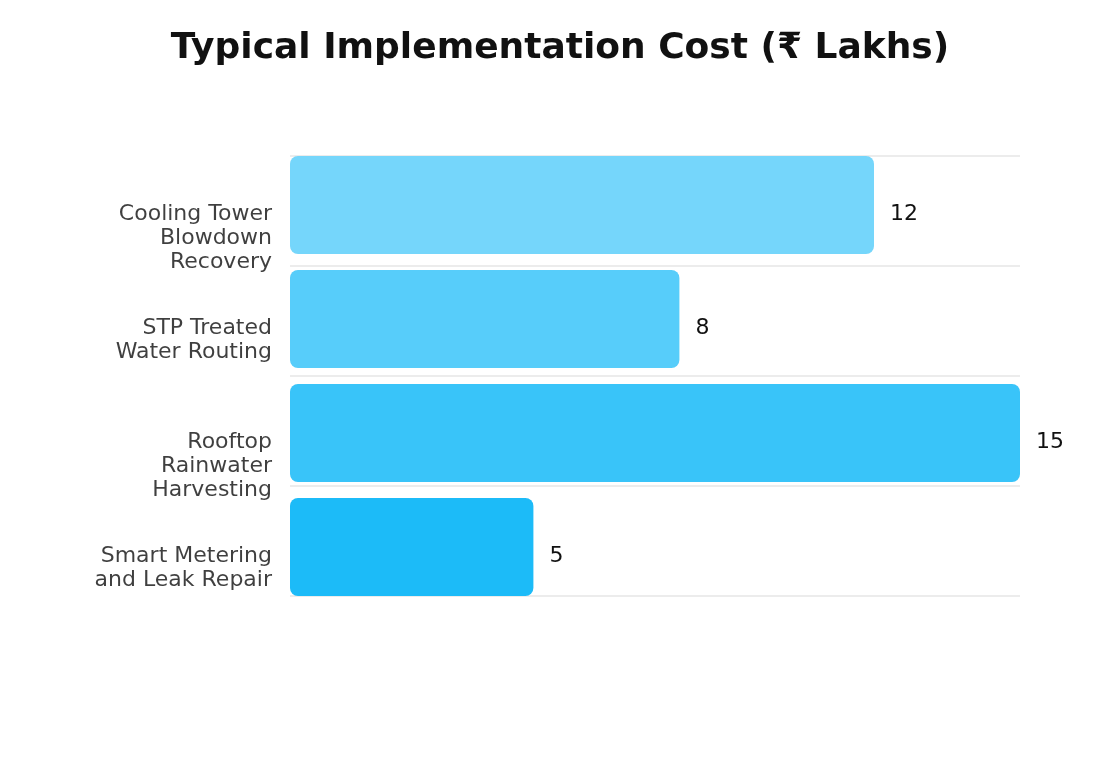
Water Recovery Potential in Manufacturing
This table shows the typical water recovery potential for a mid-sized Indian manufacturing plant implementing standard conservation measures.
How do you audit the existing water balance in a factory?
You audit a factory’s existing water balance by installing smart metres at every major consumption point to measure exactly how much water enters, evaporates, and leaves as wastewater. This data allows the plant to benchmark its industrial water use efficiency against industry standards.
Without a baseline, any investment in recycling technology is just guesswork. A proper audit reveals the low-hanging fruit, such as repairing leaks or optimizing boiler blowdown cycles, which often yield immediate savings without heavy capital expenditure.
How can factories route treated effluent back to cooling towers?
Factories can route treated effluent back to cooling towers by upgrading their STP or ETP filtration systems and piping the treated water directly into the cooling cycle. Cooling towers are typically the largest consumers of water in a manufacturing plant. Instead of feeding these towers with fresh municipal water, factories can use this recycled effluent.
This approach is central to effective water conservation and management. It turns a compliance requirement into a valuable operational asset.
How does groundwater recharge protect a factory’s borewell?
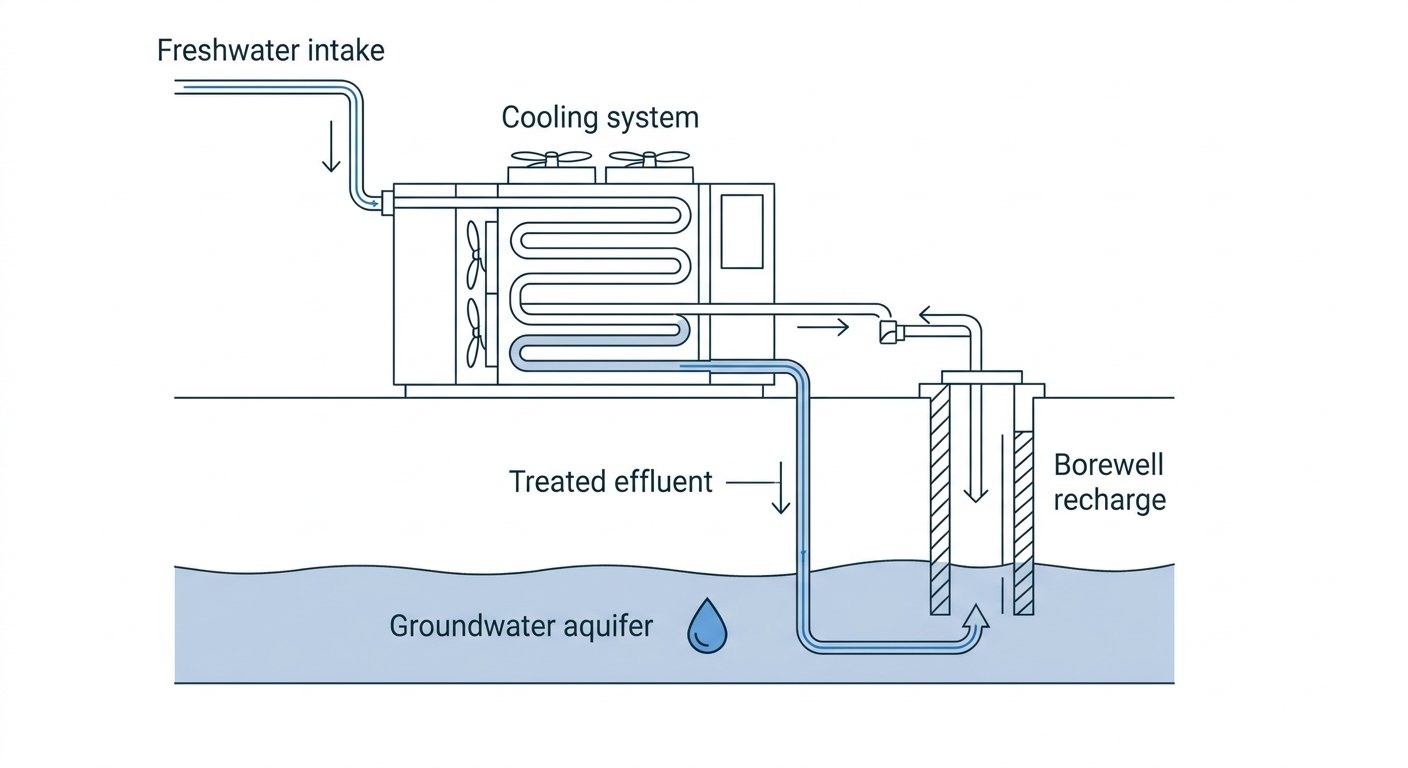
Groundwater recharge protects a factory’s borewell by capturing monsoon rainfall from the roof and directing it into scientifically designed recharge pits to replenish the underlying aquifer. Proactively replenishing extracted water ensures sustainable borewell yields and consistent production.
This process is guided by clear standards. The CGWB groundwater extraction guidelines encourage industries to implement specific recharge measures. A well-designed recharge system ensures that the aquifer beneath the factory is replenished every year, providing a buffer during dry summers and demonstrating strong environmental stewardship.
How does the 4R framework secure your production line?
The 4R framework secures your production line by closing the loop on water usage through Reduce, Reuse, Recycle, and Recharge. It shifts a factory from a linear consumption model to a circular one. By applying these four principles simultaneously, a plant can build resilience against external water fluctuations and unpredictable tanker pricing.
Implementing the 4R framework for water balance is the most reliable engineering strategy available to facility managers today. It provides the hard data required for BRSR water compliance, satisfies pollution control boards, and directly lowers monthly operating expenses.
How should facility managers train their team on water efficiency?
Facility managers should train their team on water efficiency by educating operational staff on why the systems matter and tying performance metrics directly to conservation goals. Technology alone will not save water. A common reason conservation efforts stall is that the maintenance team bypasses the recycling filters when they get clogged, reverting to freshwater use to save time.
Plant managers need to educate their employees on ways to save water and tie performance metrics to water efficiency. When the boiler operator and the cooling tower technician understand the financial impact of water conservation, the entire plant operates more efficiently.
How can a factory prepare for mandatory ESG reporting?
A factory can prepare for mandatory ESG reporting by establishing a verified water baseline and adopting measurable conservation strategies early. Water is now a board-level priority. The Securities and Exchange Board of India (SEBI) has made water disclosure mandatory for top listed companies through the BRSR framework. Large buyers are increasingly asking their suppliers to demonstrate their water efficiency.
Factories that adopt industrial water conservation strategies early will have a distinct competitive advantage. They will be able to show verified water metrics to international buyers and investors, turning compliance into a driver for real operational savings.
EcoLive helps Indian factories design, implement, and measure industrial water conservation systems. We do not just install equipment. We measure outcomes.
FAQ
How much does an industrial water audit cost? An industrial water audit typically costs between ₹25,000 and ₹1.5 Lakhs per site. The final price depends on the size of the facility and the complexity of its water systems.
What is the payback period for cooling tower water recovery? The typical payback period for cooling tower blowdown recovery is around 14 months. This rapid return on investment makes it one of the most profitable conservation measures for manufacturing plants.
Does the 4R framework help with BRSR compliance? Yes, the 4R framework provides the exact verified water metrics required for BRSR compliance. It gives ESG directors board-ready data to demonstrate measurable reductions in freshwater dependence.
Ready to cut your factory’s freshwater dependence? Call +91 9871472211 or visit ecolive.in to Request a Water Assessment.