2026 Rainwater Harvesting Mandates in India: What Building Owners Must Change
Municipalities across India are renewing their focus on rainwater harvesting mandates in 2026. While cities like Delhi and Goa have had mandates in place for years, local bodies are now actively verifying that systems are functional. The regulatory environment has shifted from requiring an installation on paper to ensuring a functional system that actually catches water.
TL;DR: State governments across India are updating their rainwater harvesting enforcement in 2026. The focus has moved from construction to verification. Buildings with inactive systems are being encouraged to upgrade. Property owners have the opportunity to transform their systems from bare-minimum compliance checkboxes to measurable, maintained assets.
What exactly changed in the 2026 rainwater harvesting mandates?
The 2026 rainwater harvesting mandates shift the regulatory focus from initial installation to ongoing operational verification. Municipalities are increasingly looking beyond the initial setup. They now require proof that the system absorbs runoff during the monsoon. The CGWA and state bodies are training inspectors to test recharge rates and check filter maintenance logs.
For years, some building owners treated rainwater harvesting as a one-time construction step to secure an occupancy certificate. This compliance-driven approach often resulted in suboptimal systems. Without regular maintenance, filters can easily become blocked, and over time, silt can accumulate in the recharge bore.
Today, local bodies are taking a more active role. Properties in Maharashtra jurisdictions are seeing routine checks. If a system is inactive, the property may fall out of compliance. You can learn more about this challenge in our guide on why compliance-driven rainwater harvesting fails.
Why are inspectors checking my existing rainwater harvesting system?
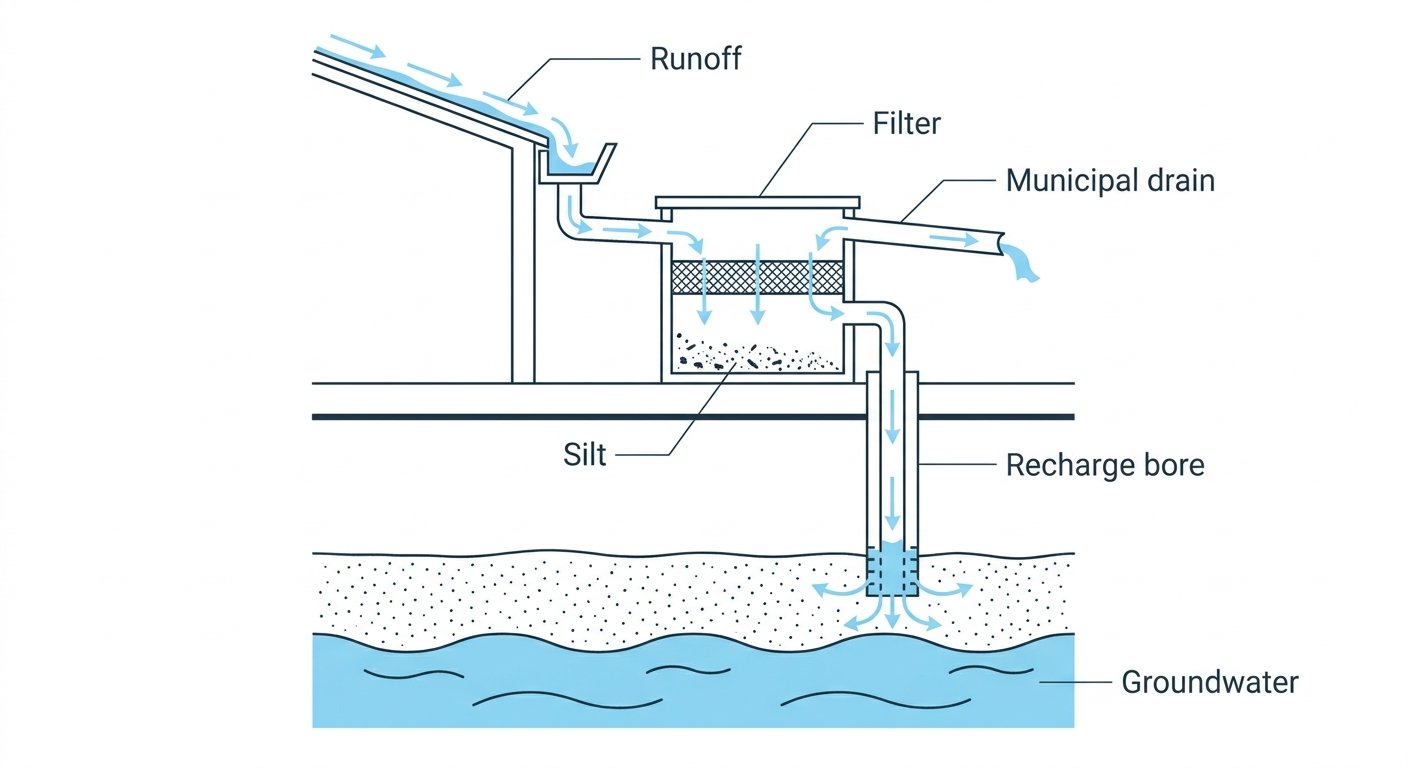
Inspectors are checking existing setups because inactive systems miss valuable opportunities to prevent urban runoff and support groundwater recharge. When a residential society’s system is unmaintained, thousands of litres of water flow into municipal drains, adding volume to city infrastructure and contributing to waterlogging on main roads, according to urban planning studies.
India captures a small fraction of its annual rainfall, while the rest flows away, as noted by the IMD. When a building owner installs a system solely to pass an inspection, they might choose minimum capacities and basic materials. Often, these systems are not optimized to handle the peak hourly rainfall of the Indian monsoon.
As a result, the filter can become blocked during a heavy storm, causing water to back up. Without proper training, a building maintenance team might bypass the system and route the roof water straight to the municipal sewer. This illustrates why rainwater harvesting systems fail within three years. Inspectors recognize this pattern, which is why verification now continues well after a building is occupied.
How much does an inactive system cost compared to functional harvesting?
An inactive system costs significantly more over time than functional harvesting because it leaves you dependent on expensive water tankers. Building owners sometimes believe they save money by choosing the lowest bidder for their installation. The data tells a different story.
Building for compliance alone often leads to long-term operational challenges. Building to actively harvest water, on the other hand, helps offset tanker dependency. Here is the five-year cost comparison for a typical 200-flat residential society in Delhi NCR.
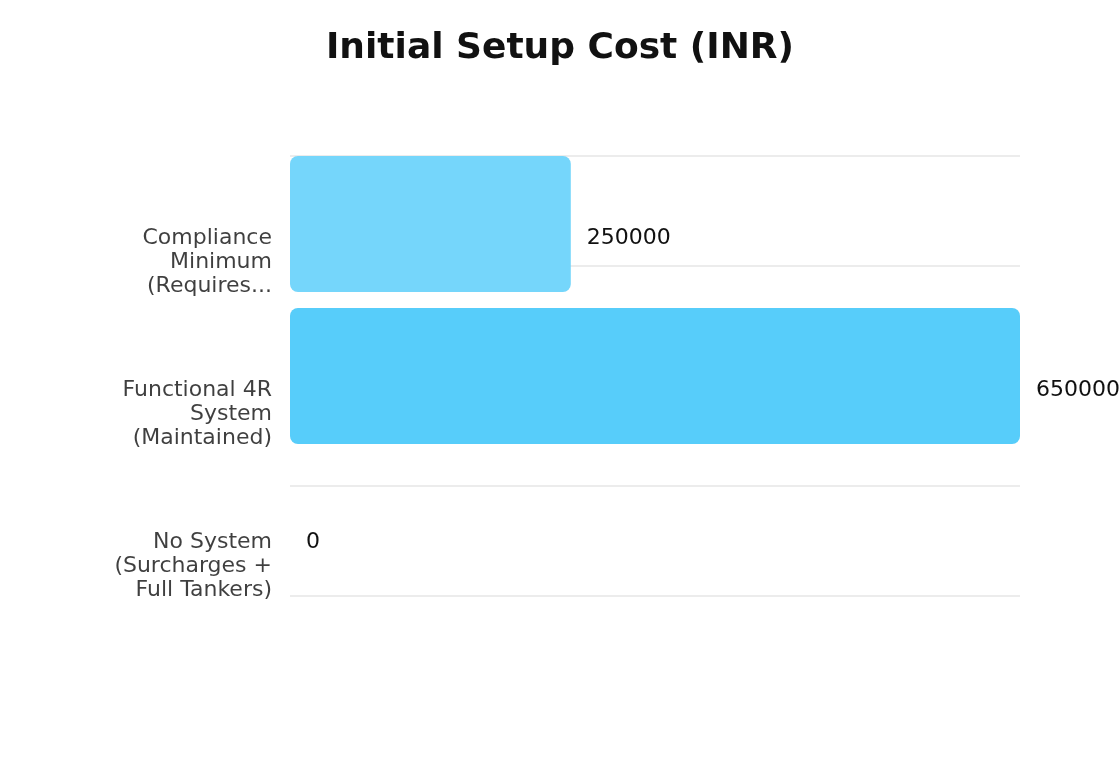
The numbers are clear. A minimally designed system can be an inefficient use of capital. It requires a setup fee, yet still leaves the property paying high tanker rates when local groundwater levels drop. A functional system requires a higher initial investment but pays for itself steadily by reducing freshwater demand. Compare the long-term benefits in our analysis of RWH vs borewell costs.
How can the 4R framework help me comply with rainwater harvesting mandates?
The 4R framework helps you comply with rainwater harvesting mandates by measuring the actual water you reduce, reuse, recycle, and recharge. Rainwater harvesting is just the “Recharge” component. It cannot operate in isolation. You must first understand your site’s total water balance. How much water enters the property? How much is consumed? How much leaves as sewage, and how much leaves as runoff?
When you design a system based on the 4R framework, you size the recharge pits to match your actual roof area and local peak rainfall data. You install lateral filtration that can handle heavy silt loads efficiently. Most importantly, you measure the outcome. You track exactly how many litres you send back into the aquifer. When the inspector arrives, you can provide a comprehensive data log, demonstrating tangible results.
How should building owners prepare for upcoming municipal inspections?
Building owners should prepare for upcoming municipal inspections by physically verifying their recharge structures and scheduling a professional water audit. Taking proactive steps ensures your property remains in good standing.
First, locate your system and ensure your facility managers know where the recharge structures are situated. Second, lift the covers and inspect the filter media. If you see standing water, mud, or debris, the system is likely inactive and the recharge bore may need maintenance.
Third, schedule a professional water audit with a water-conservation engineering partner who can assess the catchment area, calculate the required volume, and optimize the bore. Finally, establish an Annual Maintenance Contract (AMC) that includes pre-monsoon cleaning and post-monsoon verification. Read more about the two approaches to rainwater harvesting compliance to understand your options.
Frequently Asked Questions
Is rainwater harvesting mandatory for existing buildings in India?
Yes, rainwater harvesting is mandatory for existing buildings in many Indian cities. While cities like Delhi made it compulsory for plots over 100 square metres years ago, as per Delhi Jal Board, 2026 has brought a renewed focus on strict enforcement and operational verification across various states based on roof area or groundwater levels.
What happens if my rainwater harvesting system is not working?
If your rainwater harvesting system is not working, municipal authorities can levy surcharges on your building, withhold water connections, or review occupancy certificates. Recent 2026 mandate updates focus heavily on ensuring properties maintain active and functional systems, rather than just having them on paper.
How often should a rainwater harvesting system be maintained?
A rainwater harvesting system must be maintained at least twice a year. You need a thorough pre-monsoon cleaning of the catchment area and filters, followed by a post-monsoon inspection to ensure the recharge bore remains active and free of silt.
Can an inactive rainwater harvesting pit be restored?
Yes, an inactive rainwater harvesting pit can usually be restored. A water engineering team can remove the blocked filter media, flush the recharge well with compressed air to clear the silt, and install a more efficient lateral filtration system to promote long-term functionality.
Secure Your Water Independence Today
Mandates and guidelines will continue to evolve as India focuses on sustainable water management. Embracing rainwater harvesting provides a reliable method to supplement borewells and manage tanker costs effectively.
EcoLive has completed over 1,150 projects across 11 states, saving more than 652 million litres of water. We do not just install systems; we measure outcomes.
Call us at +91 9871472211 to request a Water Assessment for your building, or visit ecolive.in to calculate your potential savings.