What Monsoon Readiness Actually Means for Your RWH System
Most buildings in India believe that cleaning their rainwater harvesting (RWH) system before the monsoon is enough. Desilt the filter bed, flush the pipes, and you are done. But this is the narrowest possible definition of readiness. Real monsoon readiness addresses three problems that cleaning alone cannot fix: inadequate capacity, outdated designs, and zero measurement. Here is what it actually means to be monsoon-ready.
TL;DR: Cleaning your RWH filter before monsoon is not enough. True readiness means verifying your system can handle your actual catchment area, upgrading outdated components, and measuring how many litres you recharge each season. Start with a runoff calculation to find your gap.
Why Cleaning Alone Is Not Monsoon Readiness
A 2023 report by the Central Ground Water Board (CGWB) found that nearly 60% of annual groundwater recharge in India comes from rainfall. Yet most RWH systems installed on Indian buildings were sized and designed years ago, often by plumbers with no hydrological input. The building has since added floors, expanded rooftops, or paved more surface area. The original system was never updated to match.
Cleaning the filter media, clearing leaf traps, and flushing pipes is necessary maintenance, but it does not address whether your system can actually capture and recharge the volume of rain that falls on your roof today. You are polishing a system that may be fundamentally undersized.
Gap 1: Inadequate Rainwater Harvesting Capacity
Your RWH system was likely designed for the building as it existed on the day of installation. If you have added a floor, extended a terrace, or built an annexe, your catchment area has grown but your RWH capacity has not.
Consider this: a 1,000 sq ft roof in Gurugram receives roughly 3.7 lakh litres of rain in an average monsoon (using Gurugram’s annual rainfall of ~600 mm). If your recharge pit or storage tank was sized for 600 sq ft, you are sending nearly 40% of that rain straight into the storm drain.
The fix starts with a simple calculation. Use the EcoLive Runoff Calculator to find out exactly how much rainwater your roof generates and whether your current system can handle it. The tool factors in your city’s rainfall, your surface area, and runoff coefficient to give you a precise capacity gap number.
Gap 2: Outdated RWH Designs
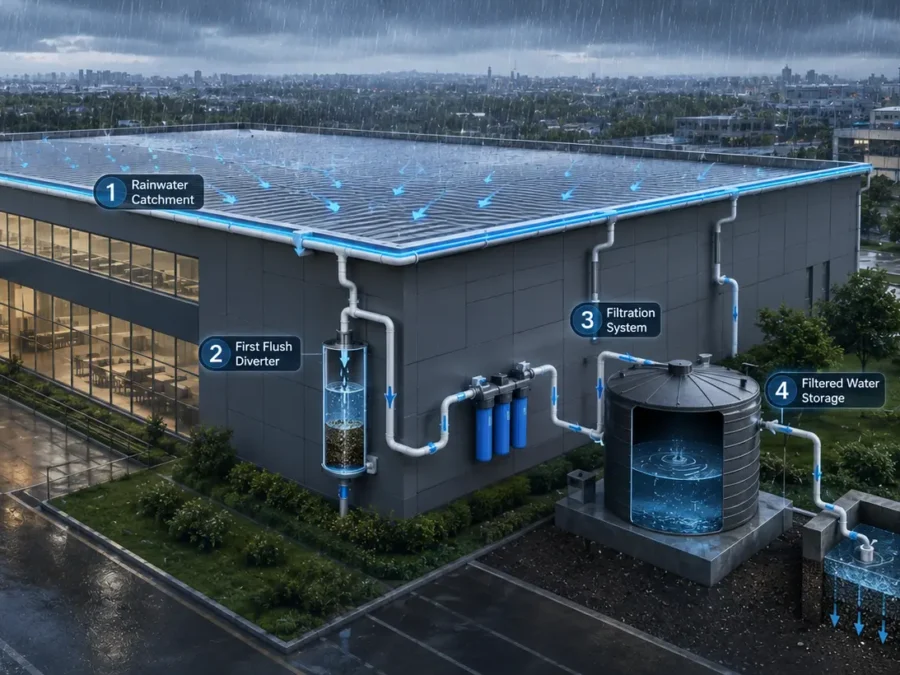
Many RWH systems installed before 2020 share the same design flaws. Single-stage filtration with no first-flush separator, mixed drainage lines (rainwater mixes with sewage or greywater), and no bypass valve for overflow management are the most common issues.
A first-flush separator discards the first 1-2 mm of rainfall, which carries roof dust, bird droppings, and chemical pollutants. Without it, all of that contamination enters your recharge pit or storage tank. Mixed drainage means your harvested rainwater never reaches the recharge structure because it joins the building’s wastewater line.
Modern RWH designs use multi-stage filtration, dedicated rainwater downpipes separated from sewage lines, and overflow routing that directs excess water to secondary recharge structures like injection borewells or dispersion trenches.
Gap 3: No Measurement or Maintenance Track Record
This is the gap that separates functional RWH from decorative RWH. Most buildings have no idea how many litres of rainwater they actually recharged last monsoon. No meter, no logbook, no before-and-after water table data. When a borewell goes dry in April, nobody can say whether the RWH system made any difference.
According to the CGWB’s 2025 dynamic groundwater assessment, India’s total annual groundwater recharge stands at 448.52 billion cubic metres. Individual buildings contribute to that number, but without measurement, there is no way to verify it, report it for BRSR compliance, or optimise it year after year.
True monsoon readiness means installing a flow meter on your recharge line, maintaining a seasonal log of litres harvested, and testing your groundwater levels before and after the monsoon. This data turns your RWH system from a compliance checkbox into a verified water asset.
4 Steps to Actually Get Monsoon-Ready
Step 1: Calculate Your Runoff and Find the Gap
Before touching any pipe or filter, run your building’s numbers through the Runoff Calculator. Enter your roof area, your city’s rainfall data, and your current RWH system’s capacity. The tool will tell you exactly how much rainwater you are capturing versus how much you are losing to drains.
Step 2: Compare Capacity Against Demand
Use the Water Balance Optimiser to see your building’s full water picture: how much you consume, how much you recharge, and what the gap looks like. This tells you whether you need additional recharge pits, larger storage, or a complete redesign.
Step 3: Upgrade Outdated Components
Address the design gaps identified in Step 2. Install a first-flush separator if you do not have one. Separate rainwater downpipes from sewage lines. Add an overflow bypass that routes excess monsoon water to a secondary recharge structure. Replace degraded filter media with fresh material.
Step 4: Set Up Measurement
Install a flow meter on your main recharge line. Create a simple monthly log: date, rainfall received (mm), water meter reading, litres recharged. Test your borewell water level in May (pre-monsoon) and October (post-monsoon). This data is what you need for ESG reporting, BRSR water metrics, and to prove that your RWH system is actually working.
Why This Matters Beyond Compliance
SEBI’s BRSR Core framework, now mandatory for India’s top 1,000 listed companies, requires verified water metrics across sites. That includes rainwater harvested, groundwater levels, and water balance data. An RWH system with no measurement is a compliance liability, not an asset.
For RWAs and residential buildings, the benefit is direct: lower dependence on tanker water, reduced borewell deepening costs, and measurable groundwater recovery. EcoLive’s projects across 11 states and over 1,150 sites have saved more than 652 million litres, precisely because every system is measured and maintained year-round.
FAQ: Monsoon Readiness for RWH Systems
What is the minimum maintenance an RWH system needs before monsoon?
At minimum: clean the filter media, clear all leaf traps and debris screens, flush the downpipes, check for cracks in recharge pits, and test that water is flowing to the recharge structure and not bypassing it. But maintenance alone does not address capacity or design gaps.
How do I know if my RWH system is undersized?
Run your roof area and local rainfall data through the EcoLive Runoff Calculator. If your system’s recharge capacity is less than 70-80% of your annual runoff, it is undersized and you are losing thousands of litres each monsoon.
Is first-flush separation really necessary?
Yes. The first 1-2 mm of rainfall on any roof carries the highest concentration of dust, bird droppings, chemical residues, and atmospheric pollutants. Without a first-flush separator, all of this enters your recharge pit or storage tank, contaminating groundwater and reducing recharge efficiency.
How much does it cost to upgrade an outdated RWH system?
Upgrades vary by site. Adding a first-flush separator costs ₹15,000-25,000. Separating rainwater pipes from sewage lines costs ₹30,000-60,000 depending on building size. A full system redesign with additional recharge capacity typically ranges from ₹2-8 lakh. Contact EcoLive for a site-specific assessment.
Can I measure RWH performance without expensive equipment?
A basic flow meter costs ₹2,000-5,000 and installs on your recharge pipe in under an hour. Combined with a simple spreadsheet log, this gives you litres-recharged data accurate enough for BRSR reporting and internal water audits.
Ready to find out how much rainwater your building is losing? Use the EcoLive Runoff Calculator and Water Balance Optimiser to calculate your gap in under 5 minutes. For a full site assessment and monsoon readiness upgrade, reach out below.
📞 +91 9871472211 | ecolive.in