Headlines Blame Rising Temperatures for Water Shortages. That Is Only Half the Story.
Every summer, Indian news channels run the same alarming reports. “Temperatures cross 48 degrees,” “City taps run dry,” “Groundwater levels plummet.” The implied message is simple and seductive: heat is destroying our water supply.
It is not wrong. But it is dangerously incomplete. Higher temperatures do accelerate evaporation from reservoirs, soil, and vegetation. India’s average temperature has risen by roughly 0.7 degrees Celsius since 1900, according to the India Meteorological Department (IMD). That added warmth does increase surface evaporation and intensifies dry spells.
But here is the part most coverage skips. The same heat that makes summer unbearable is also the engine that drives rainfall across the subcontinent. Without evaporation, there is no moisture in the atmosphere. Without moisture, there is no condensation. And without condensation, there is no monsoon. Blaming heat for water shortage while ignoring this cycle is like blaming the sun for making you sweat while forgetting that the same sun grows your food.
> TL;DR: Rising heat increases evaporation, but evaporation is what produces rainfall. India’s real water problem is not that it lacks rain. It is that the country captures barely 8% of its annual rainfall, while the rest runs off into drains, rivers, and eventually the sea. Conserving water year-round and harvesting rainfall where it falls is the practical answer.
How Does the Water Cycle Actually Work?
The water cycle is not complicated. It has four stages that repeat endlessly: evaporation, condensation, precipitation, and collection.
Evaporation: The sun heats water in oceans, lakes, rivers, and soil. This water turns into vapour and rises into the atmosphere. India’s vast coastline and tropical position make it one of the most evaporatively active regions on Earth.
Condensation: As water vapour rises, it cools. Cool air cannot hold as much moisture, so the vapour condenses into tiny droplets, forming clouds. This is why the monsoon arrives with such dramatic cloud formations over the subcontinent.
Precipitation: When clouds get heavy enough, water falls back as rain, snow, or hail. India receives an average of 1,170 mm of rainfall annually, according to IMD data. That is not a small number. For context, many water-stressed countries in the Middle East receive less than 250 mm per year.
Collection: Rainwater either soaks into the ground (recharging aquifers), collects in surface water bodies, or runs off. This is the critical stage where India falters.
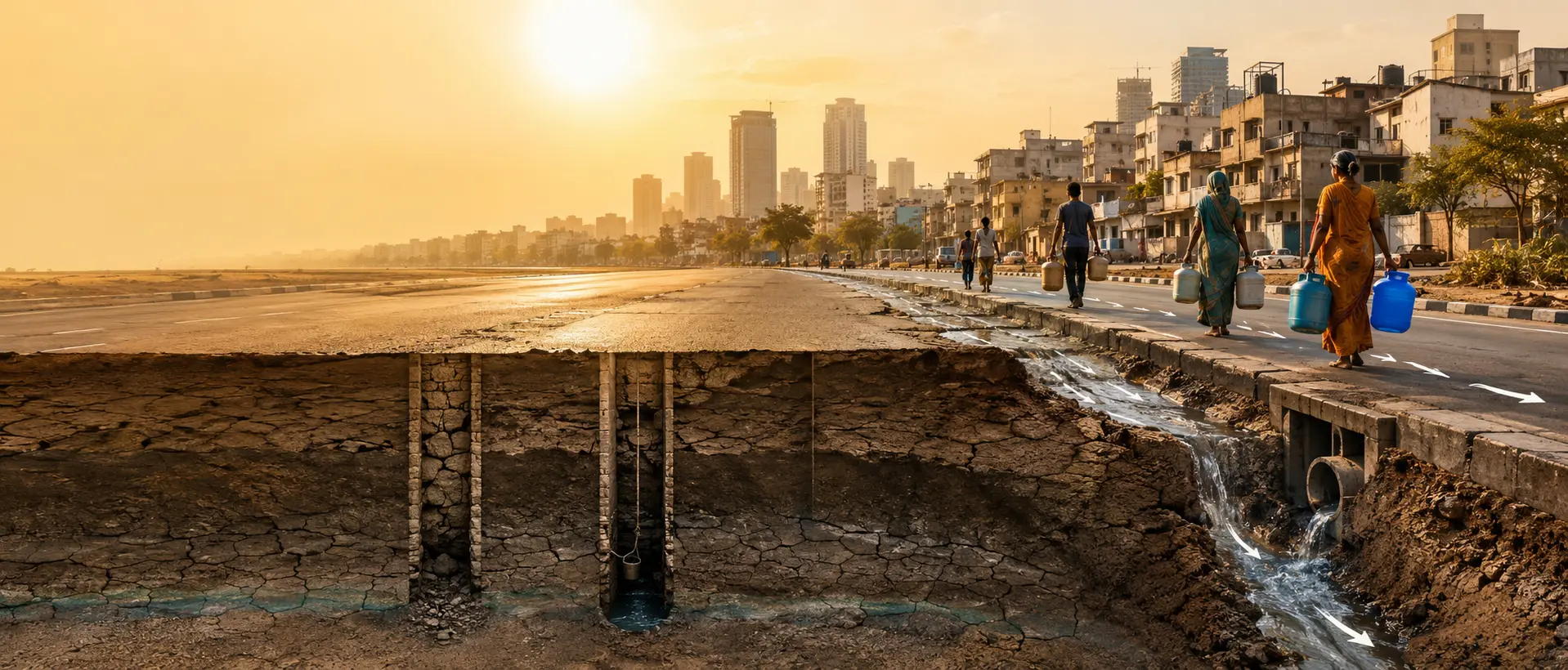
According to a NITI Aayog report cited by Down To Earth, India captures only about 8% of its annual rainfall. The remaining 92% either runs off unused or evaporates from bare soil. Countries like Israel and Singapore capture over 80% of their rainfall through systematic collection, treatment, and reuse.
India Does Not Have a Rainfall Problem. It Has a Management Problem.
India receives roughly 4,000 billion cubic metres (BCM) of rain and snow each year. That is enough water to meet the needs of over a billion people, support agriculture, and sustain industry. The shortage people experience in April and May is not because the rain did not come. It is because the rain that came was not captured, stored, or recharged.
Consider the timeline. India’s southwest monsoon delivers about 75% of annual rainfall between June and September. By March, borewells in Gurugram, Jaipur, and Bengaluru start drying up. RWAs scramble for tanker water at inflated rates. Factories face production disruptions.
The gap between abundant rainfall and summer scarcity is not a climate failure. It is an infrastructure and awareness gap. Rain that falls on impervious concrete surfaces in cities rushes into storm drains and disappears. Treated wastewater from STPs is discharged into rivers instead of being reused for cooling, gardening, or toilet flushing. Rooftop rainwater that could recharge borewells simply overflows terraces.
Why You Should Conserve Water 365 Days a Year
Most people think about water conservation only during a crisis. When taps run dry or tanker prices spike, urgency appears. But by that point, the damage is already done. Aquifers take years to recharge. Rainfall opportunity, once missed, cannot be recovered until the next monsoon.
Conserving water year-round means three things: using less freshwater daily, reusing every drop that can be reused, and preparing collection and recharge systems well before the monsoon arrives.
A single dripping tap wastes roughly 11,000 litres per year. A leaking underground pipe in an RWA can lose lakhs of litres before anyone notices. A factory that discharges its treated STP water instead of reusing it for cooling towers or landscaping is literally paying to throw away a resource.
These are not hypothetical. At EcoLive, across 1,150 projects in 11 states, the team has measured, verified, and reported over 652 million litres of water saved. The pattern is consistent: the sites that conserve and harvest water year-round never face summer shortages, regardless of how harsh the heat gets.
Step 1: Reduce Your Daily Water Demand
The first and cheapest step is to use less. Conduct a water audit to identify where water is being wasted. Check for leaks, install aerators on taps, use low-flow fixtures, and fix running toilets. A professional water audit typically reveals 15 to 30% savings potential in most buildings, often at very low cost.
If you manage an RWA, factory, or commercial building, start with metering. You cannot manage what you do not measure. Install flow meters at key points to establish a water baseline. EcoLive’s water audit service does exactly this: metering, fixture efficiency checks, leak detection, and a diagnostic report with prioritised recommendations.
Step 2: Inspect and Prepare Your RWH System Before Monsoon
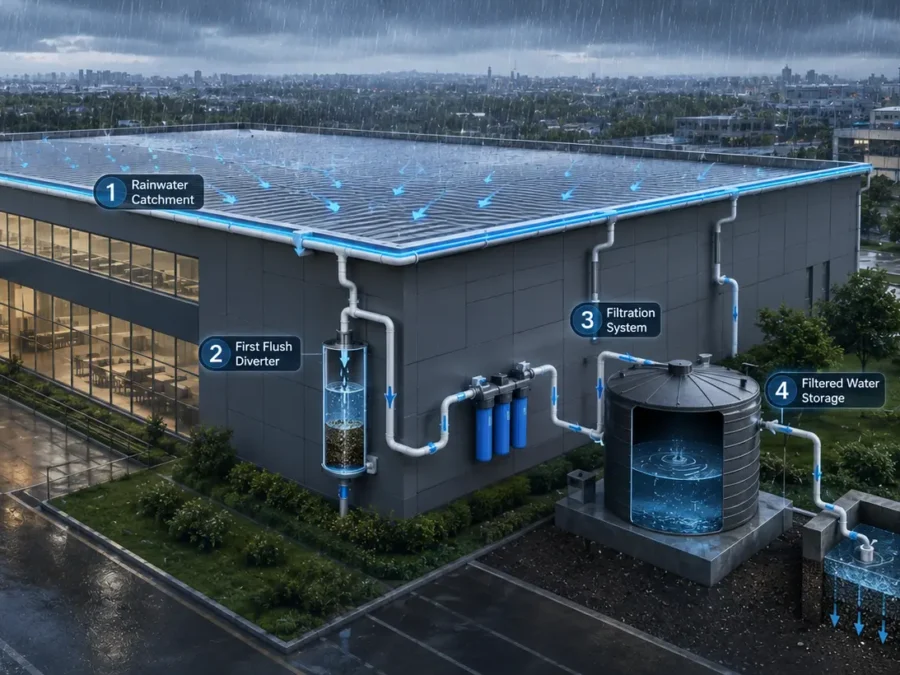
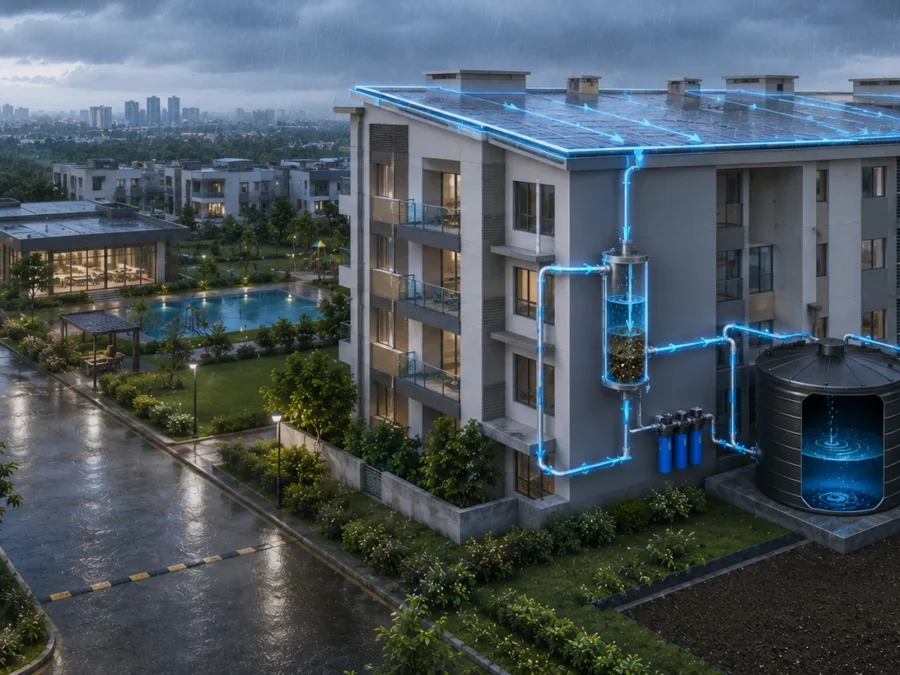
If your building or colony has a rainwater harvesting system, do not wait for the first rain to find out it is clogged. Pre-monsoon inspection is essential. Check the catchment area for debris, clean filters, verify that recharge pits are not silted up, and ensure piping is intact and directed correctly.
A neglected RWH system is worse than no system at all. It gives false confidence while delivering zero recharge. If you do not have an RWH system, the months before the monsoon (March to May) are the time to design and install one. Every square metre of rooftop in India receives roughly 0.9 million litres of rainwater per year. That water can recharge borewells, fill storage tanks, or irrigate gardens.
Step 3: Recharge Groundwater Where You Live
Rainwater does not stay on the surface for long. The most reliable way to store monsoon water is to put it back underground. Recharge pits, recharge wells, and borewell recharge structures allow rainfall to percolate into aquifers. Once underground, water is protected from evaporation and contamination, and it stays available for extraction year-round.
India extracts around 241 BCM of groundwater annually, the highest in the world. Aquifers in states like Punjab, Haryana, and Rajasthan are being depleted faster than they can recharge. Every recharge structure installed in a residential colony, factory, or campus directly offsets this extraction deficit.
Step 4: Reuse Treated Water Instead of Discharging It
If your site has a sewage treatment plant (STP) or Effluent Treatment Plant (ETP), the treated water coming out is a resource, not waste. Treated water can be used for gardening, toilet flushing, cooling towers, vehicle washing, and dust suppression. A factory that reuses its STP water for process cooling can cut its freshwater demand by 30 to 50%.
The concept is called “fit-for-purpose” reuse: matching water quality to the end use. Drinking water quality is not needed to water a lawn or cool a machine. Routing treated water to non-potable applications is one of the highest-ROI water investments a facility can make.
Step 5: Get Expert Help and Plan for the Long Term
Water management is not a one-time project. It is an ongoing practice. Annual maintenance of RWH systems, periodic water audits, and regular monitoring of groundwater levels are what separate sites that thrive from sites that scramble every summer.
EcoLive’s Annual Maintenance Contracts cover pre-monsoon inspections, filter and recharge-pit cleaning, post-monsoon performance checks, and an annual “litres harvested” report. For RWAs and factories that want water independence, an AMC is the most practical way to ensure their systems deliver year after year.
Start with a free assessment. Use the Water Balance Optimiser to simulate your site’s existing water balance and see what the 4R framework could do. Or try the Runoff Calculator to estimate how much rainwater your rooftop can harvest.
The Full Truth: Water Shortage Is a Management Problem, Not a Climate One
Heat accelerates evaporation. Evaporation drives rainfall. Rainfall is abundant in India. The shortage exists because we do not capture, store, recharge, or reuse enough of what we receive. That is the full picture, and it is actually more empowering than the half-truth that headlines sell.
Because if the problem were only climate, we would be helpless. But when the problem is management, it means the solution is in our hands. Every building, colony, factory, and campus can take action: reduce demand, prepare for the monsoon, recharge groundwater, and reuse treated water. The technology exists. The methods are proven. The only thing missing is the decision to act before the next summer crisis hits.
Frequently Asked Questions
Does rising temperature actually reduce rainfall in India?
Not necessarily. Higher temperatures increase evaporation, which puts more moisture into the atmosphere. The IMD reported that India’s 2025 monsoon season was above normal. The relationship between temperature and rainfall is complex, but India has not seen a systematic decline in total monsoon rainfall. The problem is that rainfall is unevenly distributed and poorly captured, not that there is less of it overall.
How much of India’s rainfall is actually harvested?
According to NITI Aayog data, India captures only about 8% of its annual rainfall. The rest runs off into drains, rivers, and the ocean. This is among the lowest capture rates in the world. By comparison, water-scarce countries like Israel capture over 80% through aggressive collection, treatment, and reuse.
Can individual buildings really make a difference?
Yes. A single residential colony of 200 flats with a functional RWH system can harvest 10 to 20 million litres per year. Across 1,150 projects, EcoLive has documented over 652 million litres of water saved. When thousands of buildings do this, the cumulative impact on groundwater levels and urban water supply is significant.
What is the best time to install or service an RWH system?
The ideal window is March to May, before the monsoon arrives. This gives enough time for site assessment, design, installation, and commissioning. For existing systems, pre-monsoon inspection and cleaning should happen in April or May to ensure everything works when the first rains arrive. EcoLive’s AMC service covers exactly this timeline.
Is water conservation only for summer?
No. Water conservation is a year-round discipline. Reducing daily demand, reusing treated water, and monitoring consumption matter in every season. Pre-monsoon preparation happens in spring, harvesting happens during the monsoon, and conservation continues through winter. Sites that manage water 365 days a year never face the summer panic that others experience.
Ready to stop worrying about summer water shortages? Start with a free water assessment from EcoLive. Call +91 9871472211 or visit ecolive.in.