How Water Pricing in India Actually Works (2026 Guide)
Every day, urban India generates 72,368 million litres of sewage, and only 28% is treated. As groundwater levels drop, the cost of fresh water is rising sharply. For facility managers and RWA secretaries, understanding water pricing in India is the first step to reducing monthly operational costs.
TL;DR: Water pricing in India varies wildly between municipal supply, private tankers, and flat-rate billing. Buildings that rely on tankers pay a massive premium. By implementing the 4R framework and metering consumption, commercial sites can cut their water costs by up to 60%.
Why is water pricing in India so complex?
Water pricing structures in India are complex and clumsy. Municipalities often distinguish between metered and unmetered connections, applying different rates based on property type. This lack of uniform volumetric billing means many buildings pay flat fees regardless of actual consumption, hiding the true financial cost of leaks and waste.
How much does tanker water cost compared to municipal supply?
Tanker water is significantly more expensive than piped municipal supply. For example, official bulk supply rates might be low, but private tanker lorry supply can cost a Rs. 76.15 rate per 1000 litres or much higher during peak summer months. Buildings without adequate rainwater harvesting systems are forced to rely on these expensive private tankers when borewells run dry.
The true cost of commercial water dependence
When a factory or large residential complex runs out of water, they turn to private tankers. This creates a volatile operational expense. You can easily see how commercial buildings can cut water tanker costs by capturing rain and reusing treated effluent.
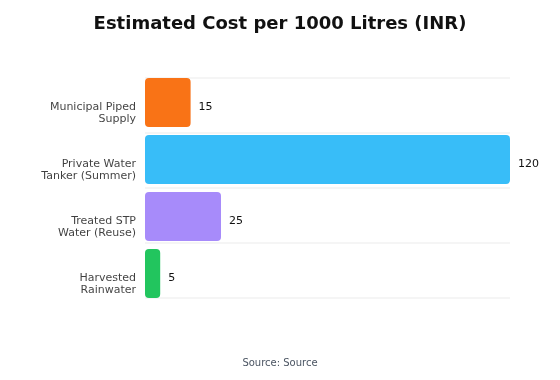
Note: Costs vary by city and season. Tanker prices often double during May and June.
What is non-volumetric water pricing in India?
Non-volumetric pricing charges a flat fee based on property size or crop area rather than the actual volume of water used. In the agricultural sector, charging on an area basis is widely used due to its simplicity. Experts suggest that output-based pricing methods might be applied to balance equity, but for urban commercial buildings, flat rates remove the financial incentive to conserve water.
Taking control of your site’s water balance
You cannot manage what you do not measure. Installing smart water metering is the most effective way to track consumption and identify expensive leaks. Once you know your baseline, you can use a Water Balance Optimiser to model how much money you could save by routing treated water back into cooling towers or flushing systems.
The goal is to achieve a closed-loop water balancing system. When you reduce demand, reuse treated water, recycle effluent, and recharge the ground, your exposure to volatile water pricing drops to near zero.
Ready to cut your tanker bills? Request a water assessment today. Call +91 9871472211 or visit ecolive.in.
FAQ
Why is water pricing in India so complex? Water pricing structures in India are extremely complex because municipalities use a mix of metered and unmetered connections, flat rates, and property-based taxes. This varied approach makes it incredibly hard to track the true cost per litre.
How much does tanker water cost in India? Tanker water costs vary heavily by city and season, often ranging from Rs. 75 to over Rs. 150 per 1000 litres during peak summer months. This makes it significantly more expensive than standard municipal supply.
What is non-volumetric water pricing? Non-volumetric water pricing charges a flat fee based on property size or area rather than the actual volume of water consumed. This system removes the financial incentive for buildings to actively conserve water.