How India’s Carbon Credit Trading Scheme Makes Water a CFO Problem
Every day, urban India generates 72,368 million litres of sewage, and pumping, treating, or discharging that water consumes massive amounts of electricity. For years, facility managers treated water and energy as separate budgets. That separation ended when the government introduced the Carbon Credit Trading Scheme (CCTS), granting the power to issue carbon credit certificates for emission reductions. Suddenly, the energy wasted on inefficient water management is a measurable financial liability.
TL;DR: The Indian Carbon Credit Trading Scheme turns greenhouse gas emissions into tradable financial assets and liabilities. Because pumping, treating, and heating water accounts for up to 30% of a facility’s energy use, poor water management now directly impacts a company’s carbon compliance. CFOs and ESG Directors must align their water balance with their carbon strategy to avoid financial penalties and capture new trading value.
What is the Carbon Credit Trading Scheme in India?
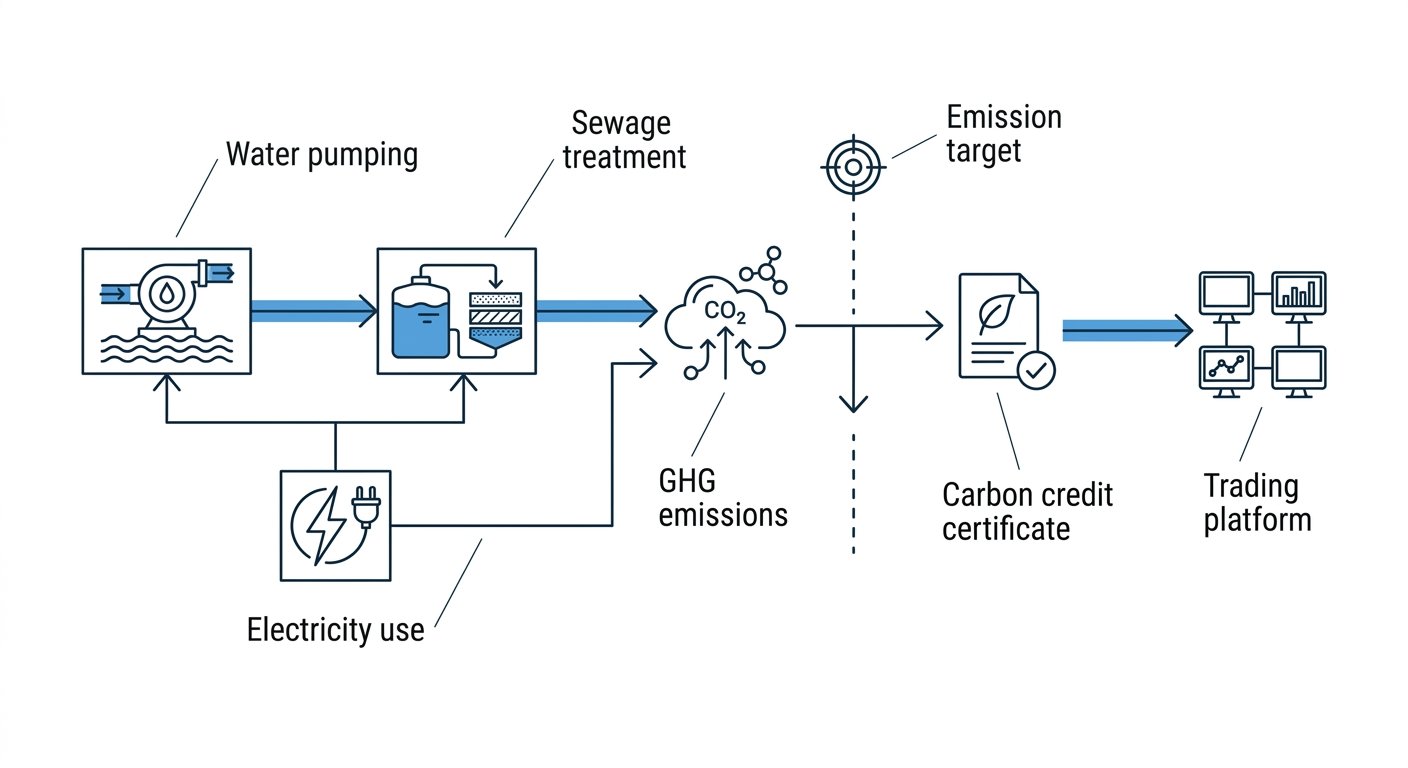
The Carbon Credit Trading Scheme is India’s national framework for pricing greenhouse gas emissions and trading carbon credits. Aligned with the Energy Conservation Act of 2001, the scheme was launched promptly in 2023 to help the country reach net-zero emissions. It requires designated energy-intensive industries to meet specific emission targets. Companies that emit less than their target earn certificates, while those that exceed it must buy them.
The mechanism operates through a centralized registry. The certificates are issued on the Indian Carbon Market registry and can be traded over an electronic trading platform. This creates a direct financial incentive for companies to audit every operation that consumes power. Because water infrastructure is incredibly energy-intensive, it is now one of the first places auditors look when calculating a facility’s total carbon footprint.
Why does the Carbon Credit Trading Scheme suddenly involve water metrics?
Carbon compliance involves water metrics because moving and treating water requires immense electrical power, which in India is still largely generated from fossil fuels. When a factory pumps groundwater from a deep borewell, runs a reverse osmosis plant, or operates a sewage treatment plant, it burns electricity. Every kilowatt-hour drawn from the grid adds to the facility’s carbon ledger.
For ESG Directors, this creates a convergence between two massive compliance pillars. The BRSR water disclosure requirements already force top listed companies to report their water consumption and discharge. Now, the carbon scheme attaches a strict financial weight to the energy used to manage that water. You cannot optimize your carbon position without optimizing your water balance. Pumping water from 500 feet below ground takes significantly more energy than reusing treated water that is already at surface level.
How much carbon does your water infrastructure actually emit?
Water infrastructure emits carbon based on the volume processed and the treatment intensity required. Pumping groundwater from a deep aquifer is highly energy-intensive. Running a Zero Liquid Discharge plant boils away water to leave solid waste, consuming massive amounts of thermal and electrical energy.
To understand the financial exposure under the new trading scheme, facility managers must map the carbon equivalent of their water operations. The table below outlines the typical energy intensity of common industrial water processes and their estimated carbon footprint.
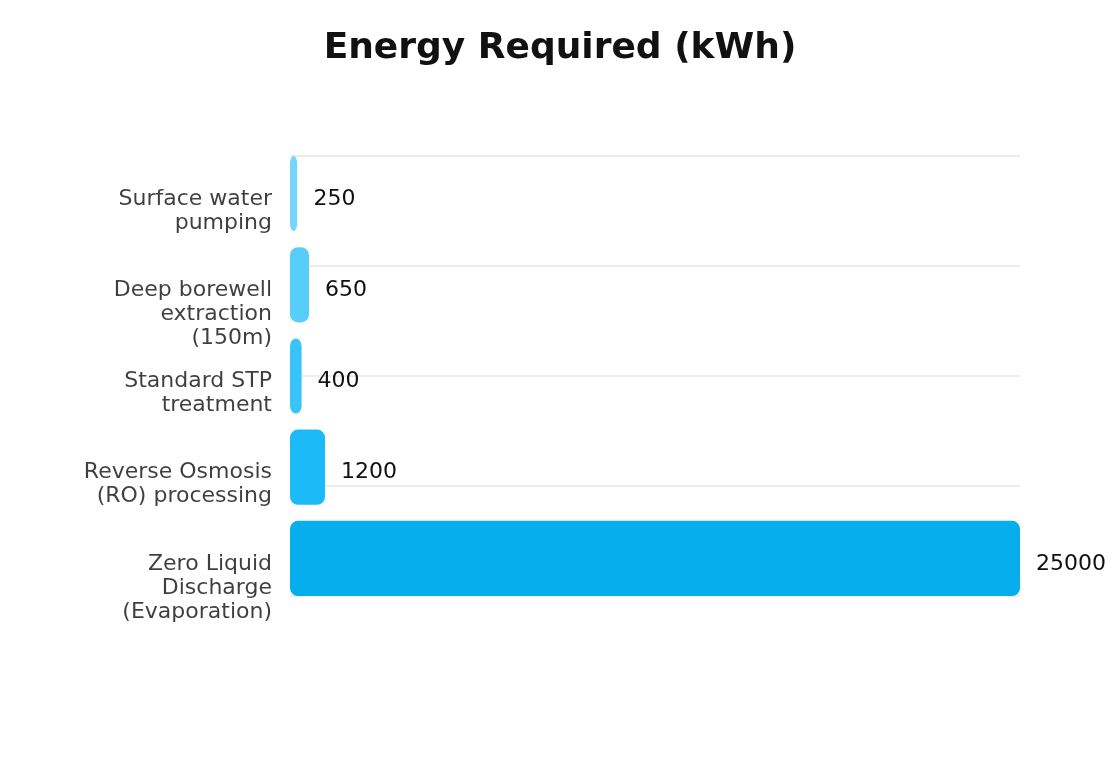
Note: Carbon equivalent assumes an average Indian grid emission factor of approximately 0.72 kg CO2e per kWh.
This data reveals why a CFO must care about water. If a factory relies entirely on deep borewells and runs a highly inefficient effluent plant, its carbon liability grows every single day.
What does the carbon scheme mean for your ESG reporting?
The carbon scheme means your ESG reporting is no longer just a corporate communications exercise; it is a financial disclosure. The scheme includes a voluntary offset market open to all entities, allowing companies to monetize their sustainability upgrades. When you report your water metrics under BRSR Core, auditors will cross-reference those figures with your energy consumption and carbon claims.
If you claim to be reducing your carbon footprint but your water extraction volumes remain high, the data will contradict itself. The CGWB groundwater extraction guidelines already put pressure on industries to reduce reliance on borewells. Now, the carbon market adds a penalty for the energy used to pump that water. Companies must present a unified data set where water reduction directly translates to verifiable carbon reduction.
How can factories reduce their water-related carbon footprint?
Factories can reduce their water-related carbon footprint by adopting the 4R framework: Reduce, Reuse, Recycle, and Recharge. The fastest way to cut the energy used for pumping water is simply to need less of it. Implementing industrial water reuse allows a facility to loop treated wastewater back into cooling towers or process lines.
Surface-level reuse bypasses the need to draw from deep aquifers. When a facility successfully implements STP water reuse, it eliminates the energy cost of pumping fresh groundwater and the energy cost of discharging waste long distances. Furthermore, capturing rainwater through scientific rooftop harvesting provides the lowest-carbon freshwater available. Rainwater falls by gravity; it requires zero extraction energy.
Why treating water as a financial asset changes the ROI math
Treating water as a financial asset changes the ROI math because the payback period for conservation systems now includes carbon savings. Historically, facility managers struggled to get budgets approved for rainwater harvesting or advanced recycling because water itself was relatively cheap. The capital expenditure looked too high compared to the monthly municipal or tanker bill.
The carbon trading scheme alters that calculation entirely. The framework exists to support various entities by pricing their additional actions toward emission reductions. When you install a water recycling system today, you save on the freshwater purchase price, you save on the pumping electricity, and you generate potential carbon credits by lowering your total energy demand. A project that used to take five years to pay for itself might now break even in two.
What should ESG Directors and Facility Heads do next?
ESG Directors and Facility Heads must immediately audit their water-energy nexus. You cannot manage what you do not measure. The first step is to install smart metres not just on the main water inlet, but on the energy feeds for all major pumps and treatment plants.
Next, run a complete water balance assessment. Identify exactly where water is lost to evaporation, leaks, or inefficient discharge. Calculate the energy cost of those losses. Once you have the baseline, design a 4R intervention that targets the most energy-intensive water processes first. By addressing water and carbon as a single engineering challenge, you protect your company from compliance risks and turn a mandatory expense into a measurable asset.
FAQ
What is the Carbon Credit Trading Scheme in India? The Carbon Credit Trading Scheme (CCTS) is India’s national framework for pricing greenhouse gas emissions. It sets emission targets for designated industries and allows companies to trade carbon credit certificates based on their performance against those targets.
How does water management affect a company’s carbon footprint? Water management affects a carbon footprint because pumping groundwater, running treatment plants, and processing wastewater consume massive amounts of electricity. In India, this electricity is largely fossil-fuel based, meaning high water use directly equals high carbon emissions.
How does the CCTS impact BRSR water reporting? The CCTS turns ESG reporting into a financial disclosure. Auditors will now cross-reference your BRSR water consumption data with your energy use. If your water extraction is high, your energy use and carbon liabilities will reflect that, making inaccurate reporting a financial risk.
What is the most energy-intensive water process in a factory? Zero Liquid Discharge (ZLD) systems and deep borewell extraction are highly energy-intensive. ZLD often requires boiling wastewater to evaporate it, consuming up to 25,000 kWh per million litres, which translates to a massive carbon liability.
How can the 4R framework reduce carbon compliance costs? The 4R framework (Reduce, Reuse, Recycle, Recharge) lowers carbon costs by replacing energy-intensive deep groundwater pumping with gravity-fed rainwater harvesting and surface-level treated water reuse, significantly dropping the facility’s total power demand.