
What Is Water Budgeting in India? The 2026 Guide for Buildings
In December 2025, the Indian government introduced a new national framework that changes how communities measure their water. NITI Aayog launched a data-driven tool to boost local water security across the country. The concept, known as water budgeting in India, sounds like an accounting term, but it is actually an engineering reality.
Most buildings treat water as an endless utility. You open the tap, water comes out, and you pay the bill. But as water efficiency becomes a priority, facility managers and Resident Welfare Associations (RWAs) are realizing that water is a finite resource that requires strict accounting. Water budgeting takes the guesswork out of water management by measuring exactly what comes in and what goes out. For example, we recently helped a commercial park save 12 million litres annually and completely eliminate their tanker dependency. Here is how the process works.
TL;DR: Water budgeting is a framework that measures a site’s total water input against its total consumption and loss. By calculating this balance, buildings can identify exact deficits, size their rainwater harvesting systems accurately, and use the 4R framework (Reduce, Reuse, Recycle, Recharge) to eliminate expensive tanker dependency.
What is water budgeting in India?
Water budgeting in India is the practice of measuring a specific area’s total water availability against its total water demand. Is the site using more water than it receives? If the answer is yes, the site is running a water deficit.
The equation is straightforward. You calculate total rainfall input and subtract surface water flows, groundwater extraction, and evapotranspiration rates. What remains is your actual available water. For a commercial building or a residential colony, this means mapping every drop of municipal supply, borewell extraction, and purchased tanker water against daily consumption and sewage discharge. When you know your exact deficit, you can engineer a specific solution to close it.
Why is the government pushing water budgeting in India now?
The government is prioritizing water budgeting because India captures barely 8% of its annual rainfall. The rest washes away as surface runoff. This creates a massive imbalance where cities extract groundwater faster than the monsoon can replenish it.
To correct this, NITI Aayog’s framework aims to build climate resilience at the block level. The Ministry of Rural Development also noted that water budgeting helps align local practices with available resources. While the initial focus targets rural and agricultural zones through initiatives like Crop Water Budgeting, the exact same mathematics apply to urban infrastructure. A factory or a housing society cannot optimize its seasonal water strategy without knowing its baseline numbers. You cannot manage what you do not measure.
How does a water budget differ from a water audit?
A water audit looks for leaks and inefficiencies within your existing plumbing. A water budget looks at the entire site’s ecological footprint. Both are necessary, but they serve different purposes for facility managers.
An audit might tell you that a leaking valve wastes 500 litres a day. A budget tells you that your rooftop receives 2 million litres of rain annually, but your borewell extracts 3 million litres. To understand your full compliance requirements, you must review the water conservation mandate for India 2026.
How do you calculate a building’s water budget?
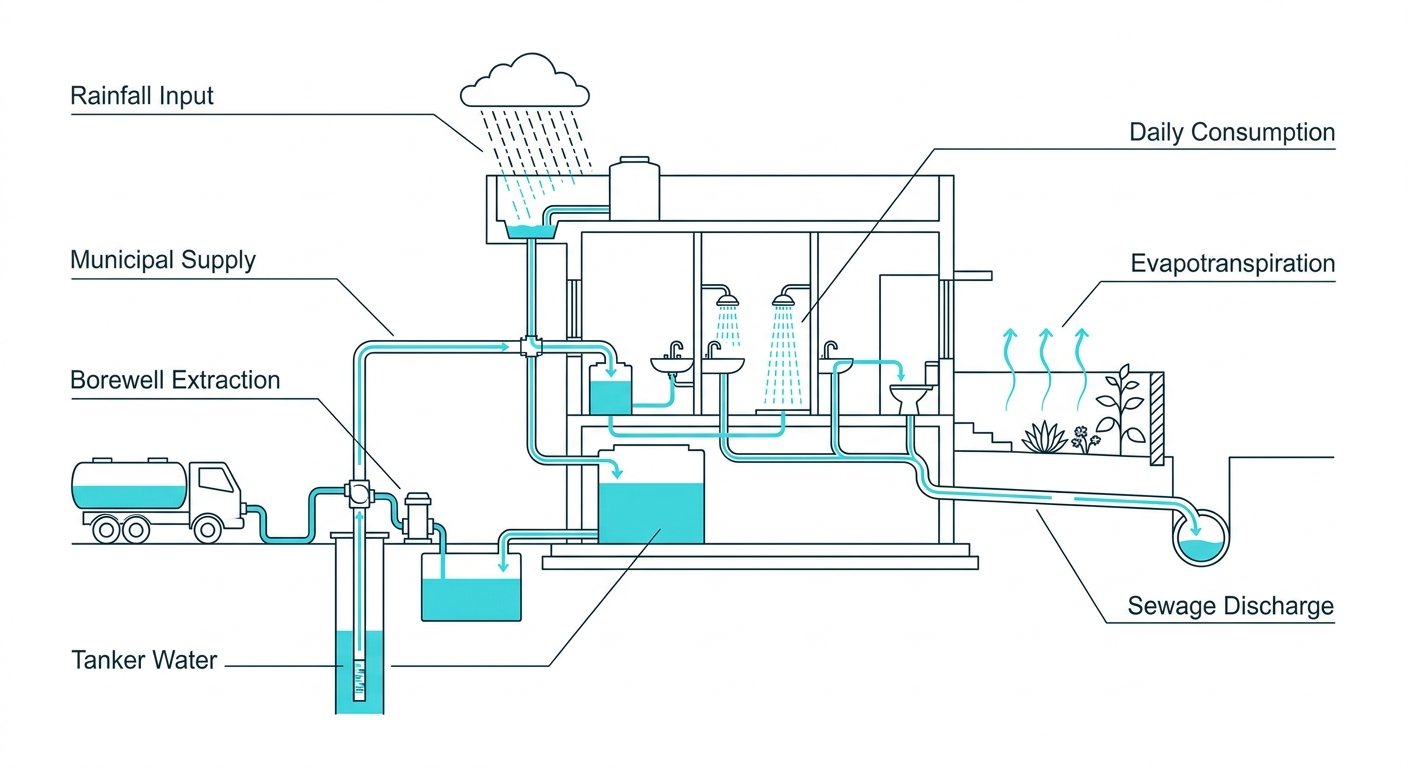
You calculate a building’s water budget by mapping three distinct data points: total input, total demand, and total discharge. You do not need complex software to start this process. You need twelve months of utility bills, your tanker receipts, and your total roof area.
First, measure your demand. Track your municipal metre readings, borewell logs, and tanker invoices. Second, calculate your natural input. Multiply your total catchment area (roofs and paved surfaces) by your city’s average annual rainfall. Third, measure your discharge. How much treated water leaves your Sewage Treatment Plant (STP) every day? The gap between your natural input and your daily demand is your deficit. This deficit dictates exactly how large your rainwater harvesting system needs to be. For a deeper look at system choices, compare RWH vs borewell options.
The 4R Framework: Closing the water budget gap
Once you know your water budget, you need a method to balance it. EcoLive uses the 4R framework to turn deficits into surpluses. This is an engineering approach that treats water as a circular resource.
Reduce The first step is lowering baseline demand. This involves installing aerators, fixing hidden leaks, and optimizing cooling towers. Reducing demand shrinks the total budget you need to balance. Every litre you do not use is a litre you do not have to buy or pump.
Reuse Most buildings flush their treated STP water down the municipal drain. This is a massive financial loss. By routing treated water back into dual-plumbing systems for flushing or landscaping, a building can cut its freshwater demand by up to 30%.
Recycle Industrial facilities generate heavy effluent. Recycling involves advanced treatment processes like RO and Zero Liquid Discharge (ZLD) to recover water for production lines. This directly offsets expensive tanker purchases.
Recharge The final step balances the natural ledger. You capture the monsoon rain that hits your roof and direct it into engineered recharge pits. This replenishes the aquifer beneath your building. For a complete breakdown of this methodology, read our guide on the 4R framework and water balance.
What happens when a building ignores its water balance?
Buildings that ignore their water balance face unnecessary operational costs. When you extract water without measuring the recharge rate, you miss the chance to build long-term water security.
Without a budget, facilities often over-rely on external tankers. Pumps work harder and consume more electricity. RWAs end up purchasing private tanker water at premium rates. A typical 200-flat society in Delhi NCR can easily spend over ₹2 Lakh per month on tankers during peak summer. This is entirely avoidable. By understanding your budget, you can implement strategies to reduce tanker water dependency in Gurgaon offices and residential societies.
How community tools support water governance
The push for water budgeting is gaining traction because new tools make it accessible. Organizations are rolling out practical community-based tools to improve governance at the local level.
These platforms help users understand their exact water availability. For example, the WOTR water budgeting tool supports villages in planning their annual usage. EcoLive brings this exact level of precision to the urban sector. We provide interactive calculators that model your building’s runoff potential and simulate your post-4R water balance. When facility managers have hard data, they stop guessing and start engineering real solutions.
How to start your water budgeting process today
Starting a water budget requires a commitment to measurement. Do not wait for peak summer demand to begin tracking your numbers. Start by gathering your basic data points today.
Collect your water bills, STP logs, and a site plan showing your roof area. If you do not have metering on your borewells, install them immediately. You cannot balance a budget if you do not know your starting balance. Once you have your baseline data, partner with an engineering firm that measures outcomes rather than just installing hardware. A verified water budget protects your budget, your borewell, and your building’s future value.
FAQ
What is water budgeting in India? Water budgeting in India is the practice of measuring a specific area’s total water availability against its total water demand. It calculates rainfall input against consumption and surface flow to determine the exact water deficit of a building or community.
How do you calculate a building’s water budget? You calculate a building’s water budget by mapping total input, total demand, and total discharge. Measure your municipal supply and borewell extraction, calculate your roof’s rainwater catchment potential, and track your STP discharge to find the gap.
What is the difference between a water audit and a water budget? A water audit focuses on internal plumbing efficiency and finding leaks to save daily litres. A water budget looks at the entire site’s ecological footprint, comparing annual rainfall and groundwater extraction against total annual consumption.
How does the 4R framework fix a water deficit? The 4R framework fixes water deficits by Reducing baseline demand, Reusing treated STP water for flushing, Recycling industrial effluent, and Recharging natural aquifers with harvested monsoon rainwater.
If you need help calculating your site’s exact water deficit, EcoLive can map your entire water cycle. We measure the input, engineer the 4R solution, and verify the results.
Ready to calculate your building’s water balance? Call +91 9871472211 or visit ecolive.in to request a comprehensive water assessment today.