How Much Does Harvesting Rainwater Cost for an Office Campus?
An office campus relying on tankers can easily spend ₹1 lakh a month just to keep the washrooms running and the cooling towers topped up. Over five years, that is ₹60 lakh paid for water that falls on your roof for free. Harvesting rainwater is the engineering fix to this constant drain on operational budgets.
TL;DR: Designing and installing a commercial rainwater harvesting system typically costs between ₹2 lakh and ₹15 lakh, depending on the roof catchment area and recharge depth. Most office campuses see a full return on investment in 12 to 24 months through reduced tanker dependence and lower municipal water bills.
What drives the cost of harvesting rainwater?
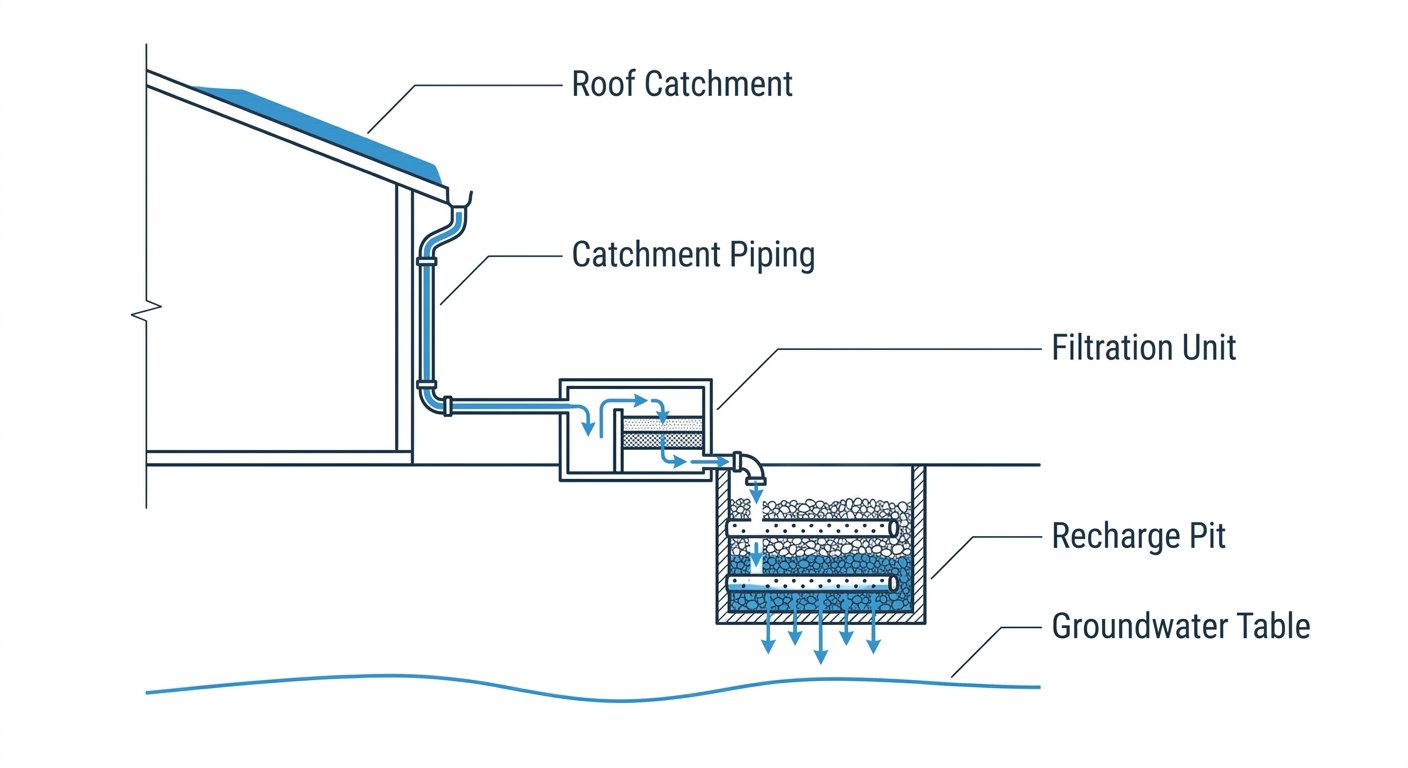
What drives the cost of harvesting rainwater? The price of a system depends directly on your catchment area, the volume of runoff, and the depth required for groundwater recharge. A 50,000-square-foot office roof generates significantly more runoff than a small commercial building, requiring larger filtration units and deeper recharge pits to handle the monsoon surge.
The Rainwater Harvesting infrastructure you need is dictated by the India Meteorological Department (IMD) rainfall data for your city. Capturing 75% of your annual rain in just four monsoon months means the system must be sized for peak flow, not average flow.
Rainwater harvesting cost breakdown
Here is a realistic look at what an office campus in cities like Gurugram or Jaipur can expect to invest. These figures cover end-to-end design, civil work, filtration, and commissioning.
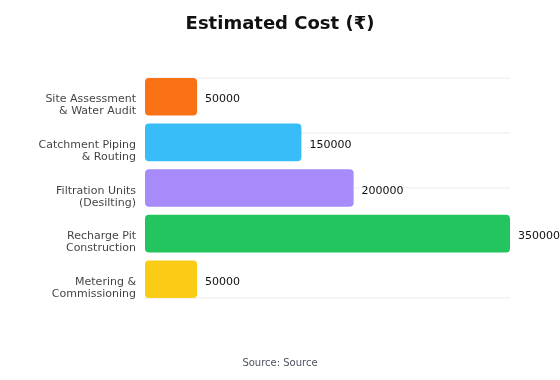
Note: These are baseline estimates for a mid-sized campus. Use a Runoff Calculator to understand your exact catchment potential.
How much can rainwater water harvesting save?
How much can rainwater water harvesting save? A properly sized system can cut commercial tanker costs by 30% to 60% annually. For a campus spending ₹1 lakh monthly on tankers, capturing and reusing rainwater can recover up to ₹6 lakh a year, directly improving the facility’s bottom line while securing water for dry months.
This is the core of the 4R framework: Reduce, Reuse, Recycle, and Recharge. When you stop treating rain as a drainage problem, you start treating it as an asset.
What is the payback period for an office campus?
Most facility managers are judged on payback periods. The math for a commercial rainwater system is straightforward. If your installation costs ₹8 lakh and you reduce your tanker dependence by ₹40,000 a month, the system pays for itself in 20 months. Every litre harvested after that is free water.
This financial return makes BRSR water compliance much easier to justify to the board. You are not just spending money to meet a mandate; you are investing capital to permanently lower operating expenses.
Why do cheap systems fail in two years?
Why do cheap systems fail in two years? Compliance-driven adoption produces weak systems that fail quickly because they are built to pass an inspection, not to handle real monsoon runoff. When building owners choose the lowest bidder, they get undersized filters that clog with silt, turning the recharge pit into a stagnant puddle.
Our ancestors harvested rain by choice, not because of a government notice. They built systems to last. Today, a system requires an annual maintenance contract (AMC) to clean the filters and check the recharge rates before the monsoon hits. Skipping this step guarantees failure.
Ready to stop paying for water that falls on your roof? Call EcoLive at +91 9871472211 or visit ecolive.in to request a commercial water assessment.