Corporate Water Stewardship India: What Must Change?
Saint-Gobain’s World Glass Complex in India connects water stewardship with recycling systems and treatment plants, as its project account describes. That gives corporate teams a useful starting point: examine what happens to water after it enters your site. For an ESG director or facility head, the next question reaches further. Does your water programme improve conditions around the site, and can you show how?
TL;DR: Corporate water stewardship connects a company’s water use with the sources, people and drainage systems around its sites. Start with a measured water balance, examine shared water conditions, and apply Reduce, Reuse, Recycle, Recharge. Track operational results and local outcomes separately. Support every public claim with evidence and clear boundaries.
Step 1: What does corporate water stewardship India add to efficiency?
Corporate water stewardship adds shared water conditions to the decisions you already make about consumption, treatment and reuse. Efficiency examines how much water your operation needs. Stewardship also examines where that water comes from, where it goes, and who else depends on the same source.
Inogen Alliance’s stewardship comparison makes this distinction explicit. Its discussion connects stewardship with managing risk and strengthening community relationships. Your facility’s performance remains central, but the assessment extends beyond the boundary wall.
A factory can reduce freshwater intake while still releasing water that needs further treatment. An office campus can install efficient fixtures while its paved surfaces send rain towards a crowded public drain. Each site has improved something. Each still has another water question to answer.
For your sustainability team, this changes the scope of the brief. Ask the facility manager to explain source reliability, discharge quality and runoff routes alongside consumption. Ask procurement what evidence supports a supplier’s water origin.
Does a lower meter reading tell you whether the surrounding groundwater source is recovering? It doesn’t answer that question on its own.
EcoLive’s 4R water-balance framework provides the operational foundation. This article builds on that foundation by connecting site decisions with shared water conditions, responsibilities and evidence.
Step 2: How do you set a boundary that matches the water source?
Set the assessment boundary around the site and the water sources, discharge routes and affected neighbours connected to it. A fence defines property ownership. It doesn’t define how groundwater moves, where runoff travels, or which communities depend on the same supply.
Begin with a source map. Identify municipal connections, borewells, delivered water, collected rainwater and incoming treated water. Record what you know about each source and mark the gaps clearly.
Delivered water deserves particular attention. A delivery receipt proves that water arrived. It may provide little evidence about the original source, its permissions or its long-term condition. Procurement should request source information rather than treating the supplier’s vehicle as the start of the water chain.
Next, trace outgoing water. Follow treated wastewater, process discharge, stormwater and overflow to their actual destinations. Check the drawings against the physical pipes. A labelled outlet on an old plan may no longer match the site.
The surrounding area matters too. Speak with the people responsible for nearby drains, shared infrastructure and local water services. Record what they observe without presenting every complaint as a confirmed engineering finding.
For a Gurugram campus, that may mean examining how roof runoff reaches the road outside. For a factory, it may mean understanding the water source shared with neighbouring users.
This boundary gives your corporate water stewardship India programme a practical focus. You can identify direct responsibilities, shared concerns and areas that require cooperation.
Step 3: What evidence should you gather before choosing a project?
Gather evidence of water entering, moving through and leaving the site before selecting equipment. Your baseline should connect meter readings, operating records, water-quality tests and physical inspections. Keep measured values separate from estimates so decision-makers can see what the evidence supports.
Start with the existing water-budgeting approach. Then add the information a stewardship decision needs: source identity, discharge destination, seasonal operating conditions and the people responsible for each record.
A useful evidence file contains:
- Incoming water records, with the source named.
- Consumption records for major uses.
- Treatment logs and maintenance records.
- Water-quality results relevant to intended reuse.
- Reuse routes and the demand they can serve.
- Rainwater collection routes, overflows and drainage connections.
- Source and discharge questions awaiting investigation.
Give each record an owner. Facility staff may handle meter readings and maintenance logs. Procurement may hold supplier documents. The sustainability team should connect these records without quietly filling gaps with assumptions.
Avoid comparing sites before checking their boundaries. A manufacturing unit and an office can report similar withdrawals while serving very different activities. Changes in production or occupancy also affect interpretation.
Allegiance India’s corporate guidance identifies monitoring and water audits as practical actions. Use that starting point to build an evidence trail your operations team can maintain.
What happens when readings disagree? Investigate the meters, recording periods and system boundaries before announcing a saving.
Step 4: How should the 4R framework guide your interventions?
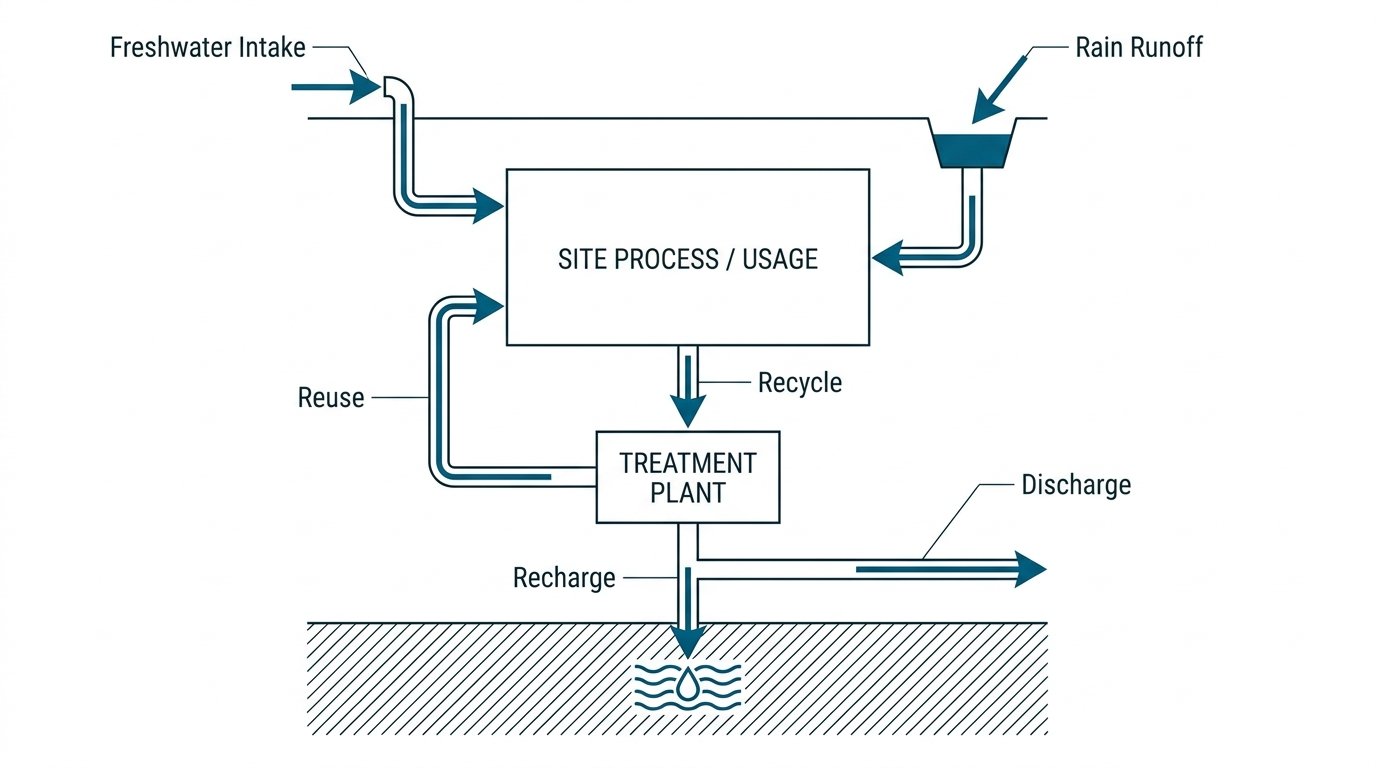
Apply Reduce, Reuse, Recycle, Recharge as a connected plan that matches the site’s water needs and local conditions. Start with avoidable demand, then examine suitable reuse and treatment. Assess rainwater collection and recharge alongside water quality, ground conditions and peak rainfall.
Reduce means finding demand you can avoid without compromising the operation. Inspect leaks, unnecessary washing, unsuitable fixtures and poorly controlled equipment. Confirm the cause before changing the process.
Reuse means directing suitable water to another use. The receiving activity determines the required quality. Keep potable and non-potable networks clearly separated, with identification and operating controls.
Recycle means treating water so it can serve a defined purpose again. Choose the treatment around the intended use. A treatment plant’s presence doesn’t establish that its output is suitable for every process.
Saint-Gobain’s water stewardship account offers a relevant industrial reference because it discusses recycling and treatment. It doesn’t provide a performance guarantee for your facility.
Recharge requires a suitable route for clean water to enter the ground. Examine geology, contamination risks, filtration, maintenance access and relevant permissions before choosing a structure. EcoLive’s guide to factory groundwater recharge develops that site-specific question.
For rainwater harvesting (RWH), design conveyance and overflow around peak hourly or daily rainfall. Annual rainfall can inform potential collection, but it cannot establish whether a pipe handles an intense storm.
Treat RWH as a conscious infrastructure choice that supports water conservation and better runoff management. Judge its design by those outcomes and its maintenance needs.
Step 5: How do you connect site action with neighbouring water needs?
Connect site action with neighbouring needs by identifying a shared concern, agreeing who can act, and defining the evidence of improvement. Keep your operational work and community projects distinct. Explain how they relate without treating a community activity as proof of better site performance.
Start with a conversation about the actual concern. Residents may describe road flooding, unreliable supply or poor water quality. Local authorities and technical teams can help determine the causes and feasible actions.
Coca-Cola India Foundation’s community partnerships describe working with local NGO partners around community water needs. That supports a partnership approach. It doesn’t establish that a similar activity will produce the same outcome elsewhere.
CSR Times’ stewardship discussion places corporate environmental work within a CSR context. For water projects, the practical question is who will operate and maintain the asset after the funded work ends.
Agree that responsibility before construction. A community tank needs an operating arrangement. A restored collection route needs protection from later blockage. A recharge structure needs access for inspection and cleaning.
Corporate teams should also examine their own contribution to the shared concern. Funding a local water project doesn’t resolve a blocked campus outlet or an unsuitable discharge.
Keep the evidence proportionate. Record the work completed, the operating condition and any measured outcome. Describe unresolved causes openly. This gives both the company and its partners a clear basis for the next decision.
Turn the findings into an operating plan
An operating plan turns each finding into a named action, an owner and a condition for completion. It should show what the facility team can handle, what needs specialist assessment, and what requires agreement beyond the site.
Keep the plan close to the equipment and records it concerns. “Improve water management” gives a maintenance supervisor little direction. “Inspect the treated-water line and confirm its destination” names a task someone can complete.
Separate routine work from investment decisions. A leaking valve may need a maintenance instruction. A new reuse network needs quality requirements, drawings, demand assessment and operating arrangements. A shared recharge project may also need permissions and partner responsibilities.
Give every proposed project an acceptance condition. For reuse, that includes suitable water quality and a working route to the intended demand. For RWH, it includes clean collection paths, suitable filtration, accessible maintenance and a safe overflow route.
Keep compliance requirements visible within the plan. EcoLive’s BRSR water-compliance guide covers the reporting context. The operating plan should explain the physical action behind the reported number.
Budget for maintenance and evidence collection alongside installation. Decide who will record performance and where those records will live. A system handover should include the information your own team needs to run it.
The resulting plan gives an ESG director a practical way to work with facilities, procurement and finance. Each team can see its responsibility without receiving an open-ended instruction to “own water stewardship”.
Step 6: What can you claim about corporate water stewardship India?
Claim only the outcome your evidence supports, within the boundary and period you measured. Distinguish water withdrawn, water reused, rainwater collected and groundwater recharge. Explain estimates and assumptions clearly, especially when the result concerns shared sources beyond your site.
A treated-water meter can support a statement about water routed for reuse. It cannot, by itself, establish that the same quantity reduced freshwater withdrawal. Check the receiving demand and the incoming water records.
Likewise, water entering a recharge structure doesn’t directly prove an equivalent increase in available groundwater. Site conditions, movement underground and other users affect the wider outcome.
The Coca-Cola Company’s India projects describe work on replenishment, groundwater recharge and local water security. These are distinct aims. Keep the distinction when defining your own project measures.
Avoid counting the same water repeatedly as separate savings. Water may pass through treatment and reuse before leaving the site. Record those movements, then explain which measure represents the outcome you are claiming.
Certification needs similar care. URS describes AWS consultancy as support for organisations seeking Alliance for Water Stewardship certification. Consultancy support doesn’t establish that your company holds certification.
Before publishing, ask the technical owner to review the claim. Check the boundary, records, calculation and wording together. If the evidence supports an activity rather than an outcome, describe the activity accurately.
Keep the decision file ready for review
A decision file should let a colleague trace a public statement back to the work, records and assumptions behind it. Include the site boundary, current findings, approved actions, operating responsibilities and the evidence available for each claimed result.
Use clear labels for different evidence types. A meter reading, a design estimate and a partner’s activity report answer different questions. Readers should be able to identify each without searching through attachments.
Record changes that affect interpretation. A new production line, altered occupancy or a changed water source can shift consumption. Your team needs that context when comparing reporting periods or explaining a movement.
Bring unresolved questions into the review. A missing supplier record may require procurement follow-up. An uncertain discharge route may need a physical inspection. A local groundwater question may require specialist assessment and broader information.
Maintenance belongs in the same file. Show whether filters, pumps, treatment equipment and recharge structures received the required attention. Completed construction and current operating performance are separate facts.
This file also helps finance assess proposed work. Present the purpose, scope, maintenance burden and evidence expected from the project. Avoid assigning a financial return to recharge or flood-related work without a defensible basis.
For directors, the useful question is whether the company can explain its water decisions and their consequences. A clear file makes that explanation possible.
Frequently asked questions
The answers below separate operational efficiency, shared-source management, certification and reporting. Use them to define your programme before commissioning work or approving public statements.
Is corporate water stewardship only for large companies?
No. Any company can examine its water sources, discharge routes and local connections, although the scope should match its operation. A commercial campus may begin with source records and runoff routes; a factory may need deeper treatment and process assessments.
Does water efficiency automatically make a company water positive?
No. Reduced consumption alone doesn’t establish a water-positive outcome. Such a claim needs a clear definition, boundaries, a method and evidence that supports the stated relationship between water use and replenishment.
Must every corporate water stewardship programme seek AWS certification?
No. Companies can build measured water-management practices without claiming certification. If you choose that route, examine the current standard and assessment requirements before describing the organisation as certified.
Can CSR water projects replace improvements inside the facility?
CSR projects can support community water needs, but they don’t establish better performance inside your facility. Track site withdrawals, treatment, reuse and discharge alongside the community project’s own purpose, responsibilities and evidence.
How does stewardship support BRSR reporting?
Stewardship can strengthen the operational records behind Business Responsibility and Sustainability Reporting (BRSR). Keep the filing requirements distinct from broader source, drainage and community work, and report each measure according to its applicable definition.
Request a Water Assessment
Ask EcoLive to examine your site’s water balance, source records, reuse opportunities and rainwater routes through the 4R framework.
Phone: +91 9871472211
Email: connect@ecolive.in
Website: ecolive.in