Most buildings in India know two numbers about their water: what the tanker bills say, and what the borewell pump’s electricity costs. Everything between those two — how much actually arrives, where it goes, and what quietly leaks away — is guesswork. A water audit is the process that replaces the guesswork with measurements.
This guide covers what a water audit is, what a proper one measures, how audits are actually done, what a good report contains, indicative costs in India, and — the question almost no one answers clearly — how to choose the right agency. If you manage an RWA, factory, hotel, school or corporate campus, this is the starting point for every water decision that follows.
Key Takeaways
- A water audit is a measured account of every source, use and loss on your site — built on the same water-balance logic utilities use worldwide, not a visual inspection.
- The audit’s core deliverable is finding the gap: water purchased and pumped versus water actually accounted for. That gap is leaks, overflow and untracked processes — and it is money.
- Site experience shows meaningful shares of purchased water routinely vanish untracked; you cannot fix what the meter never saw.
- Two levels exist: a preliminary audit (desktop + walkthrough, quick) and a detailed audit (metered measurement, testing, quantified losses).
- Indicative India costs: ₹25,000–₹1,50,000+ depending on site size and depth — cost should buy verified numbers, not a PDF of estimates.
- Choosing an agency: ask eight specific questions (below) — the difference between a checkbox vendor and an auditor who finds your litres.
What Is a Water Audit?
A water audit is a systematic, measured assessment of how water enters, moves through, and leaves your site. The auditor quantifies all inflows — municipal supply, borewells, tankers, recycled water — then maps outflows to every legitimate use: domestic, cooling, process, landscape, flushing. The difference between what came in and what is accounted for is your non-revenue water: leaks, overflows, metering errors and untracked consumption.
The method traces back to the International Water Association’s water balance framework — the same accounting structure utilities use worldwide, adapted to buildings and industrial campuses. In India it is increasingly relevant for three reasons: groundwater is regulated tighter every year (Haryana already extracts 137% of annual recharge, per CGWB 2024), ESG and BRSR reporting demands defensible water numbers, and tanker water keeps getting more expensive.
A water audit is not someone walking around with a clipboard. It is instrumentation, measurement and accounting — and when done properly, it produces the single most useful document a facility manager can own: your site’s water balance. For the framework we build audits on, see the 4R framework — Reduce, Reuse, Recycle, Recharge.
What a Proper Water Audit Actually Measures
| Audit component | What gets measured | What it finds |
|---|---|---|
| Supply metering | All inflows: mains, borewell (flow meters), tankers, recycled | The real total entering your site — usually more than anyone expects |
| Usage baseline | Consumption by zone/department: domestic, process, cooling, flushing, landscape | Which uses dominate, and which are assumptions rather than measurements |
| Leak detection | Overnight flow tests, acoustic checks, valve isolation, tank overnight drop testsHidden losses — underground leaks run 24×7 and are invisible on bills | |
| RO reject & treatment | Reject ratios, STP inlet/outlet quality and volumes | Recovery potential — often the single biggest reuse opportunity |
| Fixture efficiency | Flow rates of taps, showers, flushes across zones | Retrofit savings, quantified |
| Storage & overflow | Tank levels, float valve condition, overflow events | The classic invisible loss: tanks overflowing daily at fixed hours |
Water Audit vs Water Assessment: What’s the Difference?
The terms get used interchangeably, and the distinction matters when you’re scoping and comparing quotes.
| Water assessment | Water audit | |
|---|---|---|
| Basis | Walkthrough + records + judgement | Measurement — meters, tests, quantified flows |
| Output | Observations and recommendations | Water balance, quantified losses, prioritized savings with numbers |
| Accuracy | Indicative | Verifiable — findings can be re-checked |
| Best for | First look at a small site | Decision-making, investments, compliance reporting |
Rule of thumb: if the deliverable does not include a quantified gap between supply and accounted use, you bought an assessment, not an audit.
The Two Levels: Preliminary vs Detailed Audit
Preliminary audit: records review, a site walkthrough, key meter readings, a first-cut water balance. Purpose: establish the size of the prize and where a detailed audit should focus. Fast — days, not weeks.
Detailed audit: sub-metering where needed, overnight and isolation leak tests, RO/STP performance testing, fixture measurements, and a full water balance with quantified, ranked losses and an investment-ready savings plan. This is the audit that stands up to management reviews and assurance providers.
How a Water Audit Is Done: Step by Step
This is the sequence our audit teams follow on RWA, hotel, factory and campus sites.
- Records first. Twelve months of bills, tanker logs, pump run-hours, STP logs, existing meter data. The paper trail frames everything.
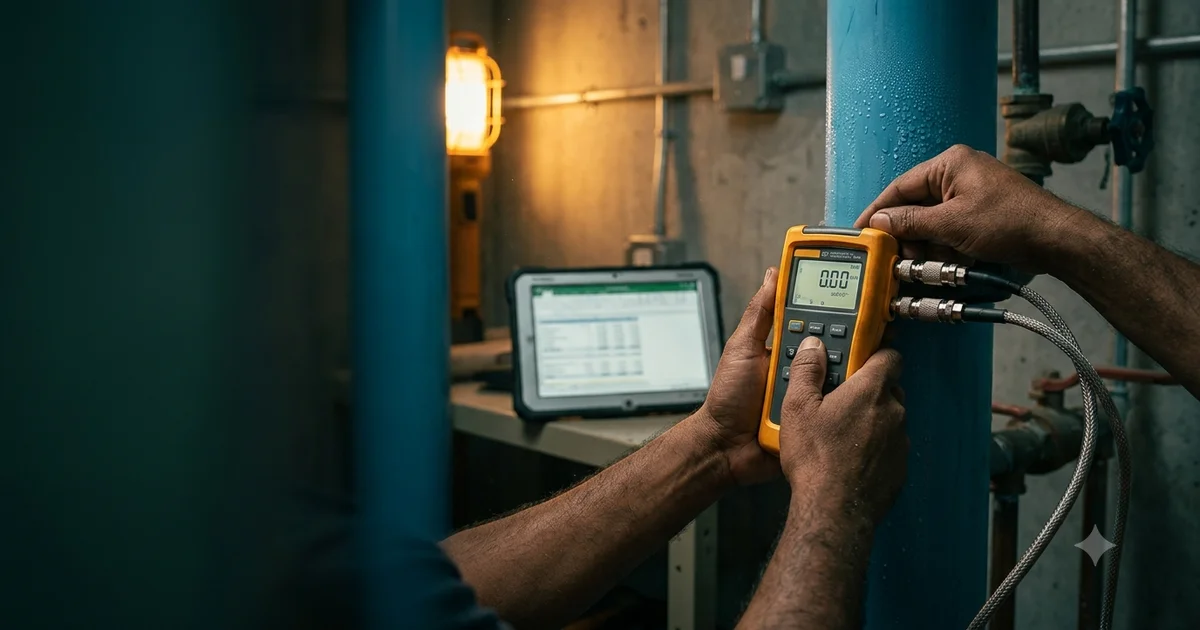
- Inflow measurement. Meter every source — mains meter cross-check, borewell flow meters, tanker volume verification. This number is the denominator of the whole audit.
- Baseline night-flow test. With all legitimate use off, measure minimum night flow. Water moving at 3 a.m. is either a leak or an overflow — both are losses.
- Zone measurement. Sub-meter or bucket-test major zones: domestic blocks, cooling, process, landscape, flushing. Build the consumption side of the balance.
- Treatment & reject checks. RO recovery ratios, STP inlet/outlet volumes and quality, reuse routing. In most industrial sites this is where the biggest rupee opportunity hides — see our guide on STP treated water reuse.
- The balance and the plan. Assemble inflows versus accounted outflows. Rank the gaps by rupee value. Deliver losses, savings and payback in that order — findings first, invoices last.
What a Good Water Audit Report Contains
Because “report format” is one of the most searched questions in this space, here is what a professional deliverable includes — use it as your acceptance checklist:
- Water balance statement — every source, every use, the quantified gap
- Metering map — what is measured, how, and where sub-meters are missing
- Loss register — each loss located, quantified (litres/day), and costed (₹/year)
- Treatment performance — RO, STP findings with data, not adjectives
- Prioritized action plan — quick wins vs capex items, with payback periods
- Compliance annexure — BRSR/CGWA-ready data where applicable
- Verification method — how each number was measured, so any figure can be re-checked
If a report’s numbers cannot be traced to a measurement method, they are estimates wearing an audit’s clothes.
Who Needs a Water Audit, and When?
RWAs and apartments: rising tanker dependency, unequal billing, suspected leaks. Factories: cost pressure plus CGWA conditions — groundwater NOCs in notified areas can require periodic water audit by accredited auditors, and the trend is tightening. Hotels and schools: brand and governance expectations, plus genuine savings. Corporate campuses: BRSR Core and CDP disclosures that must survive assurance — auditors notice the difference between metered data and estimates. For the city-scale view of why NCR sites are under pressure, see Gurugram’s water balance problem.
Frequency: a detailed audit every 2–3 years, with annual light-touch reviews (night-flow test + meter reconciliation) in between. Post-implementation re-measurement after any major intervention — that is how savings get proven, not projected.
What a Water Audit Costs in India (Indicative)
| Site type | Indicative range (₹) | What drives the price |
|---|---|---|
| Small site / school / RWA block | 25,000–60,000 | Walkthrough + core metering + balance |
| Apartment complex / hotel | 60,000–1,50,000 | Zone sub-metering, STP/RO testing |
| Industrial / campus | 1,50,000+ | Process mapping, compliance annexures, instrumentation |
A few days of metering and testing, a lifetime of decisions built on the numbers. We deliberately put cost after content — the relevant question is not the fee but the size of the gap it finds. A ₹50,000 audit that locates a ₹4-lakh-a-year leak is the cheapest consulting you will ever buy.
How to Choose a Water Audit Agency in India: 8 Questions
This is where audits are won or lost. Ask these before signing:
- “Will you meter our borewells and tankers, or read them off our logs?” — No inflow measurement, no audit.
- “Do you run a night-flow test?” — The single most revealing hour in auditing.
- “Show me a sample water balance from a past audit.” — Quantified gap, or just observations?
- “How do you verify — can we re-check your numbers?” — Methods and instruments, named.
- “Who exactly comes on site?” — Engineers with instruments, or a survey crew with a template.
- “Is the report BRSR/CGWA-usable if we need it later?” — Data trail, not just conclusions.
- “What happens after the report?” — Do they help implement and re-measure, or disappear?
- “What do you guarantee?” — A good auditor guarantees findings you can verify, not a savings percentage.
What is a water audit in simple terms?
A measured account of all the water entering and leaving your site — every source metered, every use mapped, every loss quantified. The output is your water balance: what you bring in, what you actually use, and the gap between the two.
Why is a water audit important?
Because water costs are mostly invisible: leaks run at night, tanks overflow on schedule, RO reject goes to drains. An audit converts all of it into numbers and rupees — the basis for savings, fair billing, and credible BRSR/ESG reporting.
How is a water audit done step by step?
Records review → metering all inflows → night-flow leak test → zone-wise consumption measurement → RO/STP checks → water balance + prioritized savings plan. Measurement at every step; the balance is the deliverable.
What is a water audit report?
The audited deliverable: water balance statement, metering map, quantified loss register (litres and rupees), treatment performance, prioritized action plan with paybacks, and — where needed — BRSR/CGWA-ready annexures with verification methods.
How much does a water audit cost in India?
Indicatively ₹25,000–₹60,000 for small sites and schools, ₹60,000–₹1,50,000 for apartments and hotels, and ₹1.5 lakh+ for industrial campuses — driven by site size, sub-metering needs and compliance scope.
How often should a water audit be conducted?
A detailed audit every 2–3 years, annual light reviews in between, and always a re-measurement after implementing audit recommendations — that is how savings get proven.
What is a water audit in school?
The same accounting, sized for a campus: meter or bucket-test the inlets, map toilets, labs, canteen, garden use, run simple overnight tests, and turn the findings into a student-visible water balance. It doubles as the best live sustainability education a school can run.
Water audit vs water assessment — which do I need?
An assessment is judgement-based and indicative; an audit is measurement-based and verifiable. Small simple site, first look → assessment. Investing money, reporting externally, or chasing suspected losses → audit.
Is water audit mandatory for industries in India?
For groundwater users, CGWA NOC conditions in notified/over-exploited areas can require periodic water audit by accredited auditors, and several state groundwater authorities run their own mandates. Even where not strictly mandatory, BRSR reporting expectations make audited water data the defensible standard.
Conclusion: Measure First, Then Decide
Every water strategy — recharge pits, reuse loops, smart meters, BRSR disclosures — is built on one thing: knowing your numbers. A water audit is how a site stops guessing. The gap it finds is usually paying for the audit several times over, every single year.
Start with the basics: our team conducts audits across homes, RWAs, factories and campuses — see how a water balance assessment works, or estimate your site’s rainwater potential first with the free runoff calculator.
Cost figures and the indicative gap range are Ecolive field experience; verify site-specific numbers with an audit. CGWA/BRSR references are general — check the current notification applicable to your site.