Modular Rainwater Harvesting vs Water Balance: What Actually Works?
Every day, urban India generates 72,368 million litres of sewage, while buildings spend lakhs on water tankers to survive the summer. Many facility managers try to fix this by installing modular rainwater storage tanks. They treat water scarcity as a simple storage problem rather than calculating their true water balance. That is only half the story.
TL;DR: Modular rainwater harvesting systems only capture water during the monsoon. A complete water balance approach uses the 4R framework (Reduce, Reuse, Recycle, Recharge) to map your entire consumption cycle. While a modular tank might delay tanker dependence by a few weeks, fixing your water balance can eliminate it entirely.
What is a modular rainwater harvesting system?
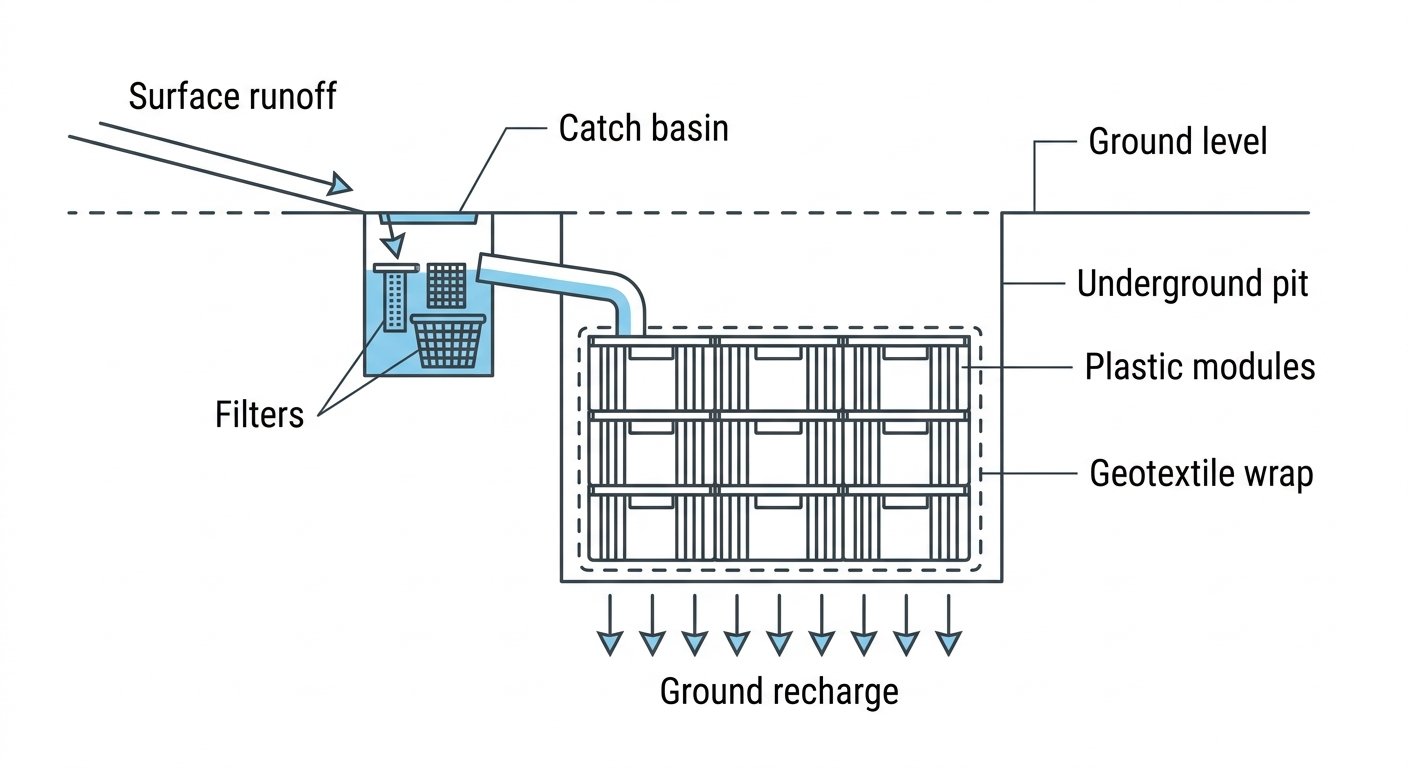
A modular rainwater harvesting system is an underground storage structure made from recycled polypropylene cells that captures and stores surface runoff. These tailored and customized harvesting alternatives assemble quickly like building blocks. They hold water temporarily for filtration or immediate reuse before it enters the ground or the drain.
These systems are popular because they are fast to install. You dig a pit, stack the plastic modules, wrap them in geotextile, and cover them up. Vendors push them heavily as a quick fix for compliance notices. The problem is that capturing rain for 40 days of the year does nothing to address how your building consumes water during the other 325 days.
Why do standalone modular systems fail to solve water stress?
Standalone modular systems fail because they ignore the demand side of your building’s water equation. Buying an underground water tank built from modular cells only gives you a bucket. If your building has massive internal leaks, inefficient fixtures, and zero wastewater reuse, that bucket empties immediately.
Most buildings lose efficiency quickly when they only focus on the installation phase. We see this constantly in our audits. A facility manager installs a modular system to meet a municipal mandate. Two years later, the filters clog, the storage capacity drops, and the tanker bills return to their peak levels. This is exactly why rainwater harvesting systems fail within three years. You cannot buy water security off a shelf. You have to engineer it.
Comparing Modular RWH vs Full Water Balance
When you evaluate modular rainwater harvesting tank benefits in India, you must compare them against a comprehensive water balance strategy. Here is how they stack up.
The data shows a clear gap. A physical product alone cannot match an engineered process.
How does the 4R framework fix the entire water cycle?
The 4R framework fixes your water cycle by measuring every drop that enters and exits your site, applying Reduce, Reuse, Recycle, and Recharge protocols to close the gap. Instead of just catching rain, this methodology maps your baseline consumption, routes treated effluent back into cooling towers or flushing systems, and recharges surplus water into the aquifer.
EcoLive has implemented this across 1,150 projects in 11 states, saving over 652 million litres of water. When we audit a site, we do not start by selling a tank. We start with a metre. We find out exactly where your water goes. Once you understand your consumption, you can implement the 4R framework for water balance to turn wastewater from a liability into a resource.
What is the ROI of a complete water balance assessment?
A complete water balance assessment typically pays for itself within 12 to 24 months through direct reductions in freshwater procurement and tanker fees. By optimizing water use and reducing dependency on municipal supplies, advanced modular rainwater harvesting systems can play a small role, but the real financial return comes from year-round wastewater reuse.
Consider a mid-sized commercial campus in Delhi NCR spending two lakh rupees a month on water tankers. A simple tank installation might save them twenty thousand rupees during August. A full water audit that fixes leaks, routes STP water to flush tanks, and recharges the borewell will reduce tanker water dependency drastically, saving over a lakh every single month.
The Verdict: Who should choose what?
If you are building a temporary structure or need a rapid, space-saving storage volume for a specific localized drainage issue, a 100% recycled polypropylene rainwater harvesting modular tank might serve your immediate need.
However, if you are a facility manager, RWA secretary, or ESG director looking to secure your water supply, cut operational costs, and report verifiable metrics to your board, you need a water balance strategy. Stop buying parts. Start engineering outcomes. Compare the long-term yields of RWH vs borewell investments, and you will see that measurement and maintenance always beat a standalone installation.
FAQ
What is the difference between modular rainwater harvesting and a water balance? Modular rainwater harvesting is a physical storage product used to capture runoff during the monsoon. A water balance is a comprehensive engineering strategy that measures and optimizes all water entering and exiting a building year-round, using the 4R framework to reduce demand and reuse wastewater.
Will a modular RWH system eliminate my tanker bills? No. A modular system only captures water when it rains, which is roughly 40 days a year in most parts of India. To eliminate tanker bills, you must address your year-round consumption by fixing your site’s complete water balance.
How does the 4R framework improve water balance? The 4R framework (Reduce, Reuse, Recycle, Recharge) improves water balance by identifying leaks to reduce demand, treating and reusing wastewater for non-potable needs, recycling industrial effluent, and recharging surplus rainwater into the ground to sustain borewell yields.
Ready to stop guessing and start measuring? Call EcoLive at +91 9871472211 or visit ecolive.in to request your site’s water balance assessment today.