Why Gurugram Floods: The Lost Absorbents and the Gradient Problem
Torrential rains battered Gurugram on July 9 and 10, bringing the city to a standstill. The immediate reaction is always to blame the volume of rain. The truth is structural. Gurugram floods because we paved over its natural sponges and ignored its natural slope.
TL;DR: Gurugram sits on a steep gradient from the Aravalli hills down to the Najafgarh basin. Historically, johads and seasonal streams absorbed this fast-moving runoff. Today, those absorbents are gone. The solution is not just bigger drains, but decentralized rainwater harvesting and groundwater recharge at the building level using the 4R framework.
What happened to Gurugram’s natural sponges?
Where did the water used to go? Before the concrete expanded, Gurugram had a vast network of natural absorbents. Urban experts attributed the crisis to the erasure of johads, seasonal streams, and Aravalli runoff channels. These water bodies caught the rain before it could flood the streets.
Decades of rapid construction dismantled these natural drainage systems. Ponds and bunds that once managed runoff have largely disappeared. When rain falls on a paved surface, it cannot sink into the ground. It becomes surface runoff. Without those natural catchments, the water has nowhere to go but the roads. This creates an immediate crisis for facility managers and municipal authorities. We treat the monsoon as a surprise, even though India’s biggest festival is the monsoon.
How the Aravalli gradient accelerates water flow
Why does the water move so fast in Gurugram? The city has a steep natural gradient sloping down from the Aravalli hills. Water naturally flows from the higher elevations in the south and east toward the lower Najafgarh drain in the north and west.
When the Aravalli hills had their natural vegetation, the trees and soil slowed the water down. Now, the water hits concrete and accelerates. Gravity pulls the runoff down the gradient at high speeds. The lower areas of the city receive their own rainfall plus all the fast-moving runoff from the higher sectors. This is why certain intersections flood within twenty minutes of a downpour. The gradient turns a heavy shower into a flash flood. You can model this exact effect for your own property using an urban flooding simulator.
Why larger drains are not the answer
Most people assume the city just needs bigger pipes. Building larger drains is inadequate because a combination of green roofs, permeable pavements, and rainwater harvesting is required to actually stop the water at the source.
Drains only move water from one place to another. They do not reduce the volume of water. When the Najafgarh drain is full, the entire city drainage network backs up. Pushing more water into a full system causes overflow. The engineering reality is that we must catch the water before it reaches the municipal drains. We need to hold it, slow it down, and push it into the ground. This is the core principle of effective water balancing for large campuses and residential societies.
Runoff comparison: Natural vs Paved surfaces
To understand the scale of the problem, look at how different surfaces handle a standard rainfall event. The runoff coefficient measures what percentage of rain becomes surface water.
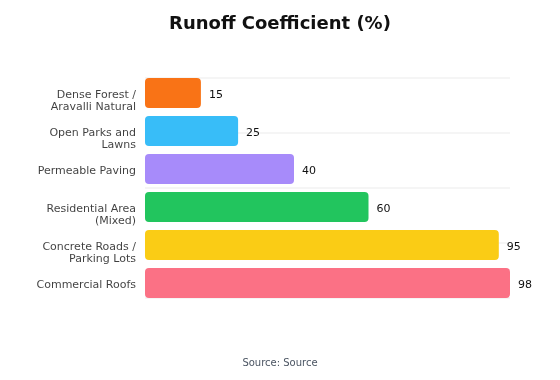
When you replace a forest that absorbs 85% of the rain with a parking lot that absorbs 5%, the excess 80% becomes a flood. Every building owner holds a piece of this puzzle.
The 4R Framework: How buildings can stop the runoff
How can a single building help prevent urban flooding? By applying the 4R framework (Reduce, Reuse, Recycle, Recharge) to capture the water that falls on its roof.
First, we reduce the speed of the water using collection tanks. Next, we route the clean rooftop water into a properly designed rainwater harvesting system. This recharges the groundwater aquifer instead of flooding the street. A commercial building with a 1,000 square metre roof can capture over 500,000 litres of water during the monsoon. That is half a million litres of water kept out of the flooded streets and put back into your dry borewell.
What facility managers must do before the monsoon
What is the first step for a facility manager? You must ensure your existing systems are clean and ready to catch the first rain.
Many buildings have harvesting pits that are clogged with silt. A blocked pit acts exactly like a concrete road. The water hits it and flows straight into the street. You need to inspect the filters, clean the desilting chambers, and verify the recharge rate. Knowing what monsoon readiness actually means is the difference between saving lakhs on tanker bills and watching your basement flood.
Frequently Asked Questions About Gurugram Flooding
Why does Gurugram flood so quickly after rain? Gurugram floods quickly because it has a steep natural gradient and most of its natural water absorbents like johads have been paved over. The water hits concrete and rushes to the lowest points.
Can better municipal drains solve the flooding? Better drains alone cannot solve the problem. Drains only move water. We need decentralized rainwater harvesting to absorb the water at the source before it overwhelms the drainage network.
How does rainwater harvesting prevent urban flooding? Rainwater harvesting captures rain falling on roofs and pushes it deep into the ground. This keeps millions of litres of water out of the streets and replenishes the declining groundwater table.
What is the 4R framework for water management? The 4R framework stands for Reduce, Reuse, Recycle, and Recharge. It is an engineering approach to close a site’s water balance by capturing rain and reusing treated wastewater.
How much water can a commercial building capture? A building with a 1,000 square metre roof in Gurugram can capture approximately 500,000 litres of water during an average monsoon season, significantly reducing its dependence on water tankers.
Ready to stop your rainwater from going to the drain? EcoLive helps buildings, factories, and RWAs capture rainwater, recharge borewells, and cut tanker costs. Call us at +91 9871472211 or visit ecolive.in to request a Water Assessment.