How Do Indian Factories Implement Groundwater Recharge Systems?
India receives 75% of its annual rainfall in just four months according to IMD rainfall data. Most industrial facilities treat this water as a drainage problem. They spend millions pumping water from failing borewells while letting monsoon runoff flood their compounds and exit into municipal drains. Capturing this runoff through groundwater recharge and directing it back into the aquifer changes the financial math of running a manufacturing plant.
TL;DR: Groundwater recharge captures rooftop and surface runoff, filters it, and injects it into aquifers. Factories can implement artificial recharge of groundwater by calculating runoff volume, sizing recharge pits, installing desilting chambers, and maintaining the structures annually. This restores borewell yields and reduces tanker dependence.
Why do factories need groundwater recharge?
Factories need groundwater recharge because borewell yields drop every summer, forcing plants to rely on expensive water tankers to maintain production. By capturing monsoon rain, a facility can replenish the exact aquifer it draws from. According to the India Meteorological Department, India receives 1,170 mm of average annual rainfall, per their annual rainfall report. A standard factory roof of 5,000 square metres can harvest over 4 million litres of water annually.
Relying on deep aquifers without replenishing them creates a deficit. The depletion of groundwater forces pumps to work harder, increasing electricity costs according to World Bank data. Recharging the aquifer stabilizes the water table beneath your site.
What are the common methods of groundwater recharge?
The primary methods of groundwater recharge for commercial sites include recharge pits, trench systems, and direct borewell recharge. The right choice depends on your soil type, available space, and total catchment area. Recharge pits work best for concentrated rooftop runoff. Trench systems handle widespread surface runoff from paved driveways. Direct borewell recharge targets deep aquifers but requires strict filtration to prevent contamination.
Understanding how to recharge groundwater effectively means matching the method to the site’s geology. You cannot force water into clay. Sandy or rocky soils accept water much faster.
How do you calculate your factory’s groundwater recharge potential?
You calculate your factory’s groundwater recharge potential by multiplying your catchment area by local rainfall and the surface runoff coefficient. You cannot design a system without knowing your volume. Measure your total catchment area. This includes factory roofs, paved parking lots, and open ground. Different surfaces absorb different amounts of water. A concrete roof sheds almost 90% of the rain that hits it, based on CGWB runoff coefficients. Open soil absorbs much more.
Use a runoff calculator to determine your exact potential. Multiply your catchment area by the local annual rainfall and the runoff coefficient of your surface. This gives you the total harvestable volume. Design your system to handle peak hourly rainfall, not just the annual average.
How do you design an artificial recharge structure?
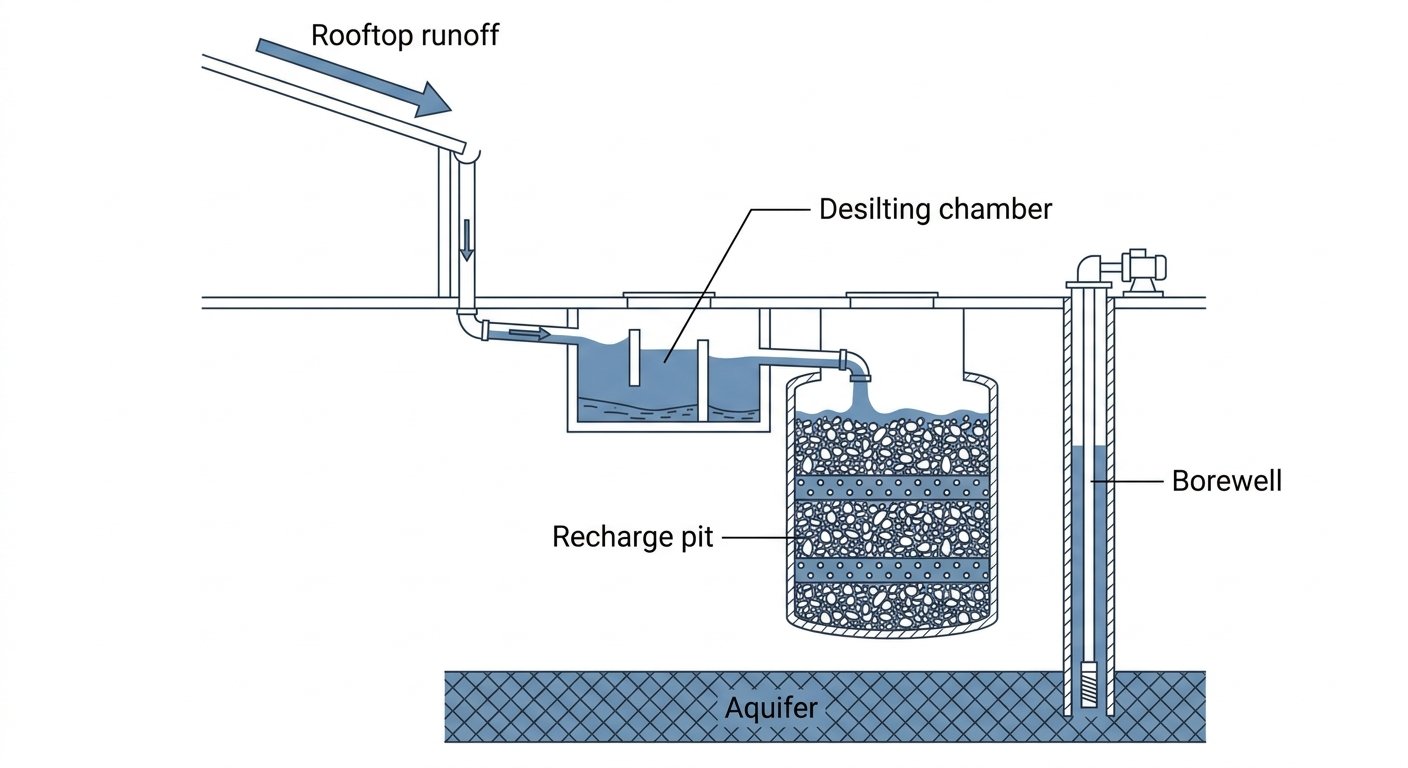
You design an artificial recharge structure by sizing a desilting chamber and a main filtration unit filled with boulders, gravel, and coarse sand. Artificial recharge of groundwater requires properly sized structures, following CPCB design guidelines. If the pit is too small, water overflows during heavy storms. If it is too large, you waste capital expenditure.
A standard recharge pit features a desilting chamber followed by a main filtration unit. The pit contains layers of boulders, gravel, and coarse sand. These layers mimic natural earth filtration. The water passes through these layers before reaching the recharge bore. For large factory campuses, a network of smaller pits often works better than one massive central pit. This distributed approach reduces the cost of laying long underground pipes.
Why is silt management critical for groundwater recharge?
Silt management is critical because injecting unfiltered surface runoff will permanently clog the aquifer. You must never inject unfiltered water into an aquifer. Surface runoff carries heavy silt, oil from parking lots, and industrial debris. Injecting this directly will clog the aquifer permanently.
Install an oil and grease trap for any runoff coming from driveways or loading bays. Route the water through a desilting chamber where heavy particles settle to the bottom. Only clear water should overflow into the main recharge pit. This step is non-negotiable for industrial sites. Poor filtration ruins the entire investment.
How do you prepare a groundwater recharge system for the monsoon?
You prepare a groundwater recharge system by cleaning roof catchments, clearing desilting chambers, and replacing hardened filter sand every May. A recharge system requires annual attention. Leaves, dust, and bird droppings accumulate on factory roofs during the dry months. The first rain washes all this debris into your pipes.
Implement a strict pre-monsoon maintenance checklist. Clean the roof catchments in May. Open the desilting chambers and remove accumulated mud from the previous year. Replace the top layer of sand in the filter pit if it has formed a hard crust. True monsoon readiness means checking every valve and pipe before the first heavy shower arrives.
How do recharge methods compare for industries?
Different methods carry different costs and maintenance requirements. Facility managers must weigh these factors when planning their capital budgets.

Trench systems cost more upfront due to excavation volume. Direct borewell injection requires the highest maintenance frequency because the filtration standards are much stricter.
Step 5: Integrate Recharge into Your Total Water Balance
Groundwater recharge should not exist in isolation. It forms the final step of the 4R framework: Reduce, Reuse, Recycle, Recharge.
A factory that recharges its borewells but wastes water in its cooling towers still runs a deficit. You must measure the water coming in against the water going out. A complete water balancing audit reveals how much fresh water you actually need. When you combine efficient usage with aggressive monsoon capture, you secure your plant’s operational future.
Most water companies install systems. EcoLive measures outcomes. Every litre saved is measured, reported, and celebrated.
Need to secure your factory’s water supply before the next dry season? Contact EcoLive at +91 9871472211 or visit ecolive.in.
FAQ
What are the methods of groundwater recharge for factories? The primary methods of groundwater recharge for commercial sites include recharge pits for rooftop runoff, trench systems for paved surface areas, and direct borewell recharge for deep aquifers. The choice depends on soil permeability and catchment size.
How do you calculate groundwater recharge potential? You calculate recharge potential by multiplying your total catchment area, including roofs and pavements, by the local annual rainfall and the surface runoff coefficient. A concrete roof captures about 90% of the rain that falls on it.
Why is filtration important in artificial recharge of groundwater? Filtration is critical because surface runoff carries silt, debris, and oil. Injecting unfiltered water directly into a borewell will permanently clog the aquifer and ruin the recharge structure.