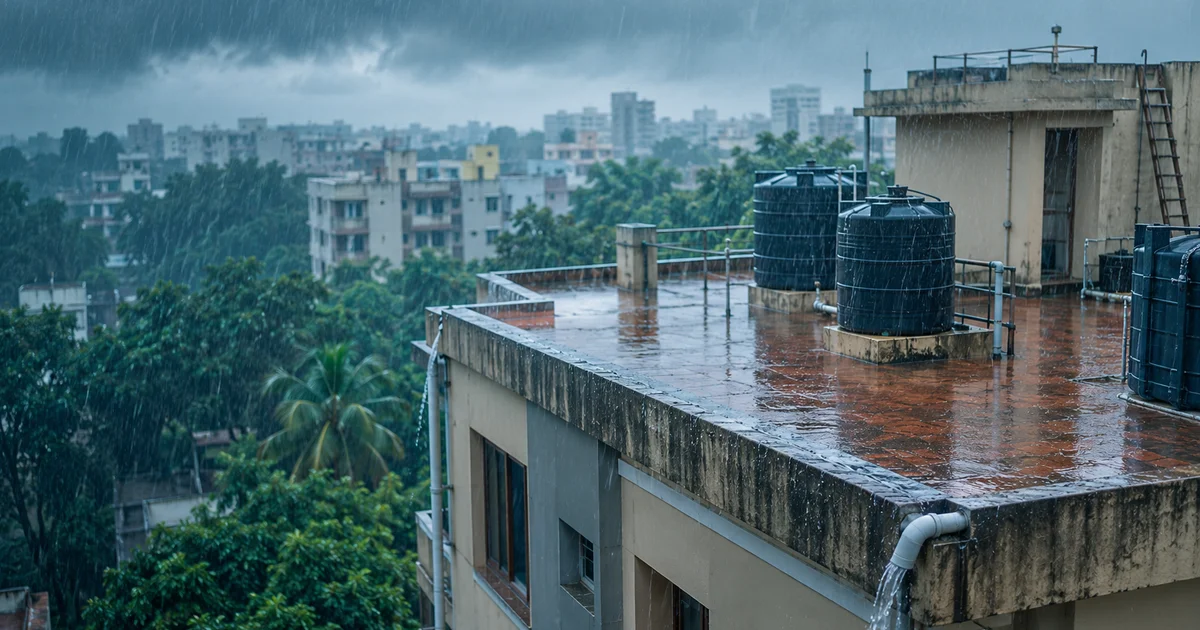
Here is the question every building owner in India should ask before the next monsoon: how many litres of rain does my roof actually catch in a year? The answer is usually startling — a modest 100 m² roof in a 900 mm rainfall zone receives around 90,000 litres of free, soft water annually. Most of it currently goes to the drain. This guide shows you how to estimate your roof’s rainwater harvest in five minutes, by hand, with the same formula engineers use — and then how to verify it with our free runoff calculator.
Key Takeaways
- The formula is one line: annual harvest (litres) = roof area (m²) × annual rainfall (mm) × runoff coefficient (0.8–0.95 for roofs).
- A 100 m² roof in Delhi NCR (~700–900 mm rainfall) catches roughly 56,000–85,000 litres a year — most of it currently lost to drains.
- The runoff coefficient is where estimates go wrong: roofs shed 80–95% of rain, not 100% — evaporation, first-flush and wetting losses take the rest.
- Monthly rainfall matters more than annual: your harvest arrives in 3–4 monsoon months, which decides storage vs recharge sizing.
- Run your numbers through the free runoff calculator — it computes harvestable litres and peak runoff for your exact roof and city.
The Formula: One Line of Arithmetic
Annual rainwater harvest (litres) = roof area (m²) × annual rainfall (mm) × runoff coefficient.
One millimetre of rain on one square metre yields one litre — that is the whole trick. Multiply your roof’s footprint by your city’s annual rainfall depth, then discount for the fraction that actually runs off. Everything else is refinement.
| Roof size | Delhi NCR (~700 mm) | Gurugram (~800 mm) | Jaipur (~650 mm) | Mumbai (~2,200 mm) |
|---|---|---|---|---|
| 100 m² (typical house) | ~56,000 L | ~64,000 L | ~52,000 L | ~176,000 L |
| 300 m² (small apartment block) | ~168,000 L | ~192,000 L | ~156,000 L | ~528,000 L |
| 1,000 m² (commercial/industrial) | ~560,000 L | ~640,000 L | ~520,000 L | ~1.76M L |
Assumes 0.8 runoff coefficient. Rainfall figures are indicative city-scale normals — your locality varies; the calculator uses your actual figure.
Step 1: Measure Your Roof Area
Use the building’s footprint — the plan area catching rain, not the sloped surface area. For rectangular roofs: length × breadth. For L-shaped or irregular plans, break it into rectangles and add. If you have the building plan, the covered area is your number. Apartments should compute per-tower roof area, plus open paved areas if they drain to the collection system.
Step 2: Find Your Rainfall Number
Use the annual normal rainfall for your city — but understand its limits. Annual totals hide the monsoon concentration: in Delhi NCR, 80% of the year’s rain arrives in roughly 12 weeks. Your harvest is a monsoon event, not a steady drip — which is why the next decision (storage vs recharge) matters so much. The runoff calculator lets you enter your city’s figure or a custom local one.
Step 3: Apply the Runoff Coefficient — Where DIY Estimates Go Wrong
Not all rain becomes runoff. Roofs shed 80–95% depending on material and slope; the rest evaporates, wets the surface, or is lost in the first flush. Use 0.8 for a conservative first estimate — the number that sizes honest infrastructure, not optimistic pamphlets. In our field experience, enthusiasm-built systems designed on a 1.0 coefficient disappoint their owners in the first dry October.
Step 4: Decide What the Number Means — Store or Recharge?
The litres you computed arrive in a concentrated monsoon pulse. Two strategies absorb it:
- Storage — tanks sized for days of use between rains. Practical for drinking-grade harvesting with treatment, or where a campus wants visible resilience. Tanks are finite; the surplus still needs a home.
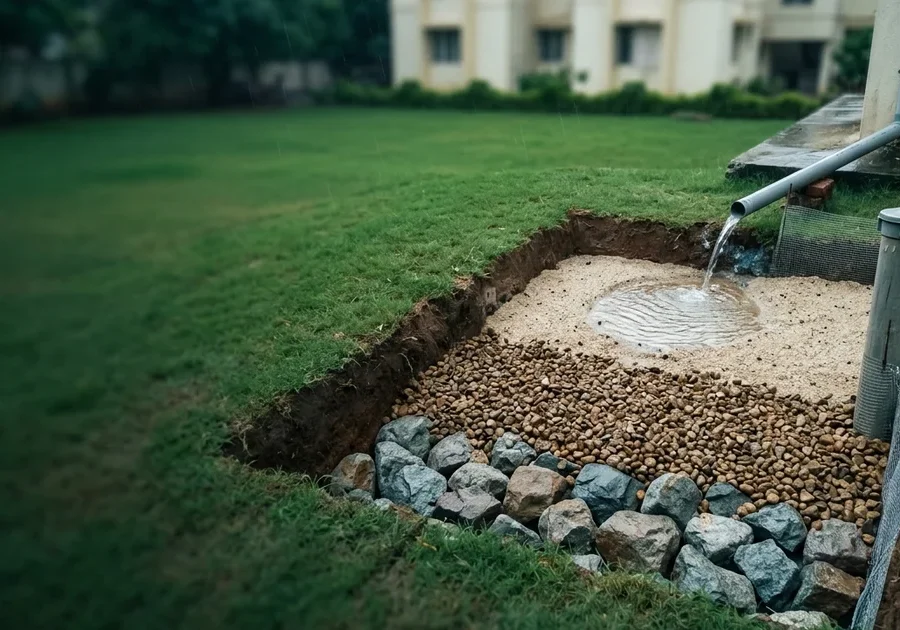
- Recharge — route the harvest into the aquifer through a properly designed recharge pit. The aquifer is effectively unlimited storage, and it feeds your borewell back — see our guides on RWH vs borewell and reviving dry borewells.
Most sites do both: storage for the dry-week gap, recharge for the monsoon surplus. That balance — storage volume versus recharge capacity for your computed litres — is the actual engineering decision, and it is what a water balance assessment sizes properly.
Step 5: Verify With the Free Runoff Calculator
Hand arithmetic gets you the magnitude. For decisions, run your exact numbers through our free runoff calculator: enter roof area, city rainfall and surface type, and it computes annual harvestable litres, peak monsoon runoff, and first-flush volume — the three numbers that size filters, pipes and pits.
Want the full picture — demand, reuse and recharge together? That is a water audit, and it is how these litres turn into a plan. The city-scale version of the same story is told in Gurugram’s water balance problem.
How do I calculate rainwater harvesting potential for my roof?
Multiply roof area in m² by annual rainfall in mm by a runoff coefficient of 0.8–0.95. A 100 m² roof in an 800 mm zone harvests roughly 64,000 litres a year. One mm on one m² equals one litre — that is the entire formula.
What is a runoff coefficient?
The share of rainfall that actually runs off the surface rather than evaporating or soaking in. Roofs: 0.8–0.95 by material and slope. Paved areas: 0.7–0.9. Bare soil: 0.2–0.5. Use 0.8 for conservative roof estimates — systems sized on 1.0 consistently underdeliver.
Is there a free rainwater harvesting calculator for India?
Yes — Ecolive’s free runoff calculator (ecolive.in/runoff-calculator) computes annual harvestable litres, peak runoff and first-flush volume from your roof area, city rainfall and surface type. No signup needed for the core numbers.
How much water can a 100 sqm roof collect?
Depends on your rainfall zone: roughly 56,000 litres/year in Delhi NCR (~700 mm), 64,000 in Gurugram (~800 mm), 52,000 in Jaipur (~650 mm), and up to 176,000 in Mumbai (~2,200 mm) — at a 0.8 runoff coefficient.
Should I store the harvested rainwater or recharge it?
Storage serves dry-week use and drinking-grade harvesting with treatment; its volume is finite and costly. Recharge sends the monsoon surplus into the aquifer — effectively unlimited storage that feeds your borewell back. Most well-designed sites combine both: the storage-recharge balance is the real engineering decision your computed litres inform.
Does rainwater harvesting reduce flooding?
At site scale, yes — every litre captured or recharged is a litre kept out of storm drains at peak. At neighbourhood scale it compounds: the argument is laid out in our Gurugram water balance guide.
Conclusion: The Number Changes the Conversation
Once you know your roof catches sixty thousand litres a year, the drain outside your gate looks different — and so does the tanker invoice. Run your numbers, then take the next step: the free runoff calculator turns this article’s arithmetic into your building’s figures — then see rainwater harvesting services in Gurugram to turn the numbers into a system.
Rainfall figures are indicative city normals; runoff coefficients are standard practice ranges. For system sizing, validate with the calculator and a site assessment.