What Is the 4R Framework for Water Balance?
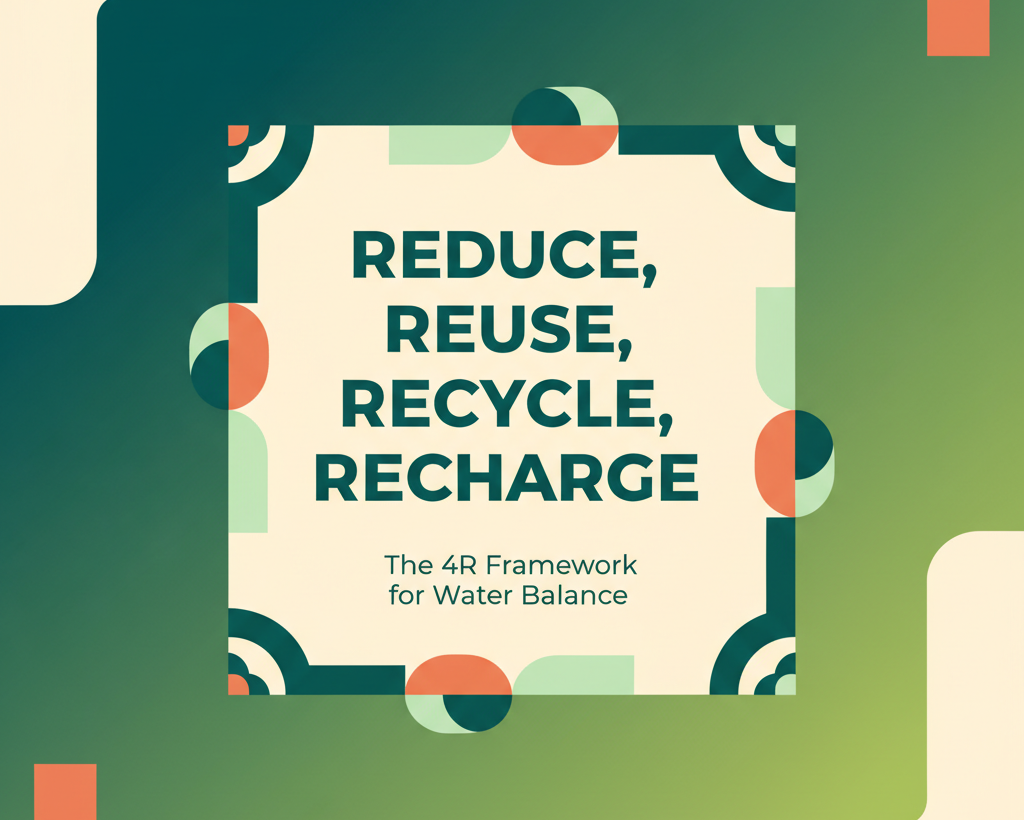
The 4R framework for water management stands for Reduce, Reuse, Recycle, and Recharge. It is a structured approach that helps businesses and communities lower freshwater consumption, cut costs, and improve their ESG water metrics. India’s NITI Aayog estimates that 21 major cities could run out of groundwater by 2030, making the 4R approach not optional but essential for every water-dependent organisation.
> TL;DR: The 4R water framework (Reduce, Reuse, Recycle, Recharge) helps Indian businesses cut freshwater demand by 30-60%, lower water bills, and build board-ready ESG metrics. EcoLive applies this framework across 2,000+ projects in 14 states, conserving over 652 million litres of water.
Why Does Water Balance Matter for Indian Businesses?
India is the world’s largest groundwater extractor, using more than China and the US combined, according to UN Water Data. For industries, this translates into three hard realities: rising tanker water costs, regulatory pressure under BRSR disclosures, and investor scrutiny on ESG water scores. A manufacturing plant in NCR can spend ₹8-15 lakh annually on tanker water alone, and costs spike 40-60% during summer months.
The 4R framework directly addresses these pain points by treating water as a manageable asset rather than an unlimited resource. Companies that adopt all four pillars typically report a 30-60% reduction in freshwater withdrawal within the first 18 months.
R — Reduce: Use Less Water in the First Place
What it means: Reduce water consumption at source through efficiency audits, fixture upgrades, and process optimisation. This is the highest-impact, lowest-cost step because saved water costs nothing.
How to Reduce Water Consumption in Industrial Facilities
- Conduct a water-use efficiency audit to identify top 3 consuming processes
- Install low-flow fixtures, sensor-based taps, and flow meters
- Set departmental water KPIs and track monthly consumption
- Train facility teams on water-efficient practices
A typical audit reveals that 15-25% of industrial water use is wasted through leaks, overflows, and inefficient processes. Fixing these alone can save lakhs annually. EcoLive’s water-use efficiency audits across facilities in Gurgaon and Pune have identified savings of ₹3-8 lakh per year for mid-size plants, often with payback periods under 12 months.
R — Reuse: Capture and Repurpose Wasted Water
What it means: Reuse water for non-potable purposes like cooling, cleaning, landscaping, and toilet flushing before it leaves the facility. This step alone can reduce freshwater demand by 20-40%.
Common Water Reuse Applications
- Cooling tower make-up water from treated effluent
- Landscaping and garden irrigation using greywater
- Vehicle washing and floor cleaning with recycled water
- Toilet flushing systems in commercial buildings
A Gurugram IT campus that implemented treated effluent reuse for landscaping and cooling reported a 35% drop in municipal water bills within one year. The key is matching water quality to the end-use. Not every application needs potable water, and that mismatch is where most facilities lose money.
R — Recycle: Treat Water for Higher-Grade Applications
What it means: Treat wastewater through filtration, reverse osmosis, or biological treatment so it can be reused for processes that require higher water quality. Recycling goes beyond basic reuse by upgrading water quality.
Industries like textiles, pharmaceuticals, and food processing generate large volumes of process wastewater. A well-designed recycling plant can recover 60-80% of this water for re-entry into production lines. EcoLive has installed water recycling systems across industrial facilities that have achieved payback in 2-3 years, with ongoing O&M support ensuring consistent output quality.
Recycling also directly improves BRSR water intensity metrics (water consumed per unit of revenue), a key disclosure that ESG auditors evaluate for top 1,000 listed companies.
R — Recharge: Put Water Back into the Ground
What it means: Recharge groundwater through rainwater harvesting pits, recharge wells, and permeable surfaces. This step addresses the long-term sustainability of the water source itself.
India receives an average of 1,100 mm of annual rainfall, but most of it runs off into drains. A single 10,000 sq ft rooftop in Delhi-NCR can harvest 6-8 lakh litres of rainwater per monsoon season. When directed into properly designed recharge structures, this water replenishes the aquifer that the facility ultimately depends on.
EcoLive has implemented rainwater harvesting and groundwater recharge across commercial, industrial, and community projects in 14 states, conserving over 652 million litres. Each recharge structure is designed for the local hydrogeology and maintained through annual servicing contracts.
How EcoLive Applies the 4R Framework
EcoLive’s proprietary WATER Framework maps directly to the 4R model: Water Avoidance (Reduce), Availability through Reuse, Treatment and Enhanced Recharge (Recycle and Recharge). This integrated approach ensures every project covers all four pillars rather than solving one problem in isolation.
With 2,000+ projects across 14 states and 652 million+ litres conserved, EcoLive’s impact is measurable and auditable. Every litre saved is tracked, reported, and aligned with ESG reporting frameworks like BRSR, GRI, and CDP.
How to Get Started with the 4R Framework
- Audit: Get a water-use efficiency audit to identify your top consumption areas and waste streams
- Prioritise: Start with Reduce (lowest cost, fastest ROI) before investing in recycling or recharge infrastructure
- Integrate: Connect all four pillars into a unified water management plan with measurable KPIs
- Report: Track and document savings for ESG disclosures and board presentations
A well-executed 4R strategy delivers ROI within 2-3 years, improves BRSR water disclosure scores, and builds long-term water resilience for your operations.
Frequently Asked Questions
What is the difference between water reuse and water recycling?
Water reuse means using water for a lower-grade application (like garden irrigation with greywater). Recycling means treating wastewater so it can return to a higher-grade application (like reusing treated effluent in cooling towers or production processes). Recycling requires more treatment infrastructure but delivers greater water savings.
How much does a 4R water management plan cost?
A basic water-use efficiency audit starts from ₹25,000-50,000 for mid-size facilities. Full implementation (audit + reuse systems + rainwater harvesting + O&M) typically ranges from ₹3-15 lakh depending on facility size and water consumption. Most EcoLive clients achieve payback within 2-3 years through reduced tanker and municipal water bills.
Does the 4R framework help with BRSR compliance?
Yes, the 4R framework directly improves key BRSR water disclosure metrics: water withdrawal per unit of revenue, water recycling percentage, and rainwater harvesting capacity. These are mandatory disclosures for top 1,000 listed companies under SEBI’s BRSR framework. EcoLive’s ECHO framework integrates water data into board-ready ESG reporting dashboards.
Can small facilities implement the 4R framework?
Absolutely. Reduce and Reuse require minimal investment (flow meters, leak fixes, greywater diversion). Recharge through simple rainwater pits costs as little as ₹15,000-30,000. EcoLive has implemented solutions for facilities ranging from 5,000 to 5,00,000 sq ft across India.
Ready to reduce your water footprint? Speak with EcoLive’s water sustainability experts for a free facility audit and 4R implementation roadmap.
📞 +91 9871472211 | 🌐 ecolive.in