Industrial STP Water Reuse: Why Your Factory Water Goes to the Drain (and How to Fix It)
Every day, urban India generates 72,368 million litres of sewage. While many factories invest heavily in Sewage Treatment Plants to meet compliance mandates, a massive volume of that treated water flows straight into municipal drains. Implementing industrial STP water reuse solves this problem permanently. You pay to pump freshwater in, you pay to treat the wastewater, and then you throw the treated resource away. This cycle drains your operational budget just as fast as it drains your local borewell.
TL;DR: Discharging treated STP water wastes money and increases your reliance on expensive water tankers. By applying the 4R framework and upgrading filtration, factories can route treated wastewater back into cooling towers, flushing systems, and floor washing. This cuts freshwater demand by up to 40% and delivers a payback period of under 24 months.
What is industrial STP water reuse?
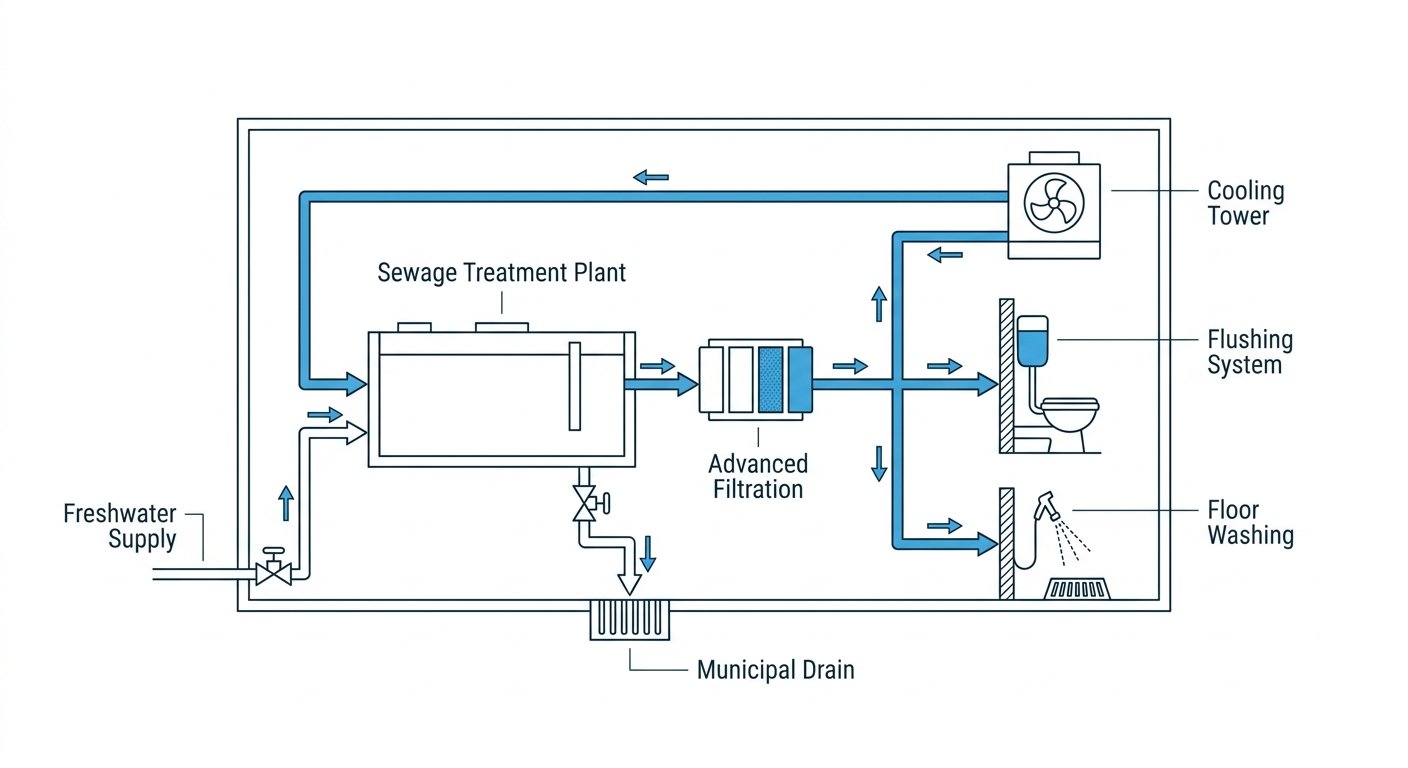
Industrial STP water reuse is the engineering process of taking treated wastewater from a Sewage Treatment Plant and routing it back into non-potable factory operations. Instead of discharging the effluent, facilities use advanced filtration to match the water quality to specific manufacturing needs. This closes the loop on site consumption and directly reduces the volume of freshwater a plant must buy or extract.
Many facilities combine multiple treatment processes to handle varying wastewater characteristics. When a plant treats its sewage correctly according to water quality standards, that water becomes a reliable secondary supply. It provides water security when borewells fail and tanker prices spike.
How much money is lost without industrial STP water reuse?
Most facility managers lose lakhs of rupees annually by discharging treated water instead of reusing it. When you throw away STP water, you lose the capital invested in treatment and force your plant to buy replacement water at a premium.
Here is a typical cost comparison for a mid-sized manufacturing plant in India consuming 100 Kilo Litres per Day (KLD) of water.
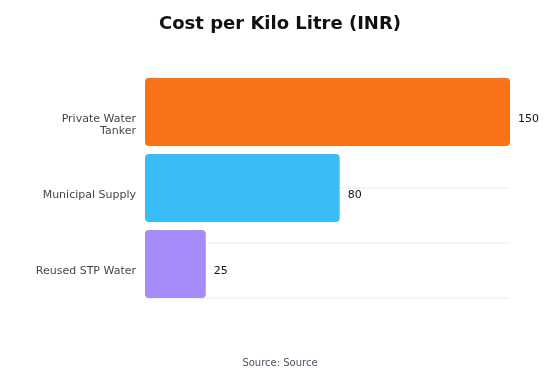
By shifting just 50% of the daily demand to reused STP water, a plant can save lakhs of rupees annually. This financial reality makes water balancing a core operational strategy rather than a simple compliance checkbox.
How do you audit your current STP output?
You audit your STP output by measuring the exact volume and chemical quality of the water leaving your treatment plant. You cannot reuse water if you do not know its chemical composition and daily flow rate.
An accurate audit measures Biochemical Oxygen Demand, Chemical Oxygen Demand, Total Suspended Solids, and pH levels. Reliable reuse requires strict purification parameters to ensure these metrics sit within safe operational limits. If your existing STP produces inconsistent water quality, the first step is fixing the biological process before planning any reuse pipelines.
Where can a factory safely reuse treated wastewater?
You must match the quality of the treated STP water to specific non-potable applications across your facility. Cooling towers, toilet flushing, floor washing, and landscape irrigation are the most common and effective targets for reused water.
You do not need drinking-quality water to wash a factory floor. By mapping your plant’s water demand by quality grade, you can route the STP output to the areas that consume the most low-grade water. This application of the 4R framework immediately drops your freshwater intake.
What equipment is needed to upgrade filtration for reuse?
You need tertiary treatment systems like Ultrafiltration or Reverse Osmosis to polish the standard STP output so it meets the specific requirements of your factory equipment. Standard STP water often contains trace suspended solids that can foul cooling towers if left unfiltered, violating global cooling standards.
Modern systems treat wastewater efficiently, but reuse often demands one extra step. Adding a polishing unit ensures the water will not scale pipes or damage machinery. The capital cost of this tertiary filtration pays for itself quickly through the massive reduction in freshwater purchases.
How do you measure the water balance outcome?
You prove the ROI of your water reuse system by installing smart metres on both the freshwater inlet and the STP distribution lines. Tracking these two numbers gives you a real-time water balance and proves the exact financial savings to your management board.
Accurate measurement is also critical for your annual environmental reporting. As the government tightens regulations, having verified data makes ESG and BRSR compliance straightforward. You can prove exactly how many litres of water your factory saved and reused. For a deeper understanding of these reporting requirements, read our guide on STP treated water reuse.
Stop letting your treated water go to the drain. EcoLive helps factories audit their existing STPs, design efficient reuse systems, and measure the exact financial outcomes.
Call EcoLive at +91 9871472211 or visit ecolive.in to request an industrial water assessment today.
FAQ
What is industrial STP water reuse? Industrial STP water reuse is the process of taking treated wastewater from a Sewage Treatment Plant and routing it back into non-potable factory operations. This directly reduces the volume of freshwater a plant must buy.
Can STP water be used in cooling towers? Yes, STP water can be used in cooling towers if it undergoes tertiary treatment like Ultrafiltration. This removes trace suspended solids and prevents scaling in the machinery.
What is the payback period for an STP reuse system? Upgrading an STP for water reuse typically offers a payback period of 12 to 24 months. This is driven by the massive reduction in commercial water tanker purchases.
Does STP water reuse help with BRSR compliance? Yes, reusing STP water directly improves your facility’s water balance metrics. Metered reuse provides hard data for BRSR Core reporting and demonstrates active water conservation.