


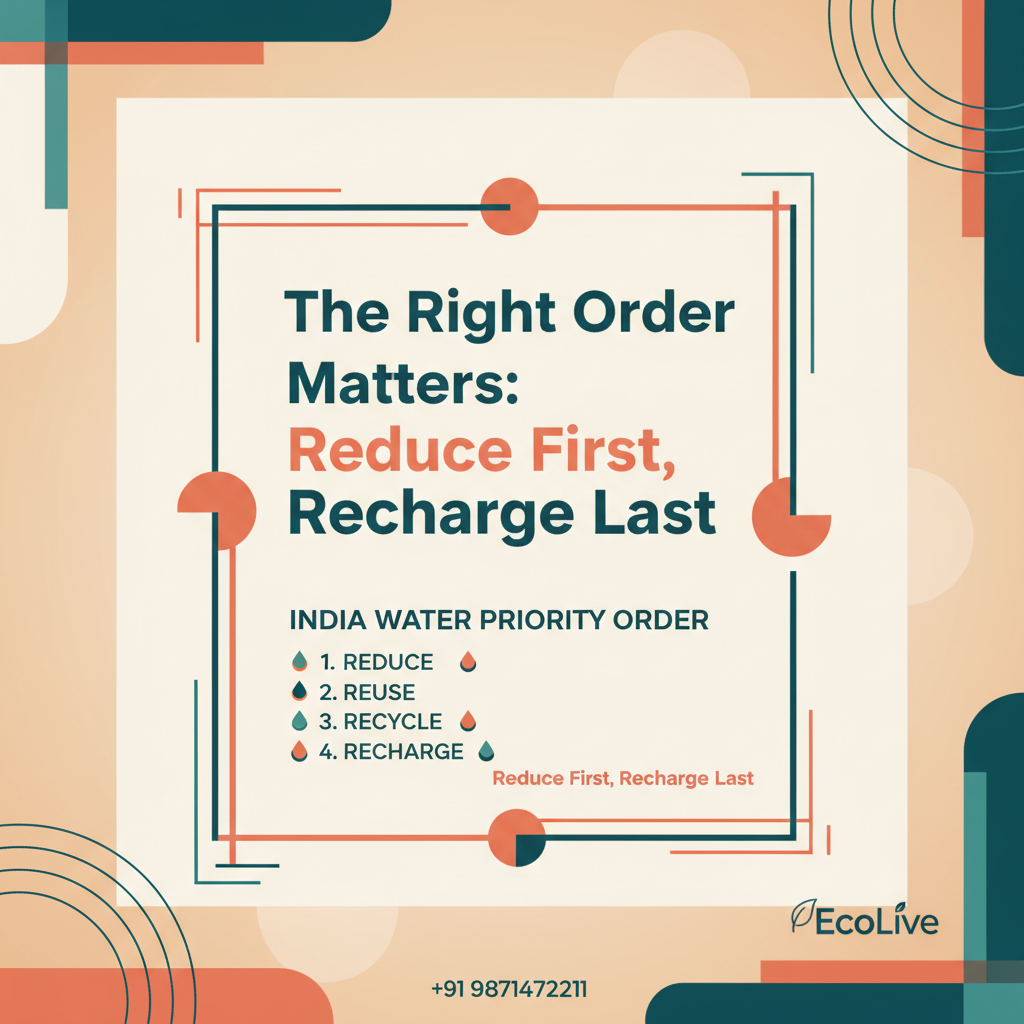
India’s per capita water availability has fallen to roughly 1,100 cubic metres, below the internationally recognised water-stress threshold. NITI Aayog projects that demand will outstrip supply by 2030 in many regions. The answer is not a single silver bullet, but a deliberate sequence of actions. The 4R framework, Reduce, Reuse, Recycle, Recharge, works best when applied in a specific order that mirrors how water actually flows through an economy.
TL;DR: India should tackle water scarcity in a strict order: Reduce demand first (it costs the least and delivers the fastest results), then Reuse water within processes, then Recycle treated wastewater, and finally Recharge groundwater. This sequence maximises every rupee invested and every litre saved. At EcoLive, our EcoWater solutions are designed to follow this exact priority ladder across 2,000+ projects in 14 states.
Why the Order of the 4Rs Matters for India
The order is not alphabetical, and it is not arbitrary. Think of it this way: if a factory is drawing 1,000 kilolitres a day but only needs 600, no amount of recycling or recharging will fix the core waste problem. You have to start at the source.
A water audit by the National Productivity Council found that Indian industries typically waste 20 to 40% of the water they draw. That means the cheapest “new” water source for most facilities is simply the water they are already paying for and throwing away. Reduce comes first because it requires zero capital investment in many cases, just awareness and process changes.
The National Water Mission and the Jal Shakti Abhiyan: Catch the Rain campaign both reinforce this logic, though public discourse often leaps straight to rainwater harvesting without addressing demand first.
Reduce First: The Cheapest litre Is the One You Never Use
Reducing water consumption should always be the first step because it delivers the fastest return with the lowest investment. A thorough water audit, mandatory under CGWA guidelines for over-exploited zones, typically reveals that 20 to 40% of water use in industrial and commercial facilities is recoverable through simple fixes.
What does reduction look like in practice?
- Fixing leaks and losses in distribution pipelines, which alone can save 15 to 20% of supplied water in urban systems
- Installing flow meters and sub-meters to identify which processes consume the most water
- Upgrading to water-efficient fixtures and process equipment
- Behavioural change programmes that make water consciousness a daily habit across the workforce
The Ministry of Jal Shakti has mandated that Indian cities reuse at least 20% of consumed water, but this target becomes far more achievable when overall consumption drops first. Reduction shrinks the denominator, making every subsequent step more effective.
At EcoLive, our water-use efficiency audits regularly identify savings of 25 to 35% for industrial clients before a single new system is installed.
Reuse Second: Close the Loop Within Your Facility
Once you have trimmed demand, the next step is to find internal reuse opportunities. This means taking water that has been used once and running it through the same or another process without full treatment. It is different from recycling, which requires treatment to a specific standard.
Common reuse applications in Indian industries include:
- Cooling tower makeup water from process condensate recovery
- Floor wash and garden irrigation using once-used process water
- Pre-rinse water in food and beverage plants redirected to initial cleaning stages
Urban India generates roughly 72,368 million litres of sewage daily, but only about 28% receives proper treatment. Reuse within industrial campuses can bypass the municipal treatment bottleneck entirely, creating a self-contained water loop that reduces dependency on both freshwater supply and wastewater discharge permits.
Recycle Third: Treat What You Cannot Reuse Directly
Recycling means treating used water to a quality standard that allows it to re-enter a process or be discharged safely. India’s wastewater treatment market reached USD 10.4 billion in 2025 and is projected to nearly double by 2034, reflecting how seriously both regulators and industry are taking this step.
The Council on Energy, Environment and Water (CEEW) has documented that scaling up treated urban wastewater (TUW) reuse could significantly ease pressure on freshwater sources, particularly in water-stressed industrial clusters. The Bureau of Indian Standards has already published guidelines for treated wastewater use in construction, cooling, and irrigation.
The key insight: recycling makes sense only after you have reduced demand and maximised direct reuse. Treating water you did not need to use in the first place is a waste of capital and energy.
Recharge Fourth: Put Water Back Where You Found It
Groundwater recharge through rainwater harvesting and artificial recharge structures is the final piece of the puzzle, not the first. India extracts more groundwater than any other country, and aquifer levels are falling in most states. But recharge alone cannot compensate for unchecked extraction.
Effective recharge requires:
- Rainwater harvesting systems designed for local geology and rainfall patterns (rooftop collection, surface runoff capture, recharge pits, and borewell injection)
- Proper site hydrogeology assessment to ensure water actually reaches the aquifer rather than evaporating or running off
- Long-term maintenance of recharge structures, which is where most community-level systems fail
The Jal Shakti Abhiyan has driven the creation of thousands of water conservation and recharge structures since 2019. But the campaign’s own data shows that structures without maintenance plans lose 30 to 50% of their effectiveness within three years.
This is precisely why EcoLive’s model combines installation with ongoing O&M support. Over 1,150 completed installations across 14 states have collectively contributed to saving more than 1,000 million litres of water. Every system is monitored, maintained, and measured.
How the 4Rs Work Together: A Practical Framework
The 4R framework is not a menu where you pick one item. It is a ladder. Each step depends on the one below it.
Step 1 (Reduce) lowers your total demand, which means you need less water from every other source.
Step 2 (Reuse) keeps water circulating within your facility, cutting both intake and discharge volumes.
Step 3 (Recycle) treats the water you cannot reuse directly, opening up new applications for it.
Step 4 (Recharge) returns water to the aquifer, restoring the natural source that future generations will depend on.
Applied in this order, a mid-sized industrial facility drawing 500 KL per day could realistically cut freshwater demand by 40 to 60% within 12 to 18 months. The savings compound: lower water bills, lower energy costs for pumping and treatment, and reduced regulatory risk under CGWA and state pollution control board norms.
What This Means for Indian Businesses in 2026
Three regulatory and market forces are making the 4R sequence urgent for Indian corporates right now.
BRSR disclosure requirements now mandate water consumption, recycling, and recharge data from India’s top 1,000 listed companies. Boards are asking for measurable water metrics, not aspirational targets. The EcoESG practice at EcoLive helps companies build board-ready water dashboards using the ECHO Framework, our output-led approach to ESG that moves beyond paperwork to measurable improvement.
Water pricing reforms are making cheap water a thing of the past. Several state water regulators have moved to volumetric pricing that penalises waste. Facilities that have already reduced demand are insulated from these hikes.
ESG-linked financing now rewards companies with credible water stewardship plans. Institutional investors are weighting water risk as heavily as carbon emissions when evaluating Indian corporates. A clear, sequenced 4R strategy, supported by verified data, is becoming a prerequisite for favourable ESG scores.
Frequently Asked Questions
What is the correct order of reduce, reuse, recycle, and recharge for water management?
The correct priority order is Reduce, Reuse, Recycle, Recharge. Reduce comes first because cutting unnecessary consumption is the cheapest and fastest way to conserve water. Reuse follows by circulating water within processes before treating it. Recycle treats what cannot be reused directly. Recharge, putting water back into aquifers, comes last because it is the most capital-intensive step and works best when overall demand has already been lowered.
How much water can Indian industries save by following the 4R framework?
A well-implemented 4R strategy can reduce an industrial facility’s freshwater demand by 40 to 60% within 12 to 18 months, according to National Productivity Council water audit benchmarks. Reduction alone (fixing leaks, upgrading fixtures, behavioural change) typically recovers 20 to 35% of wasted water before any new infrastructure is needed.
Is rainwater harvesting enough to solve India’s water crisis?
Rainwater harvesting and groundwater recharge are essential but insufficient on their own. They are the fourth step (Recharge) in the 4R priority order. If demand reduction and reuse are ignored, recharge structures cannot compensate for the rate of extraction. The Jal Shakti Abhiyan has built thousands of recharge structures, but data shows that unmaintained systems lose 30 to 50% effectiveness within three years.
What government regulations support the 4R approach in India?
The CGWA mandates water audits and conservation plans for industries in over-exploited groundwater zones. The Ministry of Jal Shakti requires cities to reuse at least 20% of consumed water. BRSR disclosure makes water metrics mandatory for top 1,000 listed companies. The Jal Shakti Abhiyan promotes recharge structures and community conservation across districts.
How does EcoLive help companies implement the 4R framework?
EcoLive offers end-to-end water sustainability solutions through its EcoWater service line, covering water-use audits (Reduce), process water optimisation (Reuse and Recycle), and rainwater harvesting with groundwater recharge systems (Recharge). With over 2,000 projects across 14 states and more than 1,150 installations, EcoLive provides strategy, execution, and long-term O&M support under a single partnership.
India does not have a water crisis as much as it has a water management sequence problem. We have been reaching for the most expensive, most visible solution (recharge) before fixing the cheapest one (reduce). The 4R ladder gives Indian businesses and communities a clear, investable path from waste to water positivity.
Want to know where your facility stands on the 4R ladder? Get in touch with EcoLive for a free water-use assessment, or call us directly at +91 9871472211. We will show you exactly how much water and money you can save, and build you a roadmap to get there.