


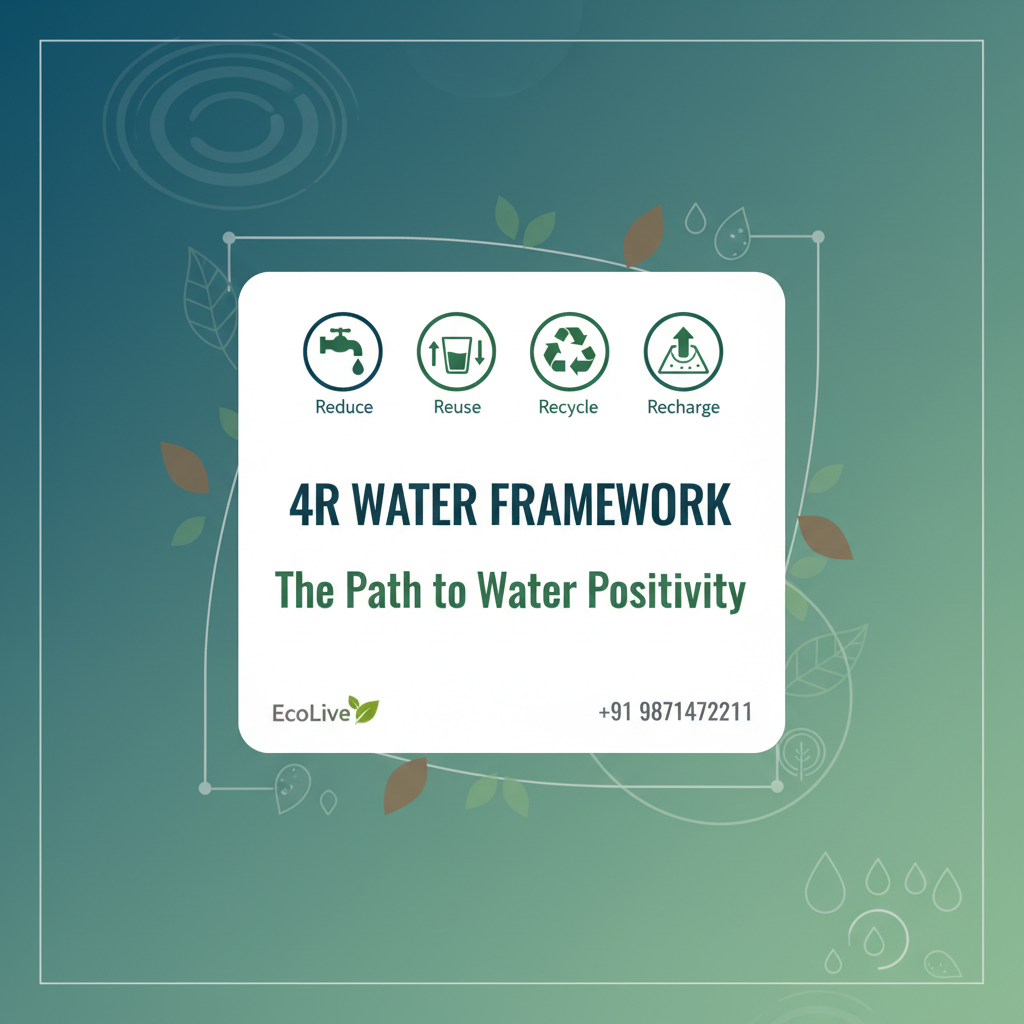
India’s corporates face a choice: adapt to water scarcity or watch costs climb. The 4R framework—Reduce, Reuse, Recycle, Recharge—offers a structured path to water positivity. Not as a buzzword, but as a measurable state where you return more water to the ecosystem than you consume.
What Does “Water Positive” Actually Mean?
Being water positive means your facility puts more water back into local systems than it withdraws. It’s not about using zero water. It’s about balance: reduce what you take, extend the life of every drop, treat and return water safely, and replenish groundwater. Companies like Microsoft and PepsiCo have committed to water positivity by 2030. Indian firms following BRSR mandates are now asked to show progress on similar metrics.
The 4R Framework Explained
EcoLive’s 4R model provides a practical sequence. Each step builds on the last:
- Reduce: Cut consumption at source through audits, efficient fixtures, and behavioural change
- Reuse: Channel greywater and process water to secondary uses without treatment
- Recycle: Treat wastewater to quality standards for non-potable applications
- Recharge: Return water to aquifers through rainwater harvesting and recharge structures
Most facilities jump to recycling—the most expensive step—without first reducing and reusing. That’s backwards. The 4R sequence prioritises low-cost interventions before capital-intensive ones.
Reduce: The First Line of Defense
Reduction costs the least and saves the most. A water audit typically reveals 15-30% waste from leaks, inefficient fixtures, and poor processes. Fixing a single leaking tap saves 10,000 litres annually. Upgrading to efficient fixtures in a 500-employee facility can cut water use by 20-25% within months.
Quick wins:
- Install aerators on taps (cost: ₹200 per tap, payback: 3 months)
- Detect and repair underground leaks (saves 10-40% in many facilities)
- Optimise cooling tower blowdown (reduces consumption by 15-20%)
Reuse: Getting More from Every Drop
Before treating water, ask: can it be used again as-is? Cooling tower bleed-off can flush toilets. RO reject water can irrigate landscapes. Condensate from air conditioning—often 5-10 litres per unit per day—can supplement cooling tower feed.
Reuse requires minimal infrastructure: storage tanks, pipelines, and basic filtration. A 100,000 sq ft office building can capture 30,000-50,000 litres monthly from AC condensate alone during summer.
Recycle: Closing the Loop
Recycling treats wastewater to a quality suitable for non-potable reuse: gardening, flushing, cooling, even process water in some industries. Sewage treatment plants (STPs) and effluent treatment plants (ETPs) are the backbone.
Modern STPs using MBR or MBBR technology produce water matching irrigation standards. For industrial facilities, tertiary treatment enables process reuse. The capital cost is higher, but so is the payoff: a well-designed recycle system can cut freshwater intake by 40-60%.
Key metric: Recycling ratio—percentage of wastewater treated and reused. Leading Indian facilities achieve 80%+ ratios. BRSR now asks for this number.
Recharge: Giving Back to the Ground
Recharge completes the cycle. Whatever you can’t reuse or recycle, you return to the aquifer. Rainwater harvesting is the primary method: capturing rooftop and surface runoff, filtering it, and directing it to recharge wells or borewells.
India receives 4,000 billion cubic metres of rain annually. Most runs off. A 10,000 sq m industrial roof in a 600mm rainfall zone can potentially recharge 40-50 lakh litres annually. That’s water for the facility and the surrounding community.
Industrial rainwater harvesting also qualifies as CSR spend under Schedule VII, making it financially attractive for listed companies.
Why Data Is the Glue Holding 4R Together
None of this works without measurement. You can’t reduce what you don’t measure. You can’t report to BRSR without numbers. Most facilities have fragmented data: some sub-meters, a few bills, manual logs that nobody reviews.
A proper 4R implementation includes:
- Flow meters at source points (municipal, borewell, tanker)
- Sub-meters by building or process
- STP inlet/outlet monitoring
- Groundwater level tracking
- Dashboards showing real-time consumption and trends
BRSR requires water data—withdrawal, consumption, discharge, and recycling ratios. The 4R framework generates exactly these numbers as a byproduct of good management.
From 4R to Water Positive: The Path
Water positivity isn’t achieved overnight. It’s a progression:
- Baseline (Year 0): Measure current water balance. Know your numbers.
- Reduce (Year 1): Audit and fix leaks, upgrade fixtures. Target 20% reduction.
- Reuse (Year 1-2): Identify secondary uses for process and greywater. Low capex.
- Recycle (Year 2-3): Install STP/ETP. Target 50%+ recycling ratio.
- Recharge (Year 2-3): Implement rainwater harvesting. Offset 20-30% of consumption.
- Water Positive (Year 4+): Recharge exceeds withdrawal. Verified by third-party audit.
Most facilities with committed leadership reach water positive status in 4-5 years. Some faster.
EcoLive’s Approach: Data-First 4R Implementation
At EcoLive, we’ve guided 2,000+ projects across 14 states using the 4R framework. We don’t start with equipment. We start with data: a water audit that maps every inlet, outlet, and loss point. Then we design interventions in sequence—reduce before reuse, reuse before recycle, recycle before recharge.
Our projects have saved over 1,000 million litres of water. Not through wishful thinking, but through measured interventions tracked on dashboards that facility managers actually use.
Next Steps
If you’re a facility manager looking to cut tanker costs, a sustainability head preparing for BRSR, or a CSR lead seeking impactful projects—the 4R framework applies to all three.
Start with a water audit. Know your baseline. Then move systematically through Reduce, Reuse, Recycle, and Recharge.
Ready to begin? Contact EcoLive at +91 9871472211 or visit ecolive.in/water to schedule your water audit.