How to Implement Water Reuse in Commercial Laundries
A standard commercial laundry processing 5,000 kilograms of linen daily consumes nearly 125,000 litres of freshwater. Most of this water is heated, loaded with detergents, and discharged directly into the municipal drain. This linear model drains operational budgets and exposes facilities to severe compliance risks. By engineering a closed-loop system for water reuse in commercial laundries, facility managers can recover and reuse up to 70% of their wastewater, as noted by industry benchmark reports.
TL;DR: Commercial laundries can cut freshwater dependency by implementing the 4R framework. The process requires a baseline audit, thermal energy recovery, greywater segregation, and fit-for-purpose filtration. This approach lowers tanker bills, ensures regulatory compliance, and advances corporate water stewardship goals.
How does water reuse in commercial laundries improve corporate stewardship?
Water reuse in commercial laundries improves corporate stewardship by measuring, reducing, and treating every drop of water used in the washing process to minimize local aquifer drain. Facilities adopting strict reuse protocols reduce their freshwater intake by up to 60%, according to global laundry standards. This practice shifts operations from a compliance burden to a measurable ESG asset.
When a laundry facility stops relying entirely on borewells or expensive tankers, it stabilizes its operational costs. This is the foundation of achieving water positive India targets.
How much money does water reuse in commercial laundries save?
Water reuse in commercial laundries saves money by eliminating the dual cost of buying freshwater and paying steep penalties for untreated effluent discharge. Water neutrality is not just an environmental metric; it is a financial strategy heavily scrutinized by the pollution control board. Commercial laundries face rising costs for freshwater access.
Below is a comparison of typical costs associated with a 100 KLD (kilolitres per day) laundry operation in a major Indian metro area.
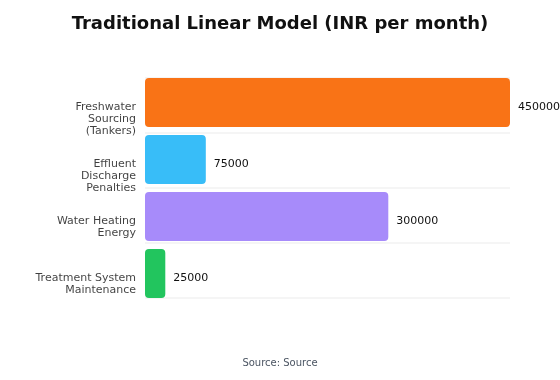
Note: Figures are indicative averages for a 100 KLD facility in Delhi NCR.
The table shows a clear payback period. The savings in tanker costs and heating energy quickly offset the capital expenditure of the treatment plant.
How do you start a water reuse project in a laundry?
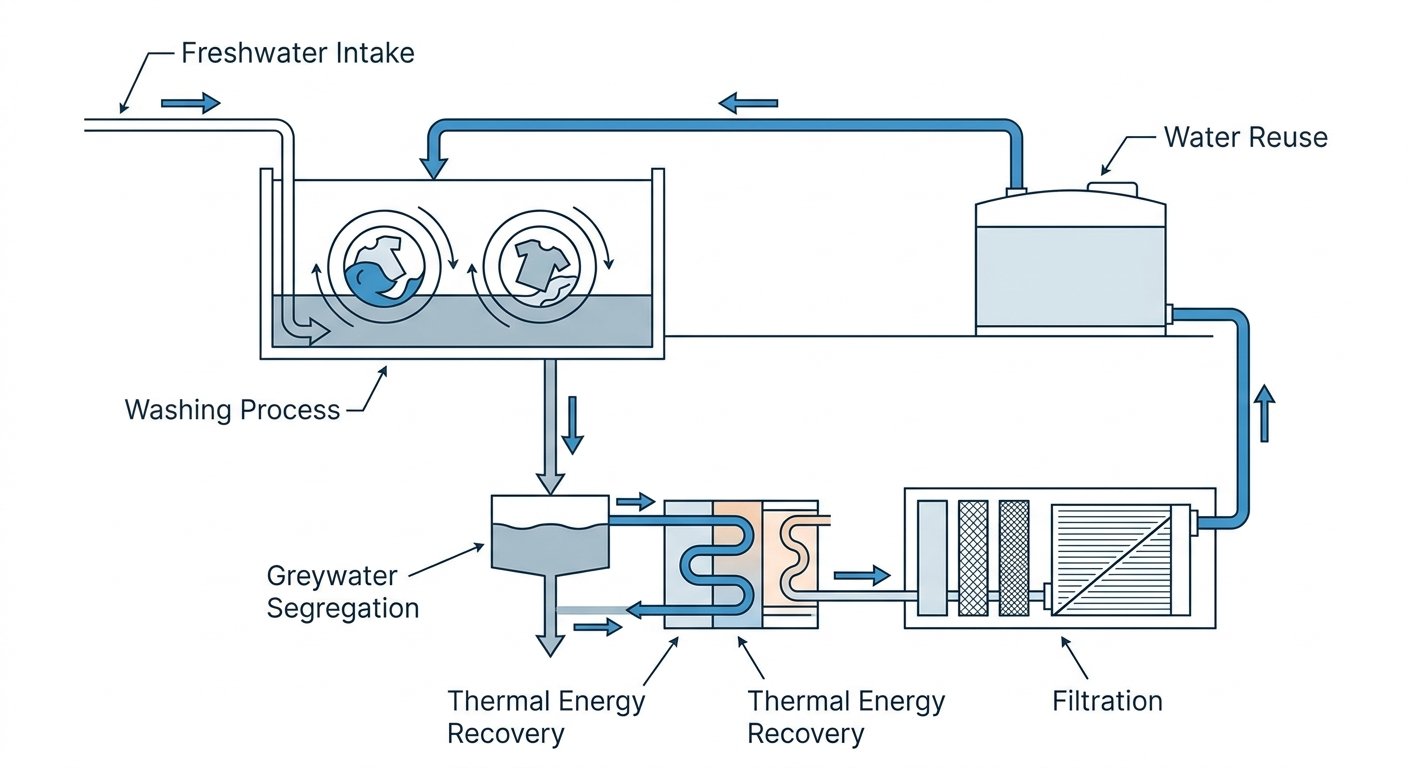
You start a water reuse project in a laundry by metering every incoming line, washing machine, and discharge point for exactly seven days to establish a baseline. Facilities that skip this step over-size their treatment plants and waste up to 30% on unnecessary capital expenditure, a common pitfall noted in water management studies.
An accurate water balance report reveals exactly where water is lost. You must identify the water intensity per kilogram of linen processed. This metric becomes your baseline for all future improvements.
Why is segregating laundry wastewater critical for reuse?
Segregating laundry wastewater is critical because separating light rinse water from heavy wash water reduces the total volume requiring intensive chemical treatment by nearly 50%. Light rinse water only needs basic filtration before it can be reused in the next pre-wash cycle.
Heavy effluent contains fats, oils, grease, and high concentrations of surfactants. Mixing this with relatively clean rinse water contaminates the entire volume. By separating the streams at the source, you lower your treatment costs and improve the efficiency of your treated water reuse system.
How does thermal energy recovery lower laundry costs?
Thermal energy recovery lowers laundry costs by transferring heat from hot, dirty wastewater to incoming cold freshwater, significantly reducing boiler fuel consumption. Laundries spend massive amounts of money heating water, as highlighted by energy efficiency data. When hot wastewater goes down the drain, that thermal energy is lost forever.
Install a heat exchanger on the heavy effluent discharge line. The hot, dirty water passes through the exchanger, transferring its heat to the incoming cold freshwater. This simple mechanical step reduces boiler fuel consumption and cools the effluent to a temperature suitable for biological treatment.
What is fit-for-purpose filtration in a laundry?
Fit-for-purpose filtration in a laundry means treating wastewater only to the quality level required for its next specific use, saving up to 40% in operational energy compared to total purification. You do not need reverse osmosis water for a pre-wash cycle.
The treatment train typically involves: 1. Shaker screens to remove lint and large solids. 2. Dissolved Air Flotation (DAF) to remove suspended solids and grease. 3. Ultrafiltration (UF) to remove bacteria and fine particles. 4. Reverse Osmosis (RO) only for the final rinse water to prevent linen yellowing.
Applying the 4R framework ensures every stage of this treatment is optimized for maximum recovery.
How do you measure ESG metrics for laundry water reuse?
You measure ESG metrics for laundry water reuse by installing smart meters on the reuse lines to track the daily volume of water recovered and the reduction in freshwater intake. Once the system is operational, you must measure the outcomes.
For corporate clients, these numbers are vital. They feed directly into BRSR reports and corporate water stewardship india initiatives. Transparent, metered data proves your commitment to sustainability and secures trust with your stakeholders.
How does water reuse help achieve a water positive India?
Water reuse helps achieve a water positive India by reducing the aggregate demand on municipal supplies by millions of litres daily, directly stabilizing local groundwater tables. When commercial laundries stop extracting from borewells and start recycling their own effluent, they leave more water in the ground for communities.
This shift is mandatory for long-term survival. Managing your water efficiently is no longer just about compliance. It is about ensuring your facility can operate through the next dry season.
FAQ
What is corporate water stewardship in commercial laundries? Corporate water stewardship in a laundry facility means measuring, reducing, and treating every drop of water used in the washing process to minimize local aquifer drain. Facilities adopting strict reuse protocols reduce their freshwater intake by up to 60%.
How much water can a commercial laundry recycle? With a properly engineered treatment system, a commercial laundry can recycle and reuse between 60% and 70% of its total wastewater for subsequent washing cycles. This drastically reduces reliance on municipal water and tankers.
Why is segregating laundry wastewater important? Segregating light rinse water from heavy wash water reduces the total volume of water requiring intensive chemical treatment by nearly 50%. Light rinse water only needs basic filtration before reuse, saving significant operational costs.
What is fit-for-purpose filtration? Fit-for-purpose filtration means treating wastewater only to the quality level required for its next specific use. This targeted approach saves up to 40% in operational energy compared to total purification.
Ready to cut your laundry’s water costs? Contact EcoLive at +91 9871472211 or visit ecolive.in to request a comprehensive water audit today.