The Water Quality Crisis in India 2025-26: Why CSR Must Shift from Access to Quality
India has connected 81.57% of rural households to tap water under the Jal Jeevan Mission. The infrastructure now exists. But the water flowing through those pipes tells a different story. Nearly 600 million Indians currently face high-to-extreme water stress, driven not just by empty aquifers but by severe contamination, accelerating the water quality crisis in India. For corporate sustainability heads planning their FY26 budgets, funding basic water access is no longer enough. The focus must shift to water quality, measurable outcomes, and permanent groundwater recharge.
TL;DR: India’s water crisis has evolved from a lack of access to a severe deficit in water quality. Corporate Social Responsibility (CSR) programs in 2025-26 must move beyond funding basic taps and borewells. The new standard requires investing in groundwater recharge, lateral filtration, and the 4R framework to deliver verifiable, board-ready water quality improvements.
What is the 2025-26 water quality crisis in India?
The 2025-26 water quality crisis in India is the rapid degradation of available surface and groundwater resources. While access infrastructure has expanded, water quality remains a top development challenge. Heavy metals, industrial runoff, and untreated sewage contaminate the supply. Corporate CSR must now address purification and source protection rather than just distribution.
For decades, companies funded borewells and overhead tanks. These projects looked great in annual reports. Today, those same borewells pump out water laced with fluoride, arsenic, and nitrates. You cannot solve groundwater depletion by digging deeper. A deeper drill simply reaches older, more contaminated water. True water security requires capturing clean monsoon rain, filtering it naturally, and putting it back into the ground.
Why is water access no longer the primary CSR metric?
Water access is no longer the primary CSR metric because government schemes have largely solved the distribution problem. The gap has moved from pipeline installation to environmental sustainability and resource quality. Funding a new pipeline does not help a community if the source aquifer is polluted or dry.
When a corporate board approves a water project, they expect lasting impact. A reverse osmosis (RO) plant installed in a village provides immediate relief. However, it also rejects up to 60% of the input water as toxic brine. This brine seeps back into the local soil. The community gets a short-term fix while their long-term soil health degrades. Modern CSR demands solutions that improve the total water balance of the region without creating secondary waste.
How does the water quality crisis in India impact community finances?
The water quality crisis in India severely impacts community finances by forcing residents to rely on expensive private water tankers when local sources fail or become toxic. A mid-sized residential society or village can easily spend ₹1 lakh to ₹2 lakh per month on tanker water during the summer. This expense diverts funds from education, healthcare, and economic growth.
Corporate CSR interventions that restore contaminated ponds or build decentralized recharge structures eliminate this financial burden. By treating and recharging water locally, communities regain their water independence. They stop paying premium rates for tanker deliveries. The return on investment for the CSR fund becomes highly visible and easily measured in rupees saved per month.
How can CSR programs measure water quality outcomes?
CSR programs can measure water quality outcomes by tracking the total volume of water recharged, the reduction in total dissolved solids (TDS), and the community’s reduced dependence on tankers. Enhancing the quality of life requires verifiable metrics. Companies must measure litres saved and litres recharged annually.
EcoLive measures every project by its outcomes. We do not just build a structure and walk away. We install smart metering and monitoring systems to verify exactly how much water enters the aquifer. This data feeds directly into corporate ESG water compliance reports. When a sustainability director presents to the board, they bring hard numbers, not just photographs of a ribbon-cutting ceremony.
Which CSR water projects are most cost-effective?
The most cost-effective CSR water projects are natural recharge and treated wastewater reuse systems, which deliver significantly more water per rupee spent than traditional RO plants or borewells. The table below compares common water projects based on their capital cost and the volume of water they secure annually.
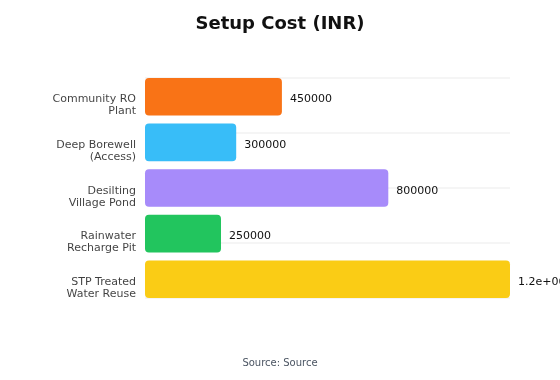
As the data shows, natural recharge and reuse projects deliver significantly more water per rupee spent. They also boast longer operational lifespans. A community RO plant requires constant filter changes and electricity. A properly designed rainwater recharge pit works via gravity and requires only basic annual desilting.
How do you implement the 4R framework for corporate CSR?
You implement the 4R framework for corporate CSR by treating water as a circular resource through a unified system of reducing demand, reusing greywater, recycling blackwater, and recharging aquifers. This methodology ensures that no drop is wasted and every intervention compounds the benefits of the others.
First, we reduce demand by fixing leaks and installing efficient fixtures in community buildings or local schools. Second, we reuse greywater for landscaping and non-potable needs. Third, we recycle blackwater through decentralized treatment plants. Finally, we recharge the local aquifer by capturing monsoon runoff. This unified approach transforms a vulnerable community into a water-positive zone.
What are the best interventions for groundwater recharge?
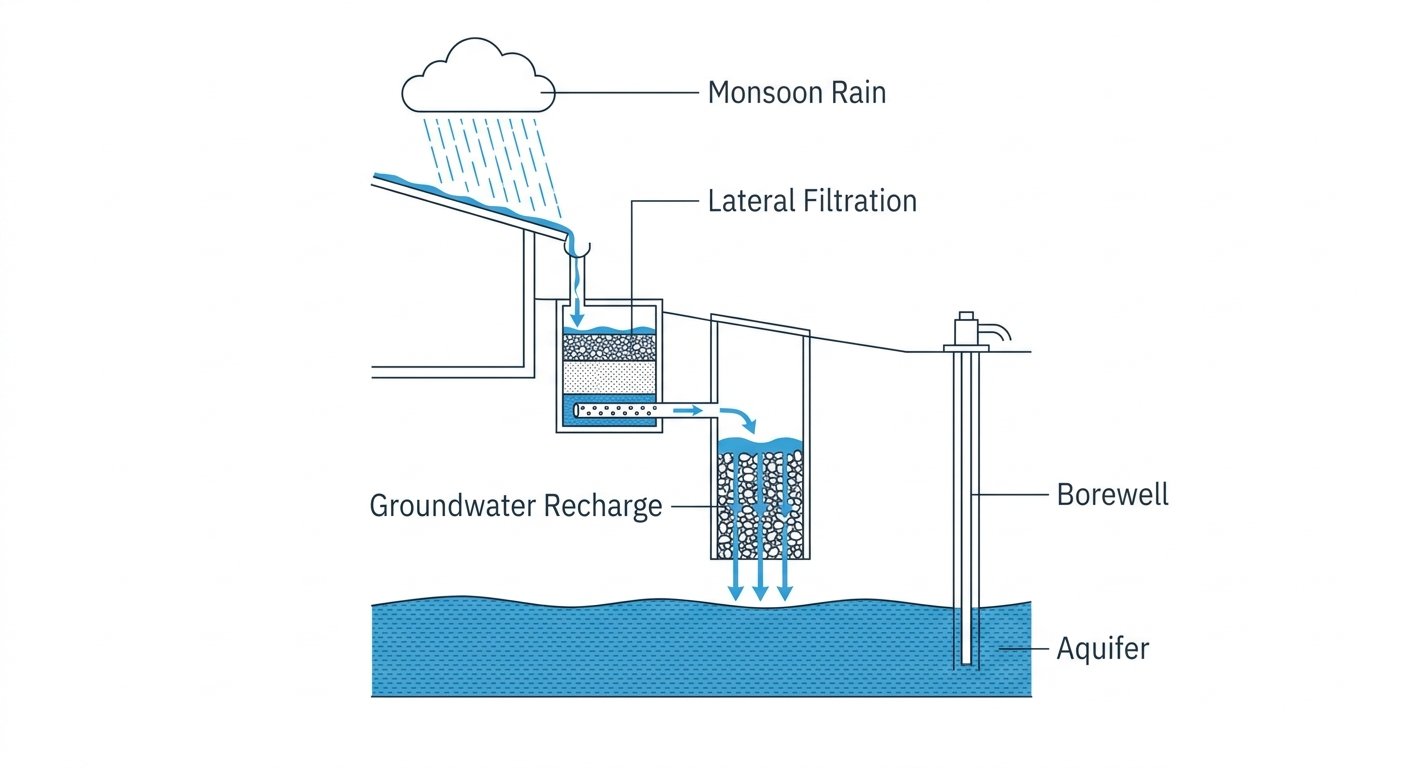
The best interventions for groundwater recharge include lateral filtration pits, rejuvenated stepwells, and scientifically designed injection wells. These structures capture the 75% of annual rainfall that arrives during the four monsoon months. They filter out silt and debris before directing the clean water into the aquifer.
Most traditional rainwater harvesting (RWH) systems fail within two years because they lack proper filtration. Silt clogs the pores of the recharge well, turning it into a stagnant puddle. EcoLive engineers recharge systems with multi-layered lateral filters. We design them based on the specific runoff volume of the catchment area. This ensures the system survives heavy monsoon downpours and continues to recharge the aquifer for decades.
FAQ
What is the focus of water CSR in India for 2025-26? The focus of water CSR in India has shifted from providing basic access (like digging borewells) to ensuring water quality. Companies are now investing in groundwater recharge, lateral filtration, and the 4R framework to combat severe contamination and aquifer depletion.
Why are traditional borewell CSR projects failing? Traditional borewell projects fail because they extract water from rapidly depleting aquifers. As the water table drops, the remaining water often contains high levels of natural contaminants like fluoride and arsenic, creating a public health hazard rather than a solution.
How does the 4R framework improve CSR water projects? The 4R framework (Reduce, Reuse, Recycle, Recharge) treats water as a circular resource. It ensures communities reduce waste, reuse greywater, recycle treated sewage, and recharge rainwater back into the ground, creating a sustainable and measurable water balance.
How can companies measure the success of water CSR? Companies can measure success by tracking the exact volume of water recharged into the ground, the reduction in local tanker water costs, and the improvement in groundwater quality (such as lower TDS levels). These metrics provide board-ready data for ESG reporting.
Take Action on Your FY26 CSR Water Strategy
The era of funding simple water access is over. The 2025-26 mandate requires measurable improvements in water quality and aquifer health. If your company needs to deploy CSR funds effectively, you need an engineering partner who guarantees outcomes. We have delivered 1,150 successful projects across 11 states, saving over 652 million litres of water.
Stop guessing about your CSR impact. Let us build a verifiable, data-backed water project that your board will proudly stand behind.
Ready to shift your CSR strategy to measurable outcomes? Call EcoLive at +91 9871472211 or visit ecolive.in to request a project assessment today.