What Is an Effluent Treatment Plant? Complete Guide
Indian industry generates an estimated 13,468 million litres of effluent daily, according to CPCB data. An effluent treatment plant is the system designed to purify that water before discharge or reuse. An ETP, or effluent treatment plant, treats industrial wastewater by removing chemicals, organic matter, and suspended solids so the water meets regulatory standards or can be routed back into the factory.
TL;DR: An effluent treatment plant purifies industrial wastewater through physical, chemical, and biological stages. Indian factories can budget ₹5 lakh to ₹1.5 crore depending on capacity. The real value lies in reusing treated water to cut freshwater costs by 30-50%.
What Is an ETP and Why Does Your Factory Need One?
An effluent treatment plant is a facility that treats wastewater from industrial processes so it meets pollution-control norms for safe discharge or reuse. The need for an ETP goes beyond regulation. Without one, your factory faces three direct costs: freshwater purchase, effluent discharge fees, and the risk of production shutdown from a compliance notice.
For a facility head in Bhiwadi or Neemrana, the question is not whether to install an ETP. Most already have one. The question is whether the existing system is reducing water costs or simply meeting the minimum discharge standard while treated water flows into a drain.
How Does the Effluent Treatment Plant Process Work?
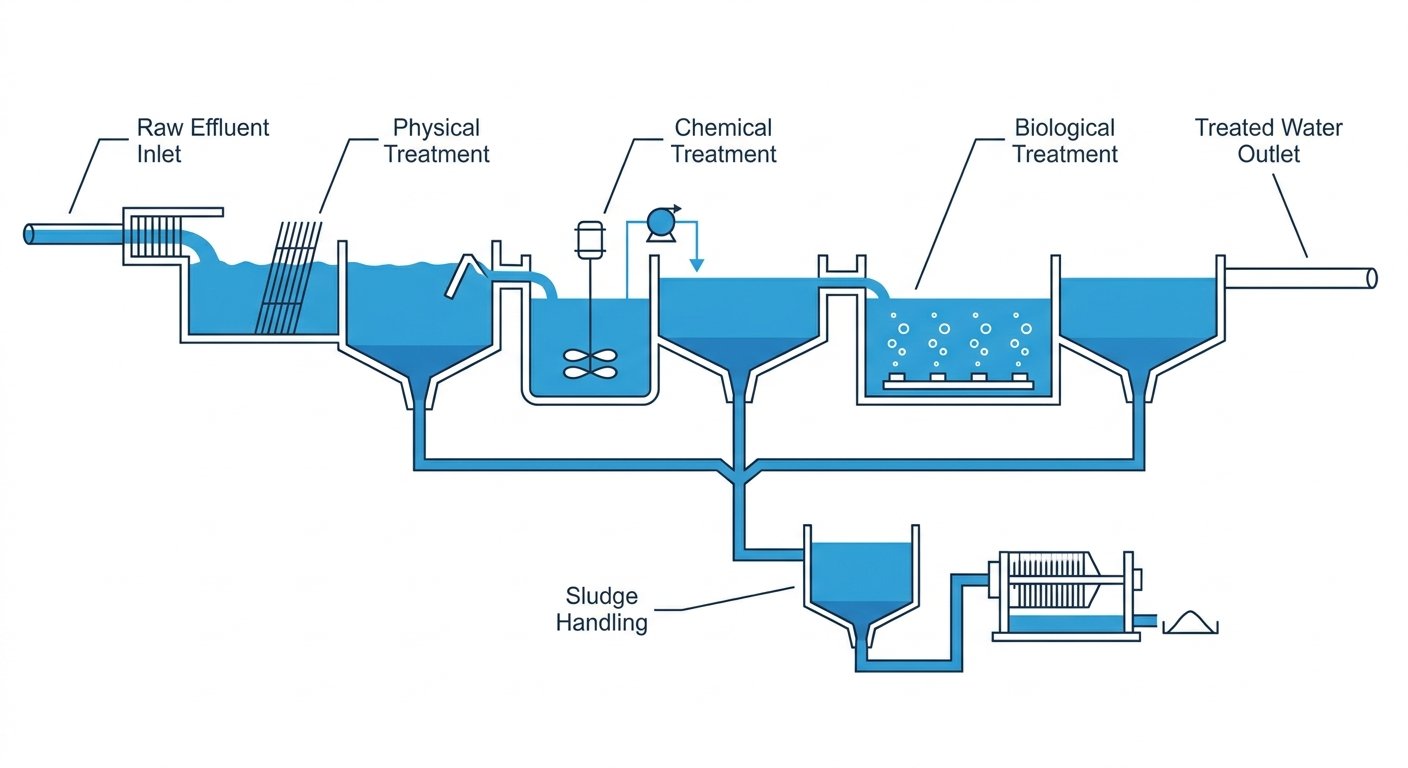
The ETP process moves wastewater through a sequence of treatment stages, each removing a specific category of contaminants. Raw effluent enters at one end. Treated water exits at the other, clean enough for non-potable reuse or regulated discharge. Sludge, the concentrated waste byproduct, is handled separately.
The process is not one-size-fits-all. A textile factory in Rajasthan produces dye-laden effluent with high COD and colour. A food-processing unit in Punjab generates organic-rich wastewater with high BOD. The ETP design for each is built around those specific characteristics.
What Are the Four Stages of Effluent Treatment?
Every effluent treatment plant follows four sequential stages: preliminary, primary, secondary, and tertiary treatment. Each stage removes a specific category of contaminants, and the standard ETP process follows this order regardless of industry. Some factories skip the tertiary stage if discharge norms allow it. Others add advanced polishing for water reuse.
Preliminary treatment
Bar screens remove large debris. An equalization tank balances flow and concentration over 8-24 hours, smoothing out the shocks from batch production. Without equalization, the downstream biological treatment crashes.
Primary treatment
Physico-chemical methods precipitate suspended solids and dissolved metals. Coagulants like alum or ferric chloride are dosed, followed by flocculation and clarification. This stage removes 50-70% of suspended solids and a portion of heavy metals.
Secondary treatment
Biological processes break down organic matter. Common technologies include activated sludge process (ASP), moving bed biofilm reactor (MBBR), and membrane bioreactor (MBR). MBR produces higher-quality effluent but costs more to operate. This stage handles BOD and COD reduction, typically achieving 80-95% removal.
Tertiary treatment
When the factory plans to reuse treated water, a polishing step is added. Options include reverse osmosis (RO), activated carbon filtration, UV disinfection, or chlorination. Tertiary-treated water from an ETP can meet cooling-tower make-up quality, toilet-flushing standards, or even process-water specifications for certain industries.
What Types of ETPs Suit Different Industries?
The right ETP design depends entirely on what your factory puts into the water. Different industries produce different contaminants, and the treatment train must match.
| Industry | Primary Contaminants | Typical ETP Technology | Common Capacity (KLD) |
|---|---|---|---|
| Textile and dyeing | Dyes, high COD, colour, salts | Physico-chemical + biological + RO | 100-500 |
| Pharmaceutical | Organics, solvents, active ingredients | MBR + advanced oxidation | 50-200 |
| Food and beverage | High BOD, oils, suspended solids | ASP + dissolved air flotation | 100-1,000 |
| Automobile and engineering | Oils, heavy metals, suspended solids | Physico-chemical + filtration | 50-250 |
| Chemical manufacturing | Acids, alkalis, heavy metals, organics | Neutralization + precipitation + bio | 200-2,000 |
An ETP manufacturer who proposes a standard package without first analysing your effluent characteristics is not engineering a solution. They are selling a box.
How Much Does an Effluent Treatment Plant Cost in India?
An effluent treatment plant in India costs between ₹5 lakh and ₹1.5 crore installed, depending on capacity and technology choice. ETP pricing varies based on capacity, automation level, and whether reuse is included. The figures below are market ranges from Indian procurement platforms, representing installed costs including civil work, equipment, and commissioning.
| Capacity Range | Installed Cost (₹ lakh) | Typical Technology | Annual O&M (₹ lakh) |
|---|---|---|---|
| 50-100 KLD | 5-15 | ASP / physico-chemical | 2-4 |
| 100-250 KLD | 15-35 | MBBR / ASP | 4-8 |
| 250-500 KLD | 35-75 | MBBR + tertiary | 8-18 |
| 500-1,000 KLD | 75-150 | MBR + RO recovery | 18-40 |
| 1,000+ KLD | 150-350 | Custom multi-stage | 40-100+ |
These are indicative. A factory adding RO recovery for reuse will see a 25-40% jump in capital cost but can reduce freshwater purchase by 30-50%. The payback period for the reuse add-on typically falls between 12-24 months, depending on local freshwater and tanker rates.
For factories already running an ETP, the faster path to savings is often not a new plant but an audit of the existing system to find where treated water is being discharged instead of reused.
How Do You Choose the Right ETP Manufacturer?
The right ETP manufacturer is one who analyses your effluent before quoting a price and can demonstrate working installations in your industry. India has hundreds of ETP vendors, from regional workshops to organised engineering firms. The gap in quality between them is significant. A poorly designed ETP fails in two to three years. Here is what separates competent manufacturers from the rest.
Effluent characterisation first
A credible manufacturer will not quote a price without receiving your effluent sample and a 24-hour composite test report. If they quote on capacity alone, move on.
Proven installations in your industry
Ask for at least two running installations in a similar industry, preferably in your region. Visit one if possible. A textile ETP behaves very differently from a pharma ETP.
O&M commitment
The plant that runs well at commissioning and fails in year two was almost certainly not maintained. Look for manufacturers who offer annual maintenance contracts with performance guarantees tied to treated-water quality parameters.
Reuse design capability
If your goal is to reduce freshwater costs, the manufacturer must design the ETP output for a specific reuse application, not just for discharge compliance. Ask a direct question: “What quality will this water meet, and for what use?”
Automation and monitoring
Modern ETPs include online monitoring of pH, COD, and flow. This is not a luxury. It is what lets a facility head know the plant is working without standing next to it.
Can ETP Treated Water Replace Freshwater in Your Factory?
Yes. Treated ETP water can replace freshwater in cooling towers, toilet flushing, floor washing, gardening, and certain process applications, cutting freshwater demand by 30-60%. Most Indian factories treat their effluent to the minimum discharge standard and release it. Urban India generates 72,368 million litres of sewage daily, and industrial effluent adds significantly to that volume. The treated fraction that actually gets reused remains small.
Treated ETP water can replace freshwater in cooling towers, boiler make-up (after further polishing), toilet flushing, floor washing, gardening, and certain process-water applications. A factory reusing 60% of its ETP output effectively cuts freshwater demand by that margin. Our detailed guide on STP treated water reuse for factories and hotels covers the quality parameters and piping requirements for each application.
The economics are straightforward. If a factory buys freshwater at ₹60 per kilolitre and uses 500 KLD, the annual freshwater bill is ₹1.09 crore. Reusing 60% of treated ETP water at an incremental treatment cost of ₹15 per kilolitre saves roughly ₹49 lakh per year. The reuse retrofit pays for itself.
Why Do Most ETPs Underperform After Installation?
Most ETPs underperform because of five fixable causes: inadequate equalization, poor sludge management, untrained operators, uncalibrated chemical dosing, and no performance monitoring. None of them require a new plant to fix.
Inadequate equalization
Batch processes create concentration spikes. If the equalization tank is undersized, the biological treatment receives shock loads and fails. This is the single most common design error in Indian ETPs.
Sludge management ignored
Sludge accumulates and is rarely analysed or disposed of correctly. Excess sludge backs up into the treatment train, reducing efficiency across every stage.
No operator training
The plant is handed over to a facility electrician or plumber with a one-day walkthrough. Biological treatment requires understanding of MLSS, F/M ratio, and aeration timing. Without trained operators, performance degrades within months.
Chemical dosing not calibrated
Coagulant and polymer doses are set at commissioning and never adjusted as effluent characteristics change with production schedules. The result is either over-dosing (wasted chemicals) or under-dosing (poor treatment).
No performance monitoring
Are you measuring treated-water quality daily? At minimum, that means pH, COD, and TSS. Without those numbers, you have no way to know whether the plant is working. You find out only when a pollution board inspector tells you it is not.
A water balance assessment identifies exactly how much of your treated water is being reused versus discharged, and where the gaps are.
Where Does an ETP Fit in the 4R Water Framework?
An ETP serves the Reuse and Recycle arms of the 4R framework, turning wastewater from a disposal problem into a usable resource within the factory. An ETP alone is not a water strategy. It is one component within the 4R framework: Reduce, Reuse, Recycle, Recharge.
Reduce. An ETP does not reduce water consumption directly. But when paired with flow meters and process audits, it reveals where water is being wasted upstream, before it even reaches the effluent stream.
Reuse. Treated ETP water routed to non-potable applications is the Reuse arm. This is where most factories find their fastest payback.
Recycle. Advanced ETP configurations with RO recovery can recycle water back into specific process steps, closing the loop within the factory boundary.
Recharge. Where on-site recharge is feasible, excess treated water that cannot be reused can percolate into the groundwater table instead of being discharged to a drain. This is especially relevant for factories in water-stressed corridors like Gurugram and Bhiwadi.
The water balance optimiser tool can simulate how an ETP with reuse integration changes your factory’s overall water balance, showing litres saved and cost reduction before you spend on any hardware.
Does ETP Performance Affect Your BRSR Disclosure?
Yes. ETP performance data feeds directly into BRSR water-intensity metrics, effluent-treatment indicators, and water-recycling disclosures. For listed companies and large unlisted firms filing BRSR disclosures, ETP performance data feeds directly into water-intensity metrics and effluent-treatment indicators. The BRSR water compliance framework requires reporting on total water consumed, water recycled, and effluent discharged. A factory with an ETP that reuses treated water reports measurably better numbers than one that only discharges.
ESG directors increasingly view ETP reuse not as an operations cost but as a reported ESG outcome. The data is already being generated at the plant level. The gap is usually in measurement and reporting, not in the treatment itself.
FAQ
What is the difference between an ETP and an STP?
An ETP treats industrial wastewater containing chemicals, heavy metals, and process-specific contaminants. An STP treats domestic sewage from toilets, kitchens, and bathrooms. Some large campuses run both systems separately because mixing the two streams complicates treatment.
How long does it take to install an ETP?
A 100-500 KLD ETP typically takes 4-8 months from design to commissioning, including civil construction. Larger plants of 1,000+ KLD can take 10-14 months. Pre-fabricated or containerised ETPs reduce this to 6-10 weeks but are suited only for smaller capacities.
Can ETP treated water be used for drinking?
No. Treated ETP water meets non-potable standards. With additional RO and UV polishing, it can approach potable quality, but Indian regulations do not permit using treated industrial effluent for drinking without specific approvals from the state pollution control board.
What happens if a factory runs without an ETP?
State pollution control boards can issue closure notices, impose penalties, and revoke consent-to-operate. Enforcement varies by state, but the financial risk of a production shutdown far exceeds the cost of installing an ETP.
Does an ETP eliminate the need for rainwater harvesting?
No. An ETP handles effluent. Rainwater harvesting captures a separate water source entirely. The two are complementary. Factories that combine rainwater harvesting with ETP reuse achieve the deepest reductions in freshwater dependence.
Want to know what your factory’s ETP could save you? Get a water balance assessment that measures exactly how much treated water you are discharging versus reusing. Call +91 9871472211 or visit ecolive.in.