India’s 2025 CGWB Groundwater Assessment: What the Data Means for Your Site
In December 2025, the Central Ground Water Board released its latest national water data in the 2025 CGWB groundwater assessment. The headline number is 448.52 billion cubic metres of annual groundwater recharge. But for a facility manager or building owner, national statistics mean very little until they affect your borewell yield or your next compliance audit.
TL;DR: The 2025 CGWB assessment confirms India’s annual groundwater recharge at 448.52 BCM. For commercial sites, this data signals stricter extraction limits and higher tanker costs ahead. Facilities must measure their exact water balance and implement the 4R framework to maintain operational independence.
What happened in the 2025 CGWB groundwater assessment?
The latest dynamic groundwater resources assessment calculates India’s total annual groundwater recharge at 448.52 Billion Cubic Metres (BCM). The Central Ground Water Board compiles this data jointly with state agencies to map exactly how much water enters the ground versus how much is pumped out. This report dictates which regions get classified as over-exploited, which directly controls your ability to secure a borewell NOC.
Why does the CGWB groundwater assessment recharge figure matter?
This 448.52 BCM figure matters because it sets the baseline for local water regulation. When the National Compilation on DYNAMIC GROUND WATER shows a deficit in your specific district, municipal authorities restrict extraction. You cannot manage a factory or a large residential complex assuming groundwater is infinite. If your local aquifer drops below the safe extraction threshold, your site will face immediate regulatory pressure.
How will this data impact industrial water costs?
Industrial water costs will rise wherever the Ground Water Resource Assessment flags over-extraction. When authorities restrict borewell usage, facilities turn to private water tankers. Tanker rates spike during summer months. A factory relying on tankers can see its water overhead double in a single quarter. The only way to insulate your operations from these price shocks is to capture your own runoff and reuse your treated wastewater.
What it means for your BRSR water compliance
Large companies must now report their water footprint under the Business Responsibility and Sustainability Reporting (BRSR) framework. The CGWB dynamic assessment provides the macro context, but your board needs micro-level data. You must prove exactly how much fresh water you consume and how much you put back.
If your site sits in an over-exploited zone, generic sustainability claims will fail an audit. You need a measured water balance that tracks every litre reduced, reused, recycled, and recharged.
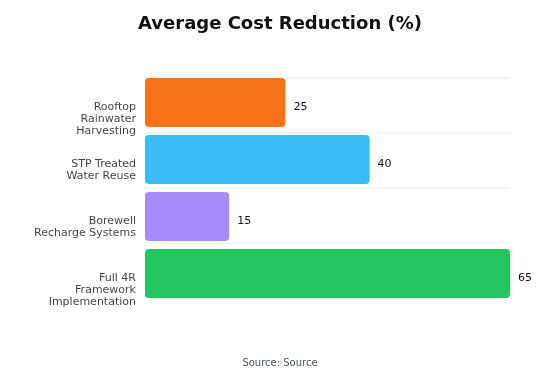
What facility managers should do next
The Central Ground Water Board (CGWB) data is a warning sign. Do not wait for a municipal notice or a dry borewell to act.
First, calculate your site’s exact rainwater capture potential using a runoff calculator. Second, audit your STP to see how much treated water goes to the drain instead of being reused for cooling towers or flushing. Finally, apply the 4R framework to close your water loop.
FAQ
What is the total annual groundwater recharge in India for 2025? According to the 2025 CGWB assessment, India’s total annual groundwater recharge is 448.52 Billion Cubic Metres (BCM). This data serves as the national baseline for local water regulation.
How does the CGWB groundwater assessment affect my factory? The assessment classifies regions by water stress. If your factory is in an over-exploited zone, you will face stricter borewell extraction limits, higher tanker costs, and tighter compliance audits.
How can commercial buildings prepare for stricter groundwater rules? Commercial buildings should implement the 4R framework: reduce consumption, reuse STP water, recycle greywater, and recharge rainwater to achieve a neutral water balance. This proactive approach ensures operational independence.
Most water companies just install systems. EcoLive measures outcomes. We help you build a system that survives the monsoon and cuts your tanker bills permanently.
Request a Water Assessment today. Call +91 9871472211 or visit ecolive.in.