Introduction
Gurugram’s groundwater has fallen by close to 5 metres in a decade. In Ambala, the level dropped from −10.5 metres in June 2014 to −29.25 metres in June 2024 — roughly 19 metres in 10 years (Government of Haryana, state Assembly reply, March 2025). Across the border in Rajasthan, groundwater extraction runs at 147% of annual recharge, and Haryana is at 137% (CGWB Dynamic Groundwater Resource Assessment, 2024).
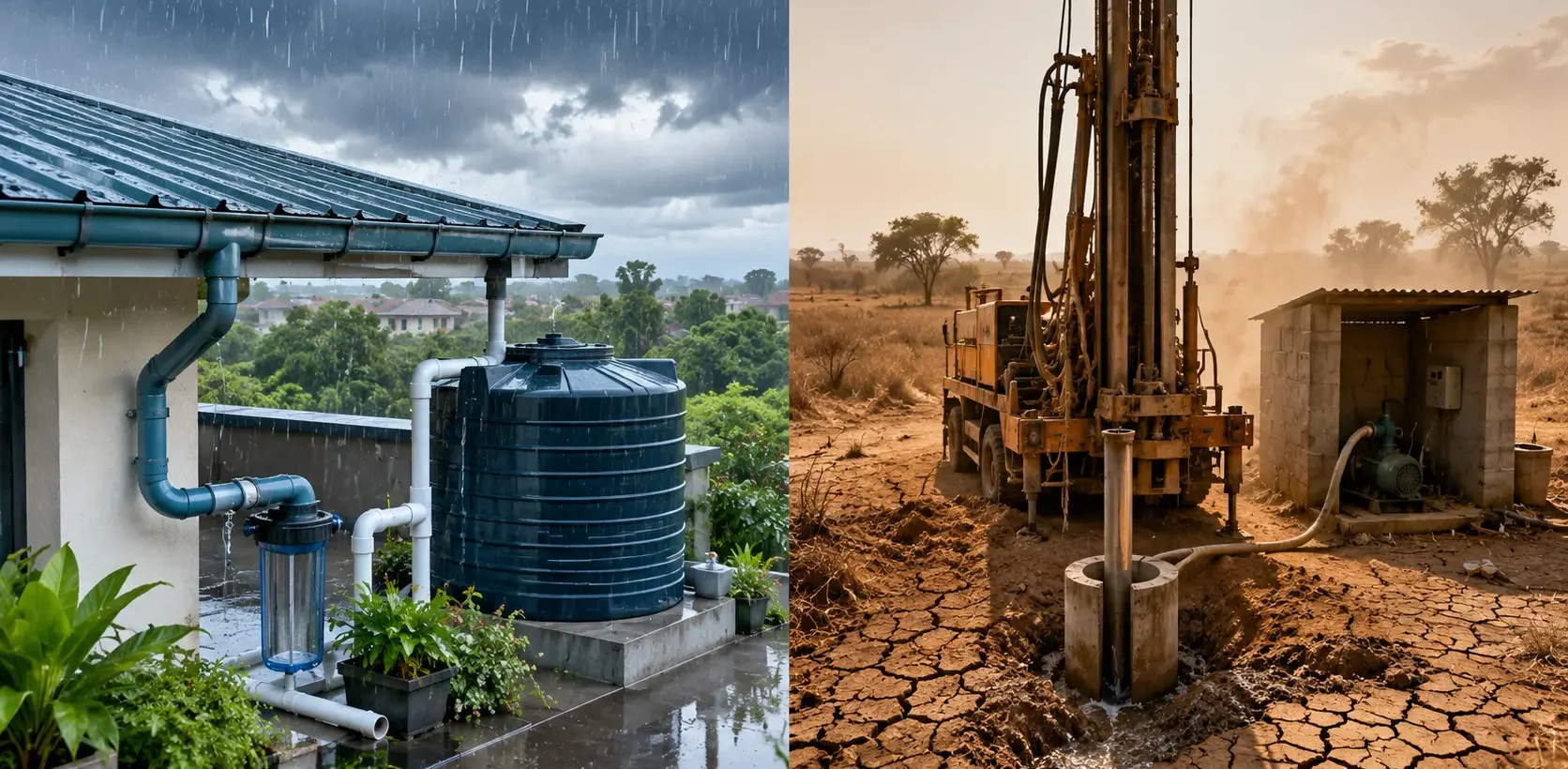
That is the backdrop to the most common question facilities and building owners in Delhi NCR and Jaipur ask us: should we fit a rainwater harvesting (RWH) system, or just drill — or deepen — a borewell?
The honest answer is not about which is cheaper. Municipal water in India is often unmetered or near-free, so “saving money on water” rarely survives contact with a real bill. The decision that matters is reliability and compliance: which source keeps water flowing when the borewell dries, which one passes the permission process, and which one survives a consent or BRSR audit. This guide compares them on exactly those terms — cost included, but never as the headline. We’re Ecolive, a water conservation company with 1,500+ completed projects across 16 states.
Key Takeaways
- A borewell gives you water fastest and in the largest instant volume, but it carries two structural risks: groundwater levels are falling (Haryana down ~5.4 m in 10 years) and every new bore needs permission that is getting harder to get (CGWB Dynamic Groundwater Resource Assessment, 2024).
- RWH costs ₹20,000–₹80,000 for a typical home and ₹2–5 lakh for an apartment or commercial block, has almost no operating cost, and produces water exactly when the groundwater stress peaks — the monsoon.
- RWH is mandatory under building bylaws in most Indian states, gives credit under BRSR Core water metrics, and in Rajasthan it is subsidised by up to 40–50% in arid districts.
- For most sites, the durable answer is not “one or the other”: it is RWH to supply the peak and borewell (or municipal) as backup, with recharge re-filling the bore you keep.
- Global and national benchmarks show harvested rainwater as the only source whose supply keeps up with demand: it arrives in the season when recharge matters most.
RWH vs Borewell at a Glance
| Category | Rainwater Harvesting (RWH) | Borewell |
|---|---|---|
| Supply pattern | Peaks in monsoon, stored for lean months | Daily, on demand — until the water table drops |
| Upfront cost | ₹20,000–₹80,000 (home); ₹2–5 lakh (apartment/commercial) | ₹80,000–₹1.5 lakh (300 ft); ₹1.6–3.2 lakh for hard-rock 600–800 ft |
| Permission needed | Mandated by most municipal bylaws; usually no special permit | CGWA / state groundwater authority NOC — increasingly contested in notified over-exploited areas |
| Operating cost | Near zero (gravity/filter only) | Pump electricity + repairs; rises as depth increases |
| Failure mode | Neglected filters, clogged first-flush | Dry bore (you pay for every foot drilled even with no water) |
| Compliance value | Building-bylaw credit, BRSR Core water metric, green-building points | Neutral at best; negative in notified over-exploited areas |
| Lifespan | 20+ years with basic maintenance | 10–20 years before yield drops; deepening is expensive |
Ranges for 2026 compiled from published Indian cost guides (AECORD 2026; HouseYog 2026; civilsite.in 2026; Studio Matrx 2026) and Ecolive project data.
Which Wins on: Groundwater Dependence?
RWH wins on water-table impact — and this is the category that decides everything else over the long run.
Every litre a borewell pumps is water removed from a shared aquifer. In Haryana, extraction is already at 137% of annual recharge (CGWB Dynamic Groundwater Resource Assessment, 2024); in Rajasthan it is 147%. A new bore in these regions is not a fresh source — it is a tap into a depleting pool, drilled deeper each cycle. Urban borewell depths in Delhi NCR routinely exceed 300–500 feet, and the rate-per-foot rises in hard rock, so each re-drill costs more for the same or worse yield.
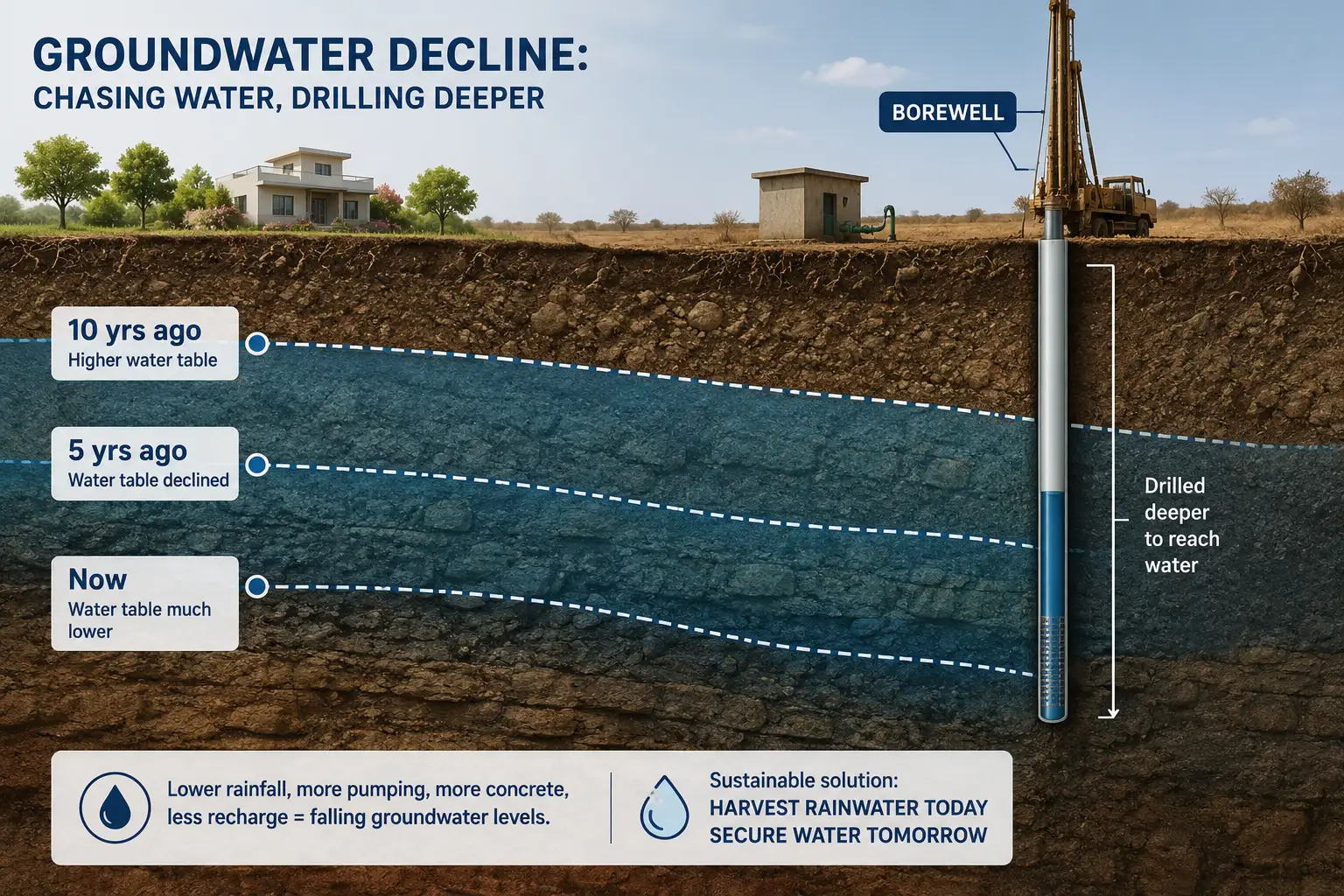
Rainwater harvesting works in the opposite direction: it captures runoff exactly when the aquifer needs refilling, and a recharge pit pushes it back into the ground. In our Sector 48 (Gurugram) project, the combination of rooftop collection and recharge pits raised the post-monsoon water level in the site’s existing borewell by enough to cut summer tanker load by a third — the harvested water and the recharge pit paid for themselves in reliability, not in bill savings.
Verdict: RWH, and decisively. A borewell alone is a claim on a falling asset; RWH is a claim on the one source keeping pace — rainfall.
Which Wins on: Compliance & Permissions?
RWH wins on compliance because it is the option regulators require, and borewells are the option regulators are starting to restrict.
Rainwater harvesting is baked into building bylaws across India — Delhi, Haryana, Rajasthan, and most state municipal acts make it mandatory above a plot-size threshold, and occupancy certificates are increasingly tied to proof of RWH installation. For businesses, the same structure maps directly onto BRSR Core water metrics: captured and reused rainfall is a defensible, auditable number, where a borewell is a withdrawal line that ESG directors increasingly have to explain.
A new borewell, by contrast, needs permission from the state groundwater authority — and in notified over-exploited areas, from the Central Ground Water Authority (CGWA). The drilled bore is also subject to consent conditions at renewal, and SPCB/CGWA scrutiny is tightening precisely in the areas where water tables are falling fastest. None of this means a borewell is impossible; it means the permission, the consent conditions and the audit trail are a real and growing part of the cost.
Verdict: RWH, without much contest. It is the compliant default; the borewell is the option that increasingly requires justification.
Which Wins on: Upfront Cost?
Borewell wins on headline cost for volume — but only when the bore strikes water.
The numbers for 2026 (Indian cost guides, retrieved August 2026): a finished 300-foot domestic borewell with casing and pump typically lands between ₹80,000 and ₹1.5 lakh. A 400-foot hard rock bore can run ₹1.6–3.2 lakh once the pump, cable and panel are added. RWH for a home is commonly ₹20,000–₹80,000; apartments and commercial blocks pay ₹2–5 lakh depending on tank size and filtration (AECORD 2026; HouseYog 2026; civilsite.in 2026).
But there are two traps hidden in the borewell headline. First, “per foot” quotes stop being cheap the deeper you go: rates step up in slabs, and hard-rock surcharges add ₹20–60 per foot. Second, and more important, a dry bore still costs you every rupee you drilled. Drilling companies bill by the foot regardless of yield. In regions where neighbours are already drilling to 500+ feet, the borewell’s “cheaper” claim is really a lottery ticket priced at ₹1.5 lakh.
RWH has no equivalent failure mode: you either have roof area and rainfall, or you don’t, and that is knowable before you spend a rupee.
Verdict: borewell wins on paper; RWH wins on certainty of outcome. It is ₹20,000–₹80,000 for water you know will arrive.
Which Wins on: Operating Cost & Maintenance?
RWH wins on operating cost; maintenance is comparable but of a different kind.
A borewell burns electricity every time the pump runs, and pump repairs and deepening are recurring items. RWH systems — gutters, a first-flush diverter, a storage tank or recharge pit — run on gravity. Operating cost is close to zero.
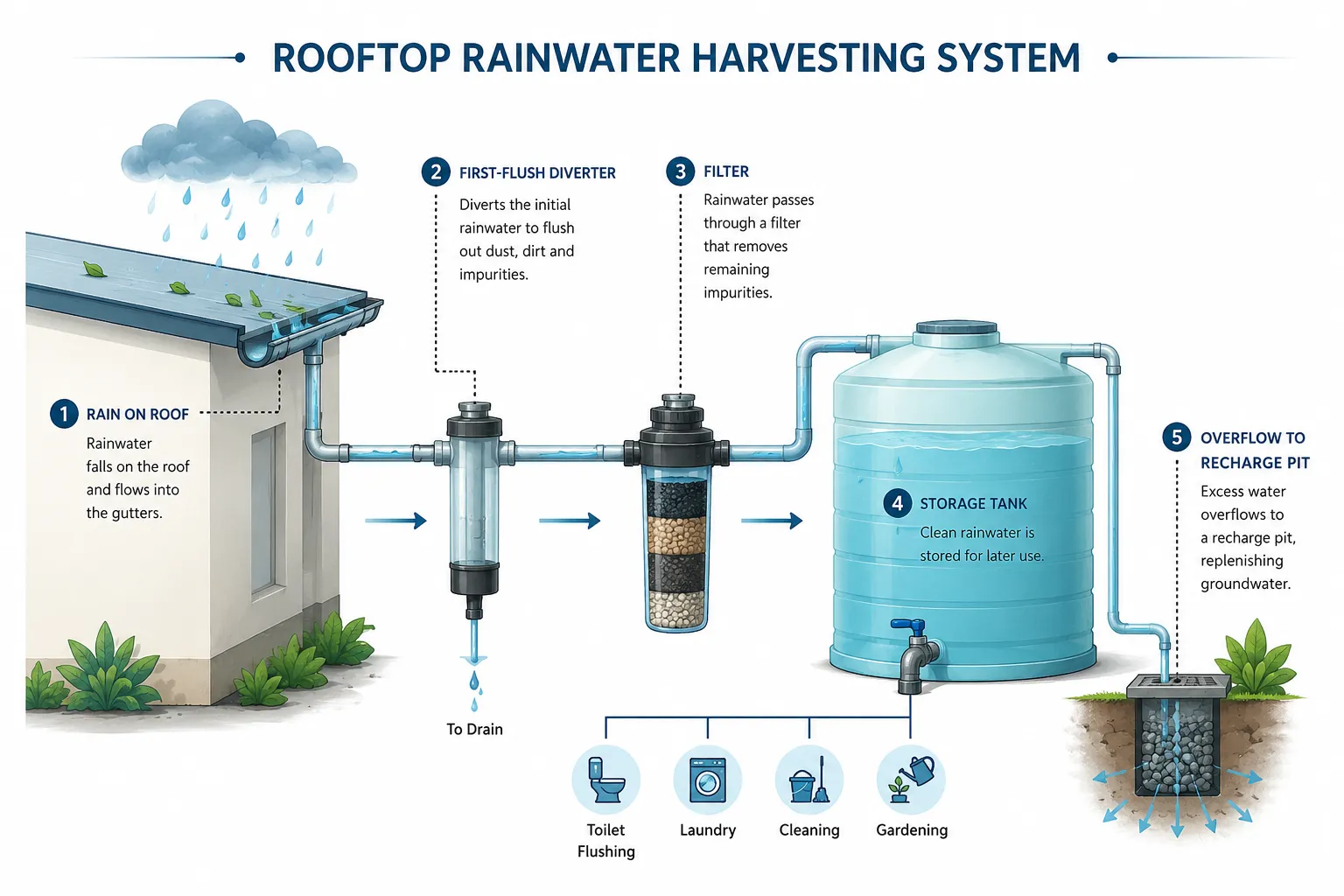
The maintenance job, though, is real on both sides. RWH’s failure mode is neglect: a clogged filter, a leaf-choked first-flush. These are cheap to fix but do need an annual monsoon-ready check — the reason we built a pre-monsoon RWH checklist and see a spike of calls every June from building owners whose systems stopped working silently. Borewell maintenance is less frequent but far more expensive when it happens: pump replacement, silt clearance, re-drilling.
Verdict: RWH on running cost; a wash on discipline — both need a scheduled check.
Which Wins on: Water Quality & Suitability?
Split — rainwater for non-potable use wins hands-down; potable treatment is an add-on for both.
Harvested rainwater is naturally soft, low in hardness and TDS — the reason facilities use it directly for cooling towers, flushing, and landscaping without scaling problems. For drinking quality, it needs treatment (filtration + UV/RO), which adds ₹1–3 lakh to a system (AECORD 2026) — so most buildings sensibly keep RWH for the non-potable share and municipal/bottled for drinking.
Borewell water in Haryana and Rajasthan carries a compounding problem: with depth comes contamination. The CGWB Annual Ground Water Quality Report 2025 puts Punjab, Haryana and Rajasthan among the states with the highest share of samples exceeding nitrate, fluoride and (in Punjab’s case) uranium safe limits. Water that was “free” from depth is becoming water you must treat before people drink it — quietly converting a cost-free source into a treatment liability.
Verdict: RWH for the non-potable bulk; treat either source before drinking.
RWH vs Borewell Cost Comparison: What It Actually Costs in 2026
For a typical building, the honest comparison is not one number — it’s three, because borewell count varies with depth luck and RWH with roof area.
| Building size | RWH (typical, 2026) | Borewell (typical, 2026) |
|---|---|---|
| Home, ~2,000 sq ft roof | ₹20,000–₹80,000 | ₹80,000–₹1.5 lakh (300 ft) |
| Apartment / commercial, ~10,000 sq ft roof | ₹2–5 lakh | ₹1.6–3.2 lakh (600–800 ft hard rock) |
| Large complex / factory | ₹5 lakh+ | ₹3 lakh+ and rising with depth |
Source: Indian 2026 cost guides (AECORD; HouseYog; civilsite.in; Studio Matrx), retrieved August 2026.
The hidden costs nobody budgets for:
- Borewell: every foot drilled is paid even on a dry bore; deepening costs after 2–5 years; CGWA/state NOC applications; pump energy that rises with depth; and treatment if water quality fails drinking standards.
- RWH: the storage tank is 40–50% of the system cost (AECORD 2026); retrofits cost 20–30% more than building it in during construction; annual filter/clean maintenance.
Where RWH gets cheaper still: Rajasthan’s official water harvesting portal documents state-level RWH promotion, and published guides report setup subsidies of up to 40–50% in arid districts. Delhi, Haryana and most states give building-bylaw credit and faster occupancy certification for a compliant system. There is no subsidy arm for a second borewell — only a permission process.
Borewell Recharge in Gurugram and Delhi NCR: Refill the Bore You Already Have
Before drilling a new borewell recharge pit in Gurugram, consider the cheaper option: recharging the borewell you already have. A borewell recharge pit in Gurugram routes rooftop runoff through a filter and into the annular space around the casing, pushing water back into the aquifer and lifting the water table your existing bore draws from. In our Gurugram projects, clients pay ₹20,000–₹40,000 for a recharge pit plus bore connection — a fraction of the ₹1.6–3.2 lakh a new 600–800 ft hard-rock bore costs to drill. Every monsoon, the recharged bore yields more water for fewer rupees, and the same structure covers the CGWA consent position because captured rainfall is reuse, not withdrawal. If you are weighing borewell recharge Gurugram pricing or need a water balance audit first, our team designs and installs recharge pits across Delhi NCR and Rajasthan.
RWH vs Borewell vs Recharge: The Decision Framework
RWH vs Borewell vs Recharge: The Decision Framework
Choose based on your real constraint — roof, depth luck, or compliance deadline.
- An RWA or society in Delhi NCR with rooftop space → lead with RWH (₹2–5 lakh) and recharge pits. It satisfies the building bylaw, cuts summer tanker dependence, and raises the water table your existing bore draws from. Recommended path: RWH design and installation.
- A factory or commercial site facing CGWA consent or BRSR Core deadlines → RWH + reuse reads as a strong, auditable water metric, and it is the only option that earns compliance credit rather than explaining a withdrawal. Recommended path: BRSR water metrics and a water balance audit.
- A single home in Jaipur with a drying borewell → the cheapest durable fix is usually RWH + borewell recharge on the roof you already have (₹20,000–₹80,000), before paying ₹1.5 lakh+ to drill a deeper lottery ticket.
The pattern across all three: the borewell you already own stays; the RWH is the new supply that protects it. That is the 4R logic — Reduce, Reuse, Recharge, Recycle — applied to a single plot (the 4R framework explained).