Rainwater harvesting sounds technical. It isn’t. For over 4,000 years, communities across India built stepwells, temple tanks, and johads without engineering degrees or government mandates. Chand Baori in Rajasthan, dating back to the 9th century, descends 13 storeys with 3,500 steps to reach groundwater recharged entirely by rain. These structures worked because they followed basic common sense: catch the rain, channel it, store or recharge it, keep it clean, and maintain it.
The same principles apply today. You don’t need advanced technology or a massive budget. What you need is a system sized correctly for your rooftop, a way to filter and direct the water without contamination, and a maintenance routine. That’s it.
TL;DR: Rainwater harvesting has three non-negotiables: your system must match your roof’s runoff capacity, store or recharge cleanly without contamination, and receive periodic maintenance. It’s a minimal one-time investment for households and pays for itself in a few years for industries. Try our free Runoff Calculator to see your roof’s potential.
How Ancient India Harvested Rain Without Any Government Notice
Long before MoHUA bye-laws and municipal compliance notices, Indians harvested rainwater because it made sense. The Press Information Bureau documents that stepwells served as “liquid asset” storage across arid regions. In Tamil Nadu, temple tanks (eris) captured monsoon runoff for year-round community use. Rajasthan’s johads, built entirely by village communities, recharged groundwater so effectively that rivers like the Arvari came back to life after decades of being dry.
The Taanka system in the Thar Desert allowed families to store enough rainwater in underground cisterns to survive 8-10 months of scorching summer. Rani ki Vav in Gujarat, a UNESCO World Heritage Site built in the 11th century, was both a stepwell and a water management marvel. None of these were built because a law required them. They were built because water mattered.
The 3 Non-Negotiable Principles of Rainwater Harvesting
Strip away the technical jargon and every functional RWH system in the world, whether it’s a 9th-century stepwell or a modern factory rooftop system, rests on three principles.
1. Match Your System to Your Roof’s Runoff
A 100 sq metre rooftop in Gurugram receives roughly 80,000 litres of rain annually. If your storage tank holds 5,000 litres and your recharge pit can handle 20,000, you’re throwing away 55,000 litres every year. The math is simple: calculate your catchment area, multiply by your city’s rainfall, and size your system accordingly. Under-sizing is the single biggest reason RWH “doesn’t work” in India.
Use our Runoff Calculator to find out exactly how much rainwater your rooftop can generate. It takes 30 seconds and uses real rainfall data for your city.
2. Store or Recharge Cleanly — Without Contamination
Harvesting rainwater is one thing. Keeping it usable is another. The first rain after a dry spell washes dust, bird droppings, chemical residue, and particulate matter off your roof. That “first flush” must be diverted, never stored. After that, a simple gravity filter (sand, gravel, charcoal layers) removes remaining impurities before water enters your tank or recharge pit.
Contamination turns a good system into a health hazard. Filtration and first-flush diversion aren’t optional extras. They are the core of the system.
3. Maintain It Periodically
An RWH system that isn’t maintained becomes a breeding ground for mosquitoes, bacteria, and sediment buildup. Filters clog. Pipes block. Recharge pits fill with silt. The solution isn’t complicated: a pre-monsoon inspection and cleaning, a post-monsoon performance check, and periodic filter replacement. Most systems need no more than 2-4 hours of attention per year.
Storage, Recharge, or Both? It Depends on Your Roof
One of the most common questions we get: “Should I store rainwater or recharge it into the ground?” The answer depends on what’s falling onto your roof and how clean you can keep it.
Store + Recharge (Clean Rooftops): If your rooftop is reasonably clean, like most private houses, warehouses, or factories with enclosed production areas, you can store harvested rainwater in a tank for direct use (gardening, cleaning, toilet flushing, even drinking with additional filtration). When the tank fills up, the overflow is channelled into a recharge pit or borewell. This is the most efficient approach because you use the water directly AND put surplus back into the ground.
Recharge Only (Hard-to-Clean Rooftops): If your rooftop collects dust, debris, or chemical residue that’s difficult to manage, skip storage entirely. Filter the water minimally and direct it straight into a recharge pit or borewell. The earth’s natural filtration does the rest. This still recharges groundwater significantly and helps your borewell yield.
Red Category Industries — Extra Caution Required: If your facility falls under the CPCB Red Category (63 industrial sectors with high pollution potential), you need to be especially careful. Airborne pollutants, chemical deposits, and process emissions settle on rooftops. Rainwater washing over these surfaces can carry contaminants into your recharge structure or storage. For red category industries, RWH requires a robust first-flush system, additional treatment or filtration before storage, and strict compliance with pollution board norms on harvested water quality. Don’t treat it as a simple plumbing job. Get a professional water audit to assess contamination risk on your specific site.
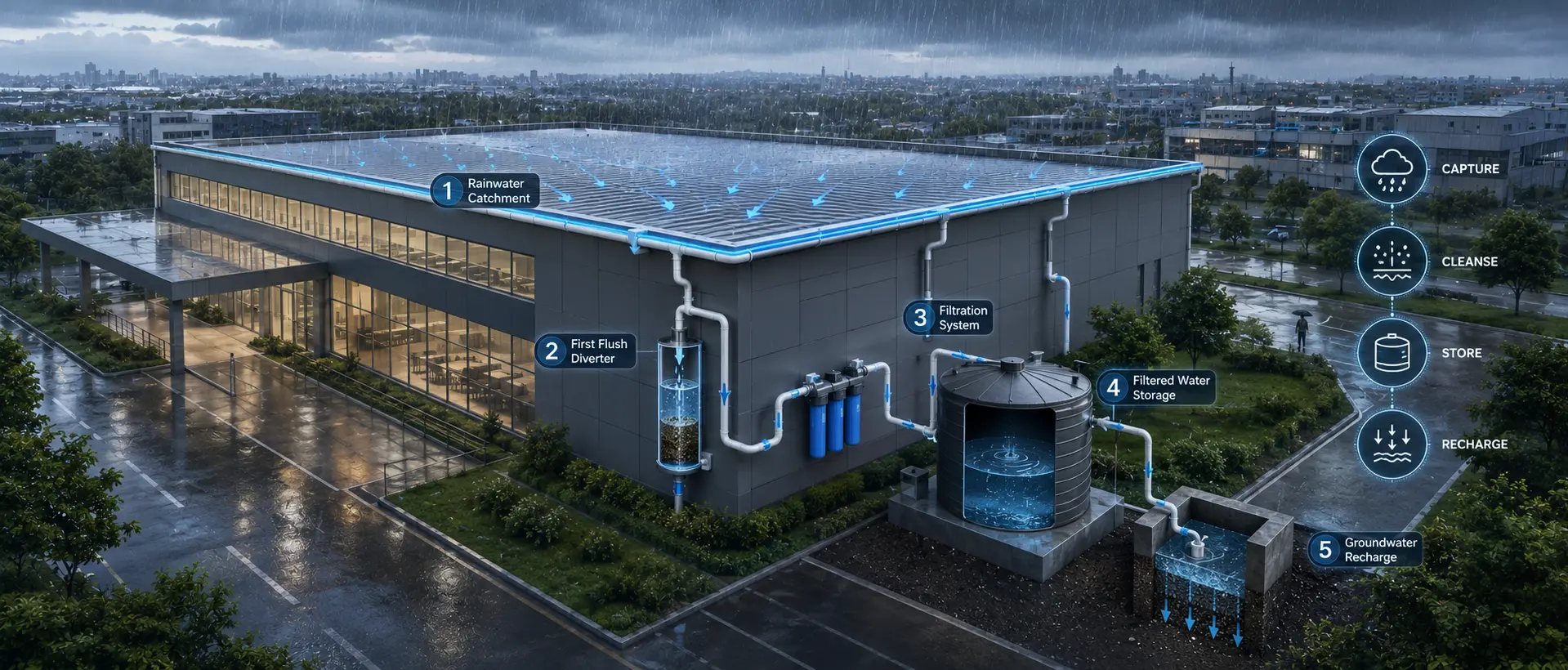
The 5 Parts of Any RWH System (Explained in Plain Language)
Every rainwater harvesting system, whether it costs ₹10,000 or ₹10 lakh, has five basic components. Understanding them demystifies the entire process.
Catchment — Your Roof
The surface where rain falls is your catchment. For most buildings, this is the rooftop. The material matters: concrete, clay tiles, and metal sheets are all effective. Slope matters too: water needs to flow towards your collection point by gravity. Flat roofs work fine with proper drainage slope. The bigger your roof, the more rain you catch.
Conveyance — Gutters and Pipes
Gutters along the roof edge collect rainwater and channel it into downpipes. That’s it. PVC gutters, half-round metal gutters, or even open channels on sloped roofs all work. The key is sizing: undersized gutters overflow during heavy rain, and you lose water. Keep them clean of leaves and debris.
First-Flush Diverter — The Most Underrated Component
The first 1-2 mm of rain after a dry spell is the dirtiest. A first-flush diverter sends this water to waste (or to a separate garden channel) and only lets cleaner subsequent rainwater pass to your tank or recharge pit. This simple device, which can be a PVC pipe with a valve, prevents most contamination from entering your system. Skipping this is why many “RWH systems” produce water people are afraid to use.
Filter — Cleaning Before Storage
A simple multi-layer gravity filter handles the rest. Sand, gravel, and charcoal layers in a PVC drum remove suspended particles and improve water quality. No electricity needed. No chemicals needed. Gravity does the work. For higher-quality storage water, additional cartridge filters or UV treatment can be added downstream.
Storage or Recharge — Where the Water Goes
Storage means a sump, tank, or underground cistern that holds water for direct use. Recharge means directing filtered water into a pit, trench, or abandoned borewell to replenish groundwater. Most well-designed systems do both: store what you need, recharge the rest. The choice depends on your roof cleanliness, water demand, and local groundwater conditions. Our Water Balance Optimiser can help you model the best split for your site.
Why Most RWH Installations in India “Fail”
Across 1,150 projects in 11 states, EcoLive has seen a consistent pattern. RWH isn’t failing because the concept doesn’t work. It’s failing because of a few predictable mistakes that any basic understanding would prevent.
Undersized Systems
A 200 sq metre roof generating 1.6 lakh litres of rain paired with a 5,000-litre tank and no recharge pit. The math doesn’t add up. Most of the rain overflows and is wasted. The system then gets blamed for “not working” when it was simply never sized to handle the volume.
No First-Flush or Filtration
Many installers skip the first-flush diverter and filter to cut costs. The result: dirty water enters the tank or recharge pit. Families stop using the stored water because it smells or looks unclean. The system sits idle and is eventually abandoned.
Zero Maintenance
Filters clog within one monsoon season if not cleaned. Gutters fill with leaves and debris. Recharge pits silt up and stop percolating. An unmaintained RWH system is worse than no system at all because it creates the false impression that rainwater harvesting doesn’t work.
Treated as a Checkbox
Many RWAs and builders install RWH only because municipal rules require it. The system gets built, the compliance certificate gets issued, and nobody ever looks at it again. This approach wastes money and damages the reputation of rainwater harvesting itself. At EcoLive, we measure and report litres harvested annually because accountability turns a checkbox into an outcome.
What Does It Actually Cost? Much Less Than You Think
One of the biggest myths about rainwater harvesting is that it’s expensive. It isn’t. Costs are minimal, especially at the household level, and for industries it’s a one-time investment that pays for itself.
| Building Type | Typical Cost Range | Expected Payback |
|---|---|---|
| Individual household | Under ₹10,000 | 1-2 years via reduced water bills |
| RWA / residential society | ₹2 lakh – ₹8 lakh | 2-4 years via reduced tanker dependence |
| Factory / warehouse | ₹3 lakh – ₹15 lakh (one-time) | 2-4 years via lower freshwater purchase + compliance savings |
| Commercial building | ₹5 lakh – ₹12 lakh | 3-5 years via water bill reduction + ESG value |
For a household, ₹10,000 can buy a functional filter, first-flush diverter, piping, and connection to an existing recharge pit or borewell. For industries, it’s a one-time CAPEX that reduces ongoing water procurement costs. When done right and maintained well, the system literally pays for itself within a few years. After that, every litre harvested is savings.
How to Get Started in 4 Simple Steps
- Calculate your roof’s rainwater potential using our free Runoff Calculator. Enter your rooftop area and city to see how many litres you can harvest annually.
- Model your water balance with the Water Balance Optimiser. Understand where your water comes from, where it goes, and how much RWH can close the gap.
- Get a professional site assessment. A water expert visits your building, checks roof condition, soil type, existing drainage, and recommends the right system size and type. No obligation.
- Follow the pre-monoon checklist. Before every monsoon, inspect gutters, clean filters, check the first-flush diverter, and ensure your recharge pit is clear of silt. Our pre-monsoon RWH checklist covers everything in a 15-minute walk-through.
Frequently Asked Questions
Is rainwater harvesting really possible with a budget under ₹10,000?
Yes, for an individual household with an existing borewell or recharge pit. The basic components, a first-flush diverter, gravity filter, and connecting pipes, cost under ₹10,000. You’re not building a water treatment plant. You’re catching rain, filtering it simply, and putting it back into the ground or a storage tank. The cost rises with larger catchment areas and storage tanks, but the principle stays affordable.
Do I need to store rainwater, or can I just recharge the ground?
Both approaches work. If your rooftop is clean and you want to use rainwater directly for gardening, cleaning, or flushing, store it in a tank with overflow going to a recharge pit. If your roof is hard to keep clean or you don’t have storage space, direct filtered rainwater straight into a recharge pit. Groundwater recharge is always beneficial, even without storage.
What happens if I don’t maintain my RWH system?
Filters clog, gutters overflow, recharge pits fill with silt and stop percolating, and stored water quality deteriorates. Within 1-2 monsoon seasons, an unmaintained system effectively stops working. Annual maintenance takes 2-4 hours and costs a fraction of what you save on water bills. It is the cheapest insurance for your water investment.
Red category industries have pollution concerns. Can they still harvest rainwater?
Absolutely, but with additional safeguards. Rooftop contamination from airborne industrial pollutants requires a robust first-flush system, treatment or filtration before any storage, and compliance with CPCB norms on harvested water quality. A professional water audit is essential to assess the specific contamination risk at your site. Many red category industries successfully harvest rainwater for groundwater recharge, which requires less treatment than direct storage.
How is this different from what EcoLive does?
Most water companies install an RWH system and leave. EcoLive’s 4R framework (Reduce, Reuse, Recycle, Recharge) treats RWH as one part of your building’s complete water balance. We audit your water usage, design the system to match your actual needs, install it, and then maintain it with annual performance reports. Across 1,150 projects and 11 states, we’ve saved over 652 million litres of water because we measure what matters.
Start With What Falls on Your Roof
Every monsoon, thousands of litres of free water land on your rooftop. Without a system, it runs into drains, floods streets, and is gone. With a properly sized, filtered, and maintained RWH system, that same water reduces your bills, recharges your borewell, and makes your building more water-secure.
It’s not complicated. It’s not expensive. And it doesn’t need a government notice to make sense.
Try our Runoff Calculator to see your roof’s potential. Or call us for a free site assessment.
📞 +91 9871472211 | ecolive.in