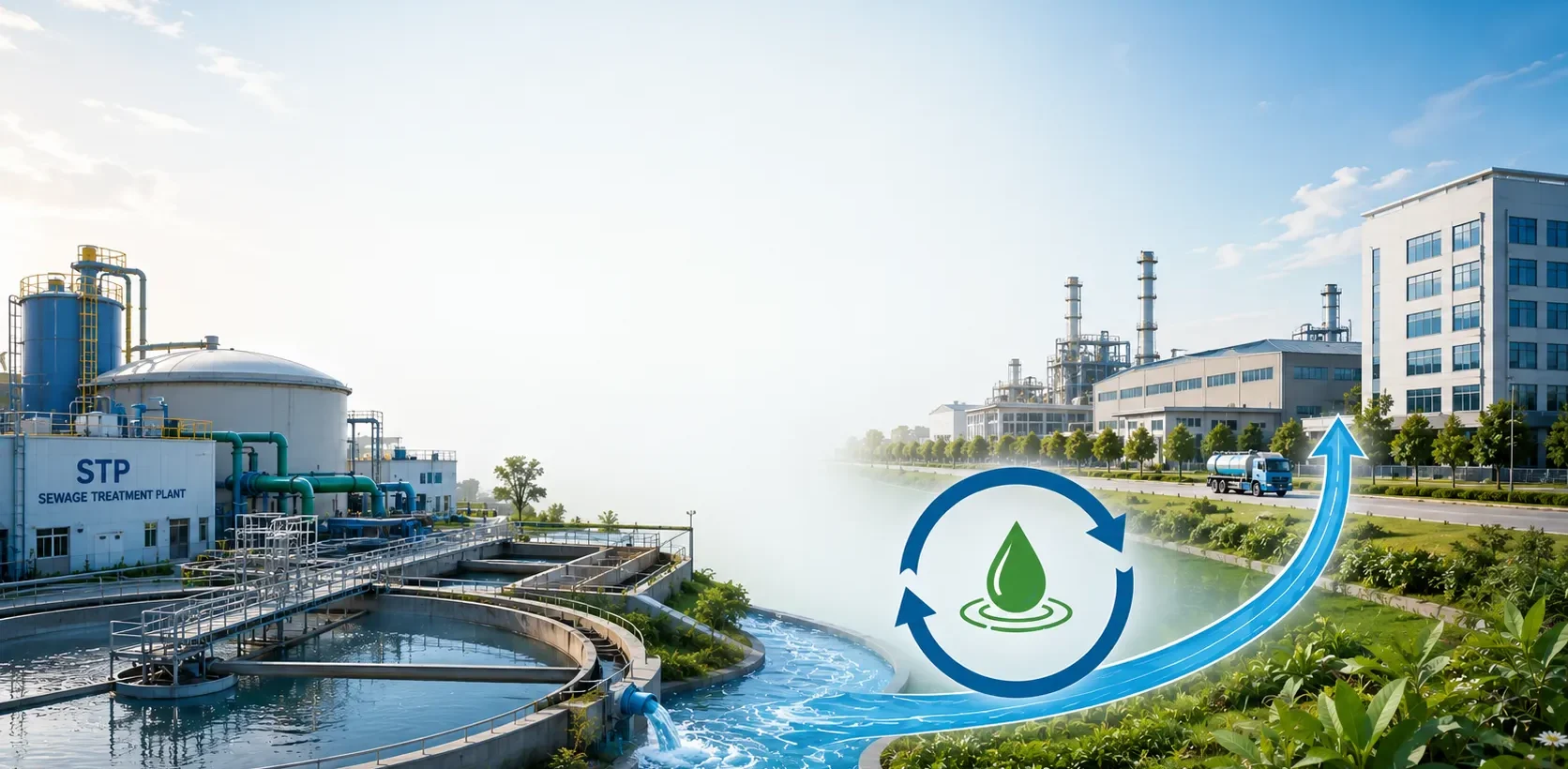
Every day, urban India generates 72,368 million litres of sewage. Of that, only 20,235 MLD (about 28%) is actually treated, according to the Central Pollution Control Board’s National Inventory of Sewage Treatment Plants (CPCB, 2021). The remaining 72% flows into rivers, lakes, and drains.
That gap is a missed opportunity for the factories and hotels that sit right next to it. Your site already produces water that has been treated to a usable standard. Most sites still route it to the drain and keep drawing fresh water from the municipal line, a borewell, or a tanker. This guide explains how to reuse STP (sewage treatment plant) treated water on a factory or hotel site: the end-uses it can safely serve, how to meter and verify the savings, and the compliance context (CGWA, state PCB consent conditions, and BRSR Core reporting) that increasingly makes reuse the sensible option.
Key Takeaways
- India treats only 28% of the 72,368 MLD of urban sewage it generates daily, and reuses less than 1,000 MLD of treated water (CPCB, 2021; WELL Labs, 2024).
- Reuse of treated water could unlock an estimated ₹3.04 lakh crore for India by 2047 (CEEW, Nov 2025).
- STP treated water is safely usable for cooling towers, flushing, landscaping, washing, and pre-treatment for industrial processes. The four-step path: audit → match end-uses → meter → report.
- The incentive is water security and compliance, not just cost. Municipal water in India is often unmetered or free, and tanker dependence is volatile.
- Global benchmarks. Israel recycles roughly 86–90% of its wastewater; Singapore’s NEWater meets ~40% of demand from reclaimed water (US EPA, 2023–2024).
Before You Begin: What You Need
Estimated time: 6–10 weeks from audit to operating reuse system. Difficulty: Moderate. You will need facility access, not deep technical training.
- Site map showing the STP/ETP location, storage tanks, and all drinking and non-potable water lines
- 12 months of water bills (municipal, tanker receipts, and borewell logs). These establish your baseline before any change
- Access to the STP control room or its operator to confirm treatment quality (BOD, TSS, turbidity)
- A decision on metering because you need to measure inlet and reuse loops to prove the system works
- Consent conditions from your State Pollution Control Board (SPCB) or the Central Ground Water Authority (CGWA), if applicable
Why this matters before you start. Reuse is only worth doing if you meter it. Without a before/after baseline, you cannot show the board, a BRSR report, or a financier that the system delivers. That single step decides whether reuse becomes a documented asset or an unproven experiment.
First: Know Where Your Site’s Water Comes From
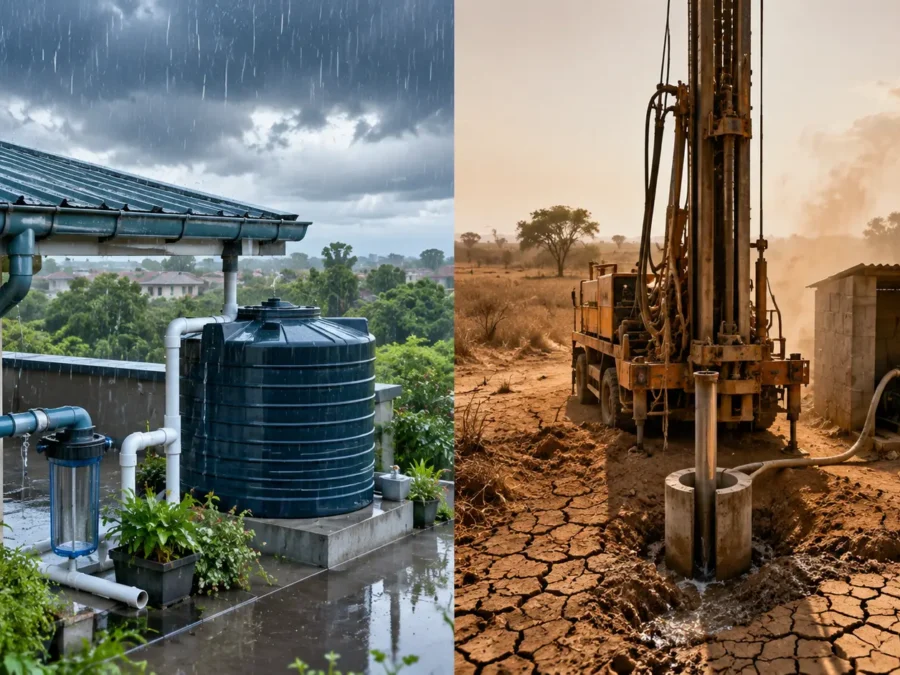
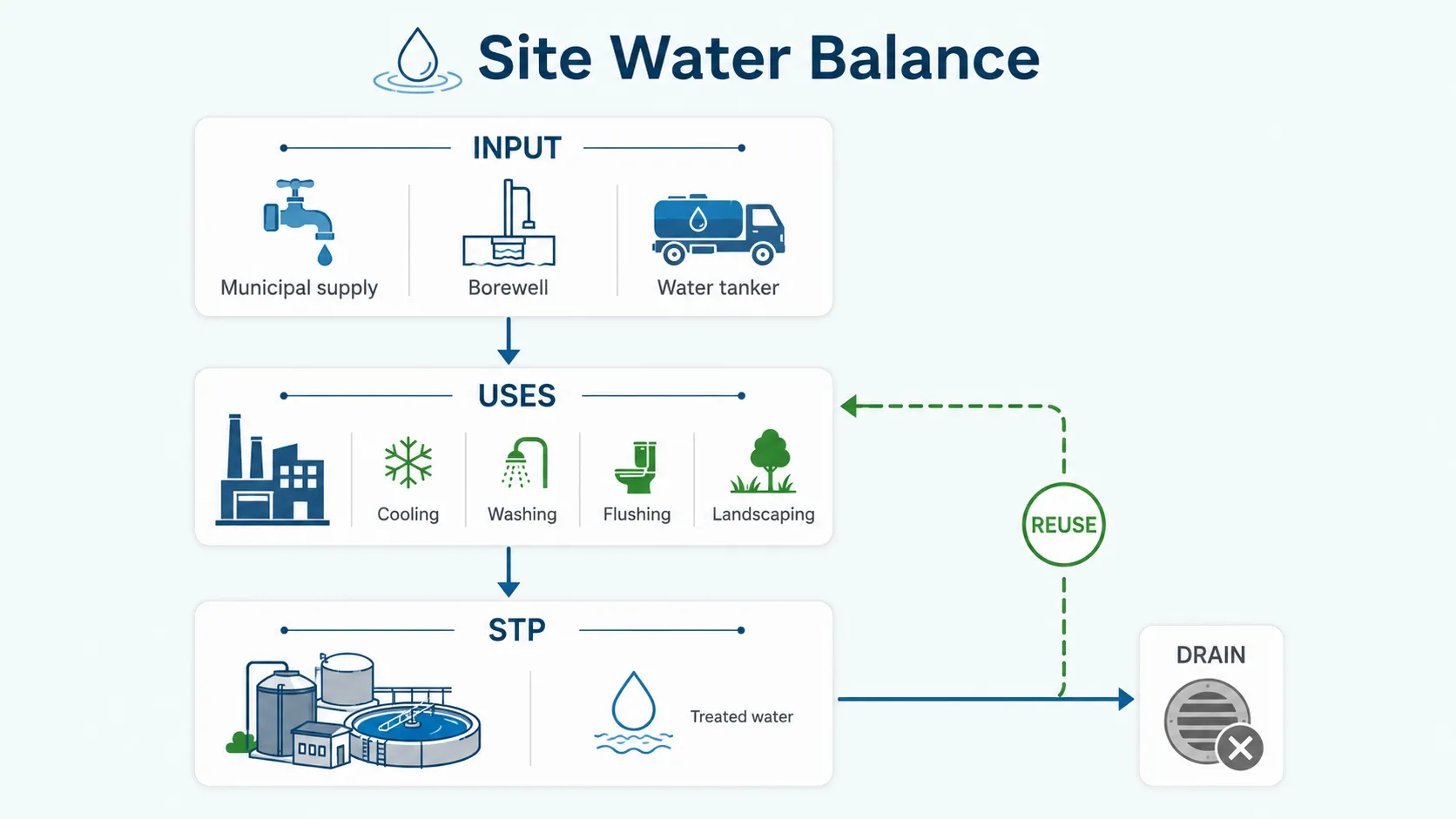
Before reusing a litre, you need a water balance of your site, every inlet and every outlet. Start by mapping your three potential water sources and their reliability in 2026:
| Source | Reliability in 2026 | Notes |
|---|---|---|
| Municipal supply | Often unmetered, capped, or intermittent | Frequently free or low-tariff in India, so “saving money” is rarely the driver |
| Borewell | Groundwater over-extraction is forcing closures | Gurugram extracted 212–214% of its permissible groundwater limit in 2024 and is a designated “dark zone” since 2008 (Times of India, Aug 2025) |
| Tankers | Cost is volatile and supply is fragile | Private tanker prices in Jaipur rose to roughly 4x normal during the May 2024 water shortage (Times of India, 2024) |
The honest framing: in much of India, municipal water is free or unmetered, so cost savings is not the primary reason to reuse treated water. The real drivers are:
- Water security. A reuse loop is a second, self-owned supply that does not depend on municipal pressure, monsoon, or tanker availability
- Compliance. CGWA and CPCB consent conditions increasingly restrict groundwater extraction and effluent discharge, and BRSR Core now asks large companies to report water withdrawal, consumption, and discharge
- Supply reliability for critical operations. Cooling towers, laundry, and process water do not stop when a borewell fails or a tanker does not arrive
To quantify your own balance, our water balance assessment service maps every inlet and outlet into a single number.
Step 1: Audit Where Your Water Goes (and Where It’s Discharged)
By the end of this step you know exactly how many litres enter your site daily, where they are used, and how many leave as treated effluent. A water audit builds the balance: inlet = consumption + loss + discharge. On a typical factory or hotel, the candidates for reuse are:
- Greywater (from washbasins, showers, and washing), low pollutant load and easy to treat
- RO reject (from water softening or purification systems), high TDS but reusable after blending
- STP outflow, treated sewage and the largest volume, the easiest to secure at a consistent quality
The audit checklist:
- Read the meters you have (daily and hourly if possible, not monthly)
- Install temporary flow meters where there are none (inlet, booster lines, and the STP outlet)
- Measure each end-use category (cooling towers, process, laundry, kitchen, landscaping, flushing)
- Confirm what the STP discharges today (volume and quality: BOD, TSS, turbidity, pH, and where it goes: drain, river, soak pit, reuse)
- Total it into a water balance (even 4–5 line items is enough to start)
Practitioner’s note. In the site assessments we run, the single biggest undetected “source” on Indian industrial sites is treated STP water going to drain. Fixing that one discharge line, rather than installing new treatment, is usually the fastest path to a second water supply.
Step 2: Match the Right Reuse Paths to Your Site
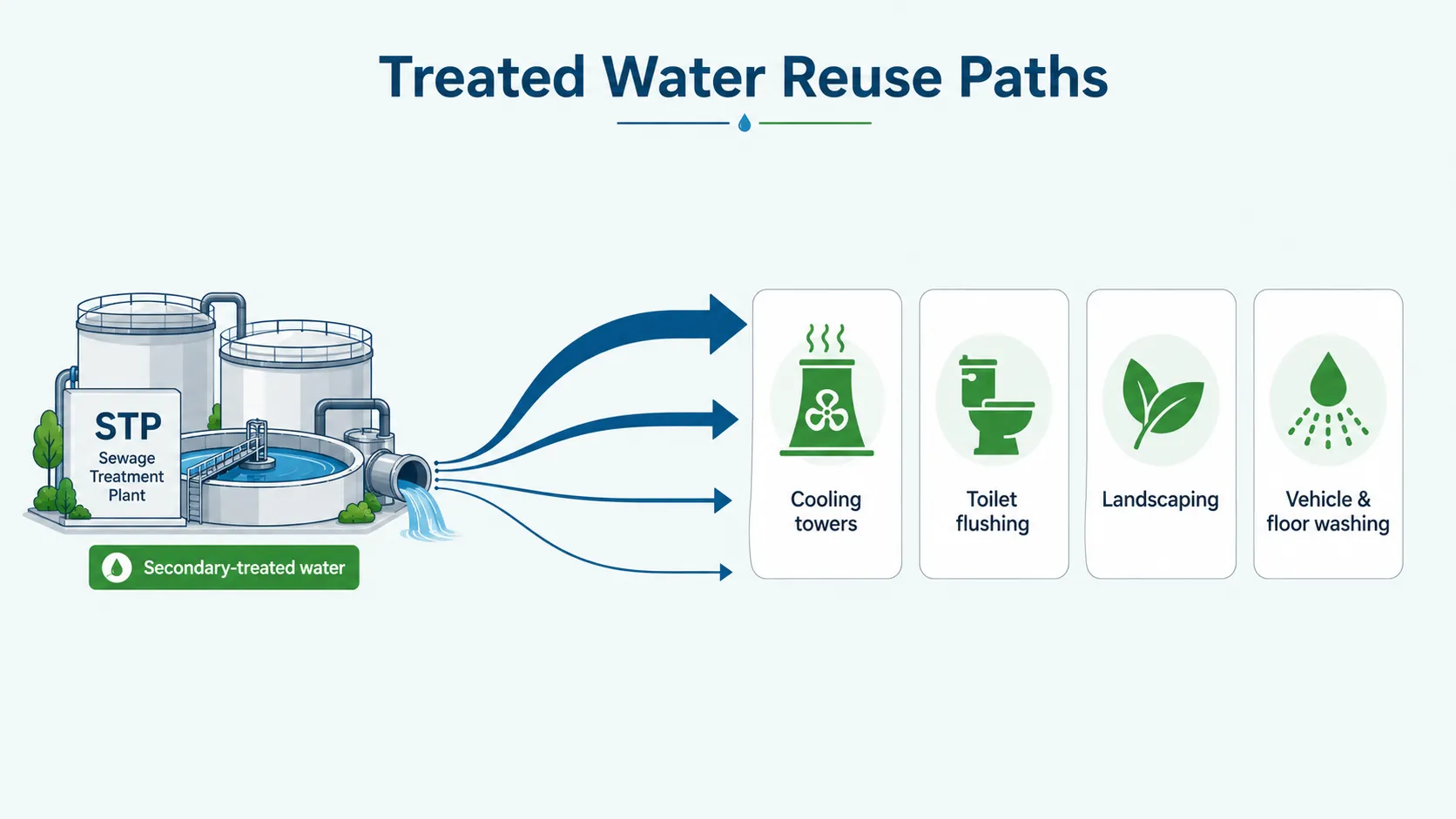
Treated STP water from a secondary STP can safely replace fresh water for cooling towers, flushing, landscaping, washing, and, with a polishing step, for some process applications. Not every end-use is equal, so match quality to application:
| End-use | Treatment needed | Typical saving (% of fresh demand replaced) |
|---|---|---|
| Cooling tower make-up | Secondary STP + mild disinfection | 25–40% of industrial water use in hot climates |
| Toilet flushing | Secondary STP | 25–35% of hotel domestic demand |
| Landscaping & gardening | Secondary STP | 100% of irrigation demand |
| Vehicle & floor washing | Secondary STP + filtration | 30–50% of washing demand |
| Process / boiler feed | Tertiary, RO/polishing (quality-critical) | Depends on process |
Two proven Indian examples:
- Tiruppur textile cluster. After a 2011 Madras High Court order pushed for zero liquid discharge, the cluster built 18 common effluent treatment plants (CETPs) and now recycles roughly 130 MLD of water per day with about 92% water recovery (Economic Times, Jun 2025)
- Arvind Ltd (Santej, Gujarat). A textile manufacturer that recycles ~95% of its input water and meets ~60% of its total water requirement from recycled wastewater (The Hindu BusinessLine, 2018)
Regulatory notes:
- ZLD is not blanket. There is no single national zero-liquid-discharge law; it is applied sector by sector via CPCB directions, SPCB consent conditions, and court orders. CPCB has identified 17 categories of highly polluting industries (CPCB) and issued specific ZLD directions for molasses-based distilleries (Jan 2023) and new coal-based thermal plants.
- State PCB consent governs what you can discharge and reuse. Your consent-to-operate conditions state the effluent quality limits. Reuse must stay within those, or the plant must polish further.
Step 3: Meter the Loops and Build Accountability
Metering is the step that turns an environmental gesture into a verifiable water asset. Two failure modes kill reuse projects in Indian facilities:
- No measurement. “We recycle, we just don’t know how much.” Without data, the reuse system can’t be reported, financed, or improved.
- One blind meter. A single meter at the property gate hides what’s happening inside. Rain, leakage, and theft are invisible.
The fix is sub-metering:
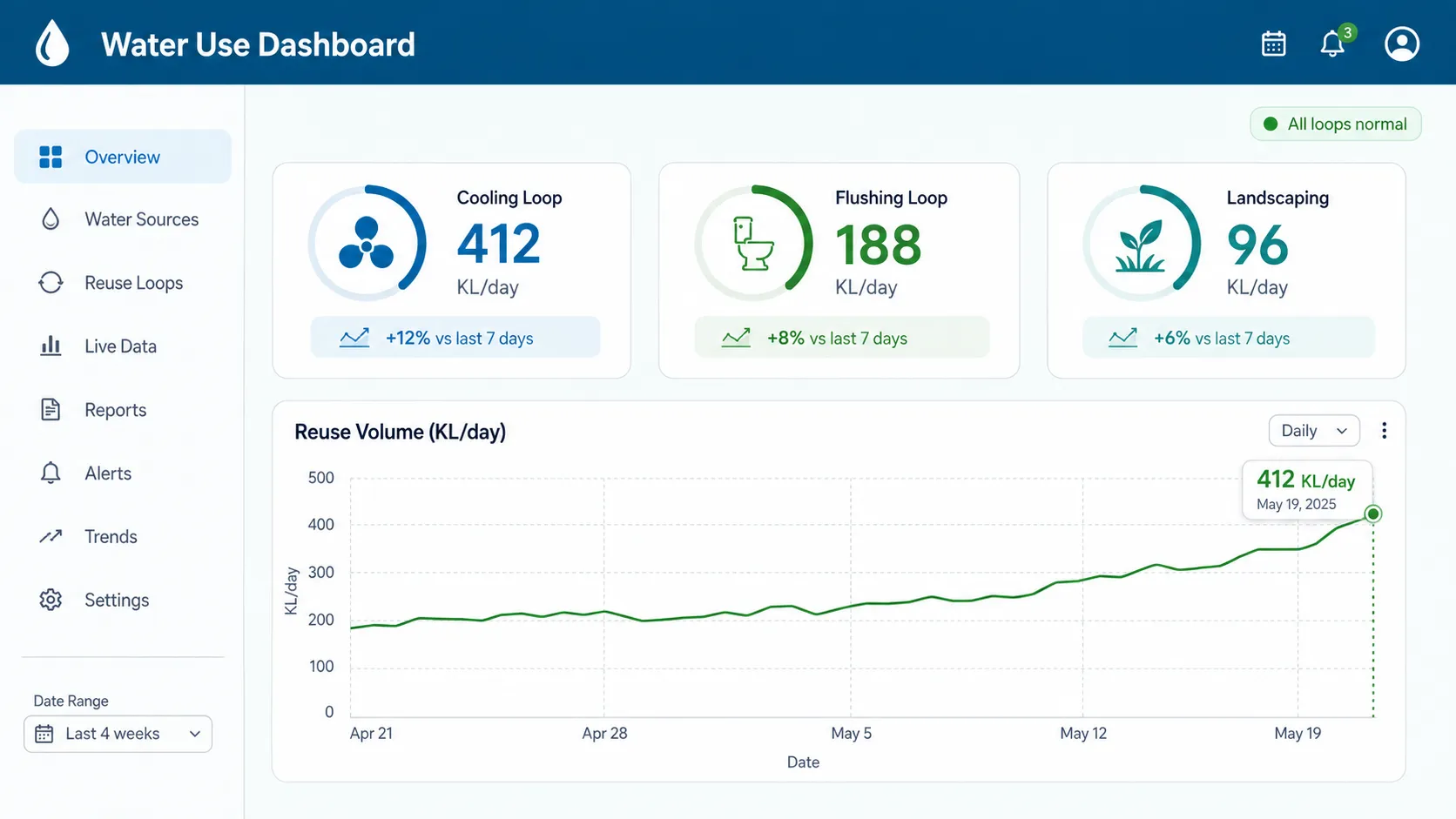
- IoT submeters on each reuse loop (inlet, cooling tower make-up, flushing line, landscaping line)
- A live dashboard showing hourly and daily flow, with leak alerts that notify the facility manager when a loop’s flow is abnormal
- Usage baselines per end-use, so a jump in the cooling tower loop is caught in hours, not months
Why this makes or breaks the business case: a reuse system that can show “X MLD treated, Y% of fresh demand replaced, discharge reduced by Z%” is a board-ready asset. It feeds BRSR Core water metrics, supports CGWA consent reviews, and protects the facility during water-supply shocks. One that can’t show numbers is unverifiable, and unverifiable water savings don’t survive an audit.
This is exactly what smart water metering is for. See how the dashboard, submetering, and leak-alert model is installed and run in practice in our smart water metering services.
Step 4: Track, Verify, and Fold Reuse Into Board Reporting
A reuse project is complete only when the numbers it promises are visible in a monthly tracker and, where applicable, in ESG or BRSR Core disclosure. A simple monthly tracker:
| Metric | Formula | Who cares |
|---|---|---|
| Treated water produced (MLD) | STP outflow minus losses | Plant manager |
| Reused volume (MLD) | Sum of reuse loop meters | Board / ESG |
| Fresh water replaced (%) | Reused ÷ total fresh demand | CFO / Sustainability |
| Discharge reduced (MLD) | Before minus after | SPCB compliance |
| Tanker calls avoided | Count per month (if applicable) | Ops |
BRSR Core context. SEBI’s BRSR applies to the top 1,000 listed companies (SEBI Circular, Jul 2023). The BRSR Core glide path moves from the top 150 entities (FY24) to top 250 (FY25), top 500 (FY26), and top 1,000 (FY27). The water disclosure template asks for withdrawal by source (surface/groundwater/third-party), total consumption, water intensity, discharge volumes, and usage in water-stress areas. A metered reuse loop directly improves several of these lines. For the full filing breakdown, read our BRSR FY26 water metrics guide.
How Much Can a Typical Factory or Hotel Gain?
The realistic gain is not a fixed percentage; it depends entirely on what your site produces and rejects today. The honest range for a well-run reuse retrofit is replacing 20–40% of fresh purchased demand with treated water, but it must be measured site by site.
- Every MLD of treated water you reuse is a MLD you don’t draw from the municipal line, the borewell, or a tanker
- Tiruppur’s cluster recovers ~92% of its water in the most demanding textile use-case (Economic Times, 2025)
- Nationally, the reuse opportunity is estimated at a ₹3.04 lakh crore market by 2047 (CEEW, Nov 2025)
A simple ROI check for your site: (a) how many litres per day does your STP/ETP currently discharge? (b) which end-uses could take at least half of that volume (cooling + flushing + landscaping)? (c) what does that amount to in replaced fresh water per year? Plug in your numbers and the answer is usually “several crore litres per year” before any new treatment is bought.
Global context. The benchmarks exist. Israel recycles about 86–90% of its wastewater (US EPA, 2023), and Singapore’s NEWater plants meet roughly 40% of demand from reclaimed water, projected to reach 55% by 2060 (US EPA, Mar 2024). These are proven systems, and Indian sectors from Tiruppur to Santej have already built operating versions.
Common Mistakes to Avoid
- Recycling without metering. The most common failure: “we reuse, we just can’t prove it.” Without loop meters, the project can’t be verified, financed, or reported. The fix: install submeters before the reuse lines open.
- Sending tertiary-ready water back to treatment. Some facilities re-treat water that is already clean enough for its intended use, doubling energy and chemical costs. Fix: match the actual end-use quality requirement, don’t over-treat.
- Ignoring consent conditions before installing. Reuse is framed by your SPCB consent and CGWA conditions. Installing in parallel with a consent that forbids it is a compliance problem. Fix: get the reuse option approved or amended in consent before commissioning.
- Reusing without a water-quality check for the end-use. Cooling tower make-up and boiler feed have stricter limits than flushing. Reusing tertiary-quality water in a process line without testing can damage equipment. Fix: test BOD/TSS/turbidity/pH for each intended end-use before the loop goes live.
Frequently Asked Questions
Is STP treated water safe for cooling towers and flushing?
Yes, when the STP produces secondary-treated water of consistent quality. Cooling tower make-up, toilet flushing, landscaping, and washing are the standard, lowest-risk reuse paths. For food-contact or boiler feed use, add a polishing step (filtration + disinfection, sometimes RO) and test for the specific end-use limits.
Do I need permission to reuse STP water?
Generally, only your existing environmental consent matters. Your SPCB consent-to-operate conditions set effluent quality and discharge limits; reusing treated water usually requires your consent conditions to acknowledge the reuse route. If you extract groundwater, CGWA clearance governs that separate activity. Confirm both with your local SPCB before commissioning.
How fast does smart metering on a reuse loop pay back?
It depends on the volume and the cost of your fallback supply. Where the reuse loop replaces tanker water, the avoided purchase cost is real and measurable. Where municipal water is unmetered or free, meter the volumes anyway, because the value is in the water-security and compliance proof, not a bill line.
What if my STP doesn’t produce consistent quality?
Then the reuse candidate is not your STP outflow alone. Polish it: a filter plus disinfection plus a holding tank typically stabilises quality for non-potable uses. If discharge quality is unreliable, fix the treatment process first; reuse is not a substitute for a functioning STP.
Conclusion
India treats only 28% of the 72,368 MLD of sewage it generates daily, and under 1% of that treated water is reused. For a factory or hotel, that gap is a second water supply sitting at the site boundary. The four-step path (audit, match end-uses, meter, report) turns that discharge into a measured, board-ready water asset, with water security and compliance as the drivers.
If you’d like to know exactly what your site’s STP outflow could replace, start with a water audit. We’ll map your balance, identify the reuse loops, and size the metering so the numbers are real before you invest.
This is general technical information, not individual regulatory advice. CGWA, state PCB, and SEBI requirements vary by facility and sector, so verify against your consent conditions and a qualified consultant.