TL;DR: The 9th India International Water Week runs 22 to 26 September 2026 in New Delhi on the theme “Climate Resilient Water Management.” The phrase is not just conference language; it is a signal of where regulation and expectation are heading. For any building or campus, resilience means a measured, verified water system, not a one-time installation. The practical first move is a water audit.
Every year, India Water Week sets the tone for how the country talks about water for the next twelve months. The 9th edition, organised by the Ministry of Jal Shakti, runs from 22 to 26 September 2026 at Bharat Mandapam, New Delhi, and its theme is telling: “Climate Resilient Water Management.” When a national platform frames water this way, it is worth asking a simpler question: what does climate-resilient water actually mean for the building you own or manage?
What does climate resilience mean for your rooftop?
“Climate resilient” sounds abstract until you translate it to the scale of a single property. It means a water system that keeps working when the monsoon is erratic, when a dry spell stretches longer than usual, and when municipal supply is under stress. In practice that comes down to three things: capturing the rain you do get, reducing what you waste, and being able to prove your system performs. A recharge pit dug once and forgotten is not resilient. A designed, maintained, and verified system is.
Why act now, not in September?
It is tempting to file a conference under “later.” But the direction of travel is already visible on the ground. Cities are tightening rainwater harvesting mandates and attaching real penalties, and ESG frameworks such as BRSR are pushing larger organisations to disclose water performance with actual numbers. India Water Week 2026 is the policy headline; compliance deadlines and disclosure requirements are the day-to-day reality that follows it. Buildings that treat resilience as a project this year will be ahead of the ones that wait for an inspection or an audit to force the issue.
How do you act on the theme in practice?
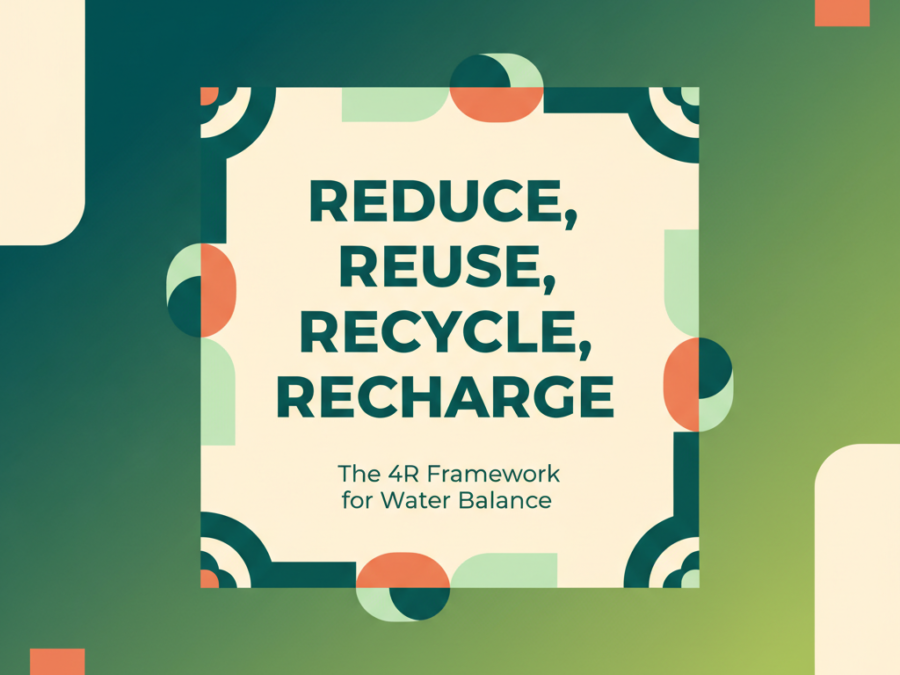
You do not need to attend a conference to apply its message. The 4R approach that runs through India’s water thinking, Reduce, Reuse, Recycle, and Recharge, is a useful checklist for any building:
- Reduce the water you consume through fixtures, leak detection, and simple behaviour changes.
- Reuse greywater where it is safe and sensible, for flushing or landscaping.
- Recycle through treatment where volumes justify it, especially on larger campuses.
- Recharge the ground with a rainwater harvesting system sized to your roof and soil, so the water you capture actually goes somewhere useful.
The point of the framework is balance. Most buildings over-invest in one letter and ignore the others. A proper assessment tells you which of the four will move your water balance the most, so you spend where it counts.
The bottom line
India Water Week 2026 is a reminder that water is moving from a background utility to a managed, measured, and disclosed resource. For a building owner or an ESG lead, the resilient response is not to buy equipment, it is to first understand where you stand. A water audit establishes your real baseline, your risks, and the shortest path to a system that performs when the climate does not cooperate.
At Ecolive, this is exactly what we do: we audit, design, install, and verify climate-resilient water systems, and we measure the outcome rather than just handing over a certificate. If India Water Week has you thinking about your own building, that thinking is best turned into a baseline. Book a water audit with Ecolive: call +91 98714 72211 or email connect@ecolive.in.